Published On 4/6/2026
|
Last update: 13:46 (Mecca time)
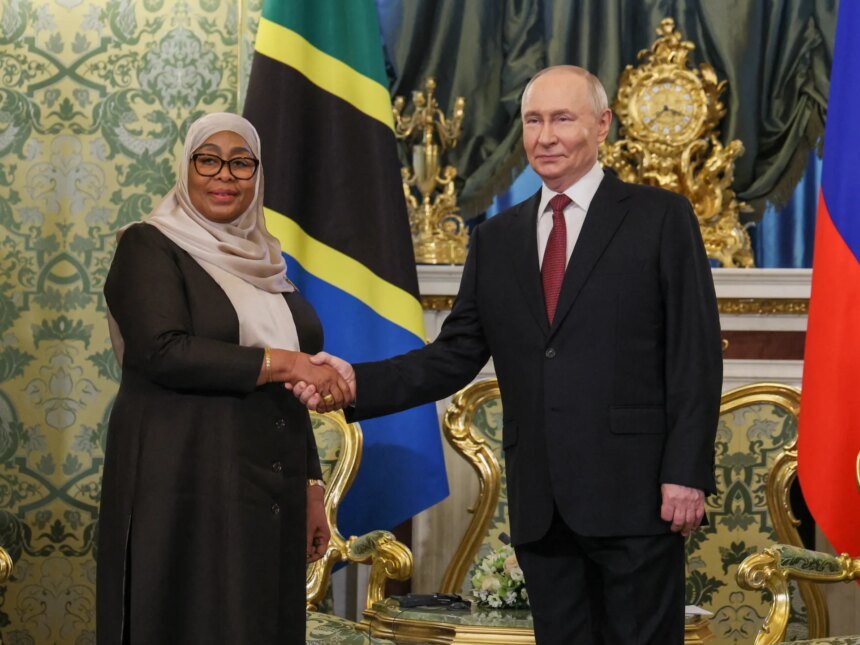
Yesterday, Wednesday, Tanzanian President Samia Suluhu began a three-day state visit to Russia at the invitation of Russian President Vladimir Putin, in the first visit of a Tanzanian president to Moscow since the visit of founding father Julius Nyerere in October 1969. Suluhu met her counterpart Putin in the Kremlin, where she described her visit as “historic,” while Putin called on the two countries to “increase trade exchange,” according to Agence France-Presse.
Western pressure and Russian rapprochement
The visit comes amid Western pressure on Suluhu’s government. The United States announced a review of its relations with Tanzania, and last week imposed sanctions on a senior police officer for torturing activists. The Tanzanian website “The Chanzo” explained that the American draft law presented by American lawmakers threatens to suspend economic and security aid, noting that Washington is Tanzania’s largest development partner by about one billion dollars annually, while the European Union has frozen 156 million euros (about 168 million dollars) in development funding.
On October 29, 2025, Tanzania witnessed elections that resulted in Suluhu winning by 98% according to the official results, followed by protests and a security campaign. Agence France-Presse referred to a government report on the violence that mentioned the killing of 518 people without identifying those responsible.
On the other hand, Putin was one of the first to congratulate Suluhu on her victory, and the Russian observation mission gave a positive assessment of the elections, saying that they met “international standards,” according to the Kenyan newspaper, The East African. The Chanzo website added that Russia was the first country to send a high-level delegation to Tanzania, headed by Sergei Kiriyenko, First Deputy Chief of the Russian Presidential Office, who met with Suluhu on November 6, 2025.

Economic file
On the economic level, the Tanzanian presidency presented the visit as a regular diplomatic mission and not a geopolitical statement, according to The East African. The anticipated agreements include the fields of higher education, science and technology, investment, information and communications technology, in addition to talks in trade, energy, mining, agriculture, infrastructure and tourism.
The volume of trade exchange between the two countries amounts to about 307.5 million dollars annually. Agence France-Presse reported that the only concrete joint project is a uranium mine planned for more than a decade, that the Russia-Tanzania Business Council was established last January, and that Tanzania Airlines announced the launch of flights from Dar es Salaam to Moscow before the end of the year.
A report by the Tanzanian Daily News newspaper indicated that Tanzania has reserves of gold, graphite, coal, rare metals, nickel and uranium, and that Russia’s experience in extracting and processing minerals may support the establishment of refining, processing and technical training facilities.
Suluhu will also participate in the St. Petersburg International Economic Forum and deliver a speech at its plenary session, and will be awarded an honorary doctorate from the Russian Peoples’ Friendship University, according to The Chanzo.
Different readings
Regarding the implications of the visit, Fergus Keel of the British Chatham House Institute believed that Russia does not have much to gain from the visit, but it “seizes the opportunity of a weak Tanzanian administration,” while a former professor of political science at the University of Dar es Salaam, who requested to remain anonymous, said that Russia could benefit from support “even by abstaining from voting in a decisive vote at the United Nations” on the war in Ukraine, according to Agence France-Presse.
The visit tests Tanzania’s non-alignment policy, according to The East African, in what The Chanzo described as a “calculated strategic shift” that reflects the administration’s determination to diversify its international partnerships.
Source: Al Jazeera + French + African press