Published On 9/6/2026
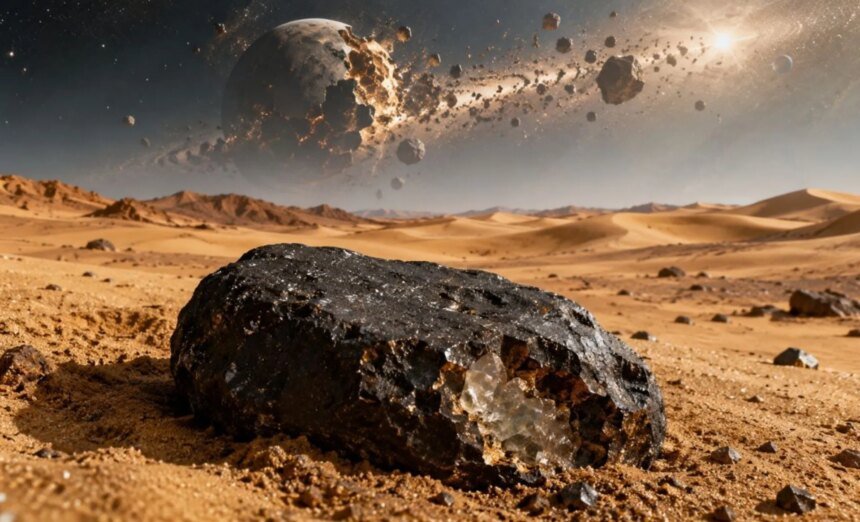
In a discovery that may change scientists’ understanding of the early stages of planetary formation, researchers revealed that a rare meteorite found in the Sahara Desert in 2019 carries the first strong evidence of the existence of a lost world that may have been the size of the moon or larger, before it disappeared from the solar system billions of years ago.
The meteorite bears the name “Northwest Africa 12774” (NWA 12774), and it weighs only about 454 grams, but it may be one of the most important remaining pieces of evidence from the era of the first planets’ formation. This meteorite is classified within an extremely rare category known as angrite, which is one of the oldest known volcanic rocks in the solar system.

The results of the study were published in the journal Earth and Planetary Science Letters, opening a new door to the search for lost worlds that no longer exist today.
Read also
list of 2 itemsend of list
Rare meteorites from the dawn of the solar system
Scientists know that angrite meteorites formed approximately simultaneously with the birth of the Sun more than 4.5 billion years ago. For this reason, they are considered time capsules that preserve rare information about the conditions that prevailed in the beginnings of the solar system.
What increases its importance is its extreme scarcity. Of the more than 80,000 meteorites found on Earth, only 68 meteorites were classified in this category. These rocks have long puzzled researchers because of their different chemical composition from Earth, Mars, and most other rocky worlds, as they contain very small amounts of silica, which is the basic material in sand and rocky crusts of planets.

For this reason, scientists previously assumed that the source of these rocks was a relatively small asteroid that may have existed only during the first million years of the history of the solar system after its formation about 4.56 billion years ago.
Crystals reveal the existence of a world larger than expected
While studying the meteorite, researchers discovered crystals of a mineral that is exceptionally rich in aluminum. Calculations showed that the formation of these crystals required enormous pressures exceeding 17,000 times the atmospheric pressure at the Earth’s surface, conditions that are very difficult to achieve inside a small asteroid.
When scientists reconstructed the environment in which these minerals originated, they discovered that the parent body from which the meteorite emerged was much larger than thought. The crystals also retained sharp edges and subtle chemical fingerprints that should have disappeared if they remained for long periods of time inside the depths of a hot celestial body.
Together, this evidence indicates that the rocks formed at relatively shallow depths, meaning that the original body was large enough to generate those pressures near its surface, not just deep down.
A lost world the size of the moon
According to the results of the study, the radius of that lost world may have exceeded 1,800 kilometers, a size that makes it close to the Moon and perhaps closer to Mars in terms of mass and size. Any body with a radius of less than 200 kilometers will not be able to generate these pressures internally.

But this world did not escape the chaos that characterized the beginnings of the solar system. Researchers believe that it was destroyed during one of the violent collisions that were common at the time, when protoplanets constantly collided during their growth and development. After its collapse, its fragments were scattered in space, and some of its parts later merged into other planets and bodies, and perhaps into the Earth itself.
Scientists believe that the desert meteorite is only a small part of a much larger story, and that museum and laboratory collections may contain similar samples that have not yet been sufficiently studied.
The memory of the universe preserved in stones
This discovery reminds us that the history of the solar system was written not only with the planets we see today, but also with worlds that appeared and then disappeared, leaving nothing but scattered fragments. Every meteorite that falls to Earth may be a page that has survived from a huge cosmic book that has lost most of its chapters.
By studying these tiny pieces, scientists continue to reconstruct the story of the birth of the first planets and worlds. It is a journey that reveals that scientific research is not limited to discovering the unknown, but rather gives us the ability to recover a history that was lost billions of years ago, and understand where the Earth itself came from.