Gaza- “My children ask me every night: When will we see my father? And I find no answer except tears that I try to hide from them,” says Alaa Lafi, one of hundreds of wives stranded with their children in the Gaza Strip, separated by borders and restrictions from husbands and fathers outside the devastated and besieged Strip.
This mother lives with her five children in a tent inside a crowded camp for displaced people in the Al-Mawasi area, west of the city of Khan Yunis, in the south of the Gaza Strip, while her husband resides abroad, deprived of the ability to live under one roof. She cannot travel, and he is unable to return, due to the tight siege and Israeli restrictions imposed on the crossings.
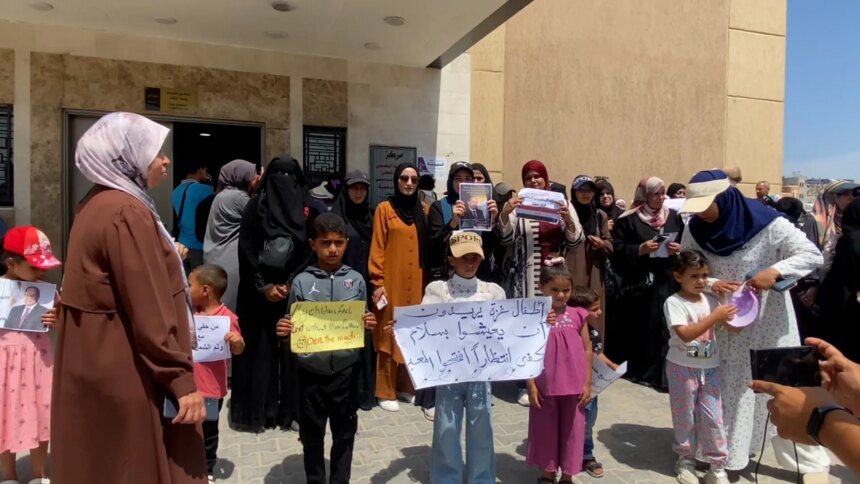
For the third week in a row, Lafi and the stranded wives with their children participated in protests in the south and north of the Gaza Strip, raising banners and chanting slogans calling for the right to travel and family reunification.

The tragedy of a sick wife
Lafi told Al Jazeera Net, “We live in a worn-out tent that does not protect us from the heat of summer or the cold of winter, and I struggle daily to provide water and food for my children.”
Lafi lost her home, and a number of her family members were martyred, and she alone bears responsibility for her children since the outbreak of the genocidal war on the Strip on October 7, 2023, after her husband decided to travel five years ago in search of a better life for his family, and arrived in Belgium, which granted her and her children the right to “unification.”

“I try to be both a father and a mother for my children, but the burden is heavy.” With great sadness, Lavi speaks about her youngest child, who only knows what his father looks like from pictures and video calls whenever the Internet becomes available. She says: “Whenever my children ask me about their father, I feel like my heart is breaking.”
This woman suffers from cancer and has a medical referral for treatment abroad, as appropriate treatment for her condition is not available in the Gaza Strip’s almost collapsed hospitals. Which makes her life more difficult.

Tragedy and lost rights
Hanadi Al-Adini has a similar story of pain. She is a mother of four children. She tells Al-Jazeera Net that they suffer daily, face risks, and bear a great responsibility that exceeds their age. They seek to fill water and get a meal.
Hanadi’s husband traveled before the outbreak of war in search of a better life for his children, and over the past years she bore the responsibility alone, with a fervor that indicated that she could no longer bear to play the role of father and mother together, especially in light of the difficult circumstances resulting from war and displacement.

“What is the world waiting for? Are they waiting for us to lose our lives?” Hanadi asks bitterly, a survivor with her children of an Israeli raid that left them injured.
The little girl, Fidaa Abu Suleiman, could not control herself and cried bitterly. She threw herself into the arms of her mother, Haneen Abu Suleiman, saying: “I miss my father.”
The mother tells Al Jazeera Net that her husband has been an expatriate for 6 years, and their daughter Fidaa was a baby in her first year at the time, and this child does not stop crying daily, longing for her father.

Amid a gathering of stranded wives and their children at the Nasser Medical Complex in the city of Khan Yunis, the child Abdul Rahman Abu Tair, who was wearing a keffiyeh and carrying a banner demanding his right to be reunited with his father, was clearly affected.
This child has not met his expatriate father for 8 years, and he lives with his family a miserable life in a tent in the Al-Mawasi area, since they were forcibly displaced from their home from the towns east of Khan Yunis.
Abu Tair told Al Jazeera Net: “I have the right to live with my parents. I have the right to learn, play, and practice my hobbies like the children of the world.”

Hopes hang on the walls of closed crossings
In turn, the spokeswoman for the stranded wives, Hadeel Hussein Habib, told Al Jazeera Net that the stranded wives, especially those with children, live in miserable living conditions, most of them in tents and shelter centers, after they lost their homes during the genocide war.

Hadeel estimates that about 830 wives are stuck, including mothers of about 1,500 children, as well as fiancées, who have been stuck in the Gaza Strip for many years, and their lives and hopes are now hanging on the fences of closed crossings, and in light of severe Israeli restrictions on travel, preventing them from being reunited with their children and spouses.
Hadeel (32 years old) is engaged to a young Jordanian man. She points out that they got married at the beginning of the war about 3 years ago, and since then she has not had the opportunity to travel to him and consummate their marriage.
With a heart dripping with sadness, this girl speaks of her fear for her future, and says: “My life is on hold, and I live here dreaming of the opportunity to travel for my fiancé in Jordan.”
Hadeel lives with her mother, brother, and his family (6 members) in a classroom inside a school that has been turned into a shelter center for displaced people in the “Hamad Residential City” in the city of Khan Yunis, after the occupation forces destroyed their residential apartment in the city, and a family home in the Shujaiya neighborhood in Gaza City.

Hadeel and other stranded wives like her only wish for the opportunity to travel and join their husbands in Arab and European countries, and they are calling on these countries to evacuate them humanitarianly from the Gaza Strip, in light of the complications of traveling through the Rafah land crossing, which has been under Israeli control since the invasion and occupation of the entire city of Rafah on the border with Egypt in May 2024.