Published on 6/6/2026
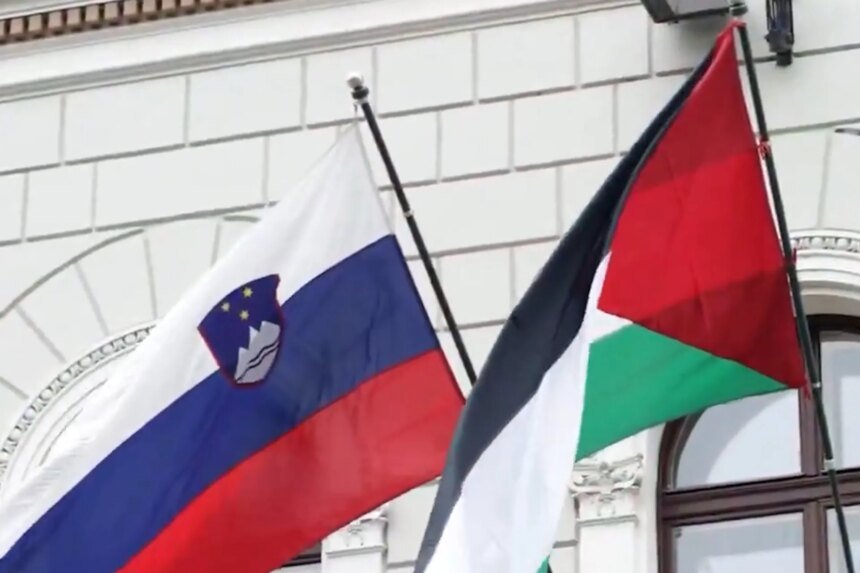
The President of Slovenia, Natasa Peretz Musar, announced today, Saturday, the raising of the Palestinian flag on the facade of the Presidential Palace in the capital, Ljubljana, in a move that appeared to be a response to the new government’s decision to remove the Palestinian flag from the Prime Minister’s Office building.
Musar explained, in a post on the “X” platform, that raising the flag carries connotations that go beyond the Palestinian issue itself, noting that it has become a global symbol of denouncing gross violations of international law and human rights.
The Slovenian President confirmed that the flag will remain raised on the front of the palace for a week, before it is moved inside the building to be available for display to visitors.
In her statements, Musar denounced the continuation of what she described as “genocide” against the Palestinians, stressing that the residents of the Gaza Strip and the West Bank still lack the most basic elements of peace and human dignity, stressing that this tragedy has not stopped despite repeated international demands.
This move comes at a time when Slovenia is witnessing a state of severe political polarization, following the general elections held on March 22, which led to Janez Janša assuming the presidency of the government, as the new government lowered the Palestinian flag from the Prime Minister’s Office building.
These elections sparked widespread controversy following accusations against the private Israeli intelligence company Black Cube of interfering in the country’s political process.
According to what was reported by the Slovenian magazine “Mladina”, officials from the aforementioned company visited the capital, Ljubljana, three times, where they met with the then opposition leader (current Prime Minister) Janez Janša.
The magazine said that the company’s members used fake identities and pretended to represent a foreign investment company to record meetings with local politicians.
Former Prime Minister Robert Golub called on the European Union to open an investigation into the possibility of foreign interference in the elections, while Janša denied knowledge of this company or having any relationship with it.
This disagreement comes in the context of the discrepancy over the position on Palestine, as the Golub government had officially recognized the State of Palestine in 2024, and imposed restrictions on military dealings with Israel. On the other hand, Janša criticized the recognition decision, claiming that it harms the country’s interests.