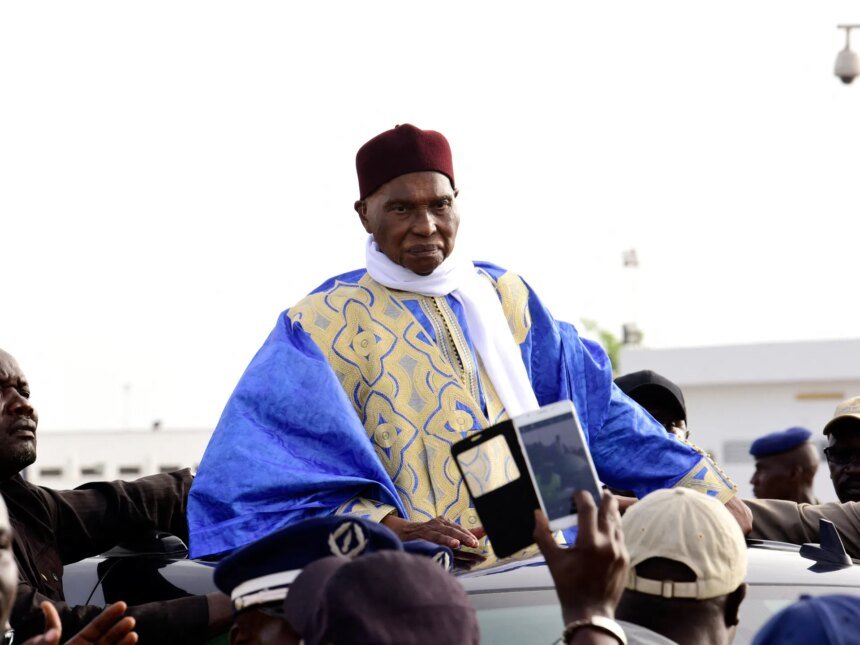
100 years of clamor and political brilliance, most of which did not lose sight of the glowing presence of the Senegalese child, Abdullah Wade, who was born from the womb of the most difficult changes in the history of Africa, and then his life span extended until he reached his hundredth year today, bearing witness to an entire century of events, and marking some of his most important milestones in Senegal and Africa.
Former Senegalese President Abdoulaye Wade, since adolescence, had great hopes for leadership, and he continued to evade and struggle until he achieved his goal of presidency of Senegal. However, “Gorge” (as the Senegalese call him, meaning old man) was not just a passing Senegalese name, but rather an African voice full of revolution and politics.
These days, the great man of Africa turns 100 years old, which he lived between the phases of colonialism, opposition, imprisonment, rule, and forced retirement. During his past centenary, he moved gracefully from the intensity of the opposition to the tricks of rule, and from confronting successive regimes to the temptations of power and the attractiveness of the ruling seat.
Wade.. son of Senlui and Kapmir
On the shore of the Senegal River in the city of Saint Louis (Senloui), known in Arab-Mauritanian literature as the city of “Ander”, Abdallah Oued Nour – according to many sources – came to see the father of a wealthy merchant whose family lineage belongs to the city of Kepmir, which is also known – especially to travelers coming from the north towards the capital, Dakar – as the city of barbecue, spices and hot meals for those crossing the two banks.
Due to the wealth of his family, and his father – a former soldier in the rifle group – and his understanding of the changes in the new world at that time, the child “Ablai” found a quick path to the colonial school in Senegal, where he studied at the William Ponty School near Dakar, then continued his studies at the prestigious “Condorcet” High School in Paris, where he obtained a baccalaureate degree in 1950.
Then he supplemented this by specializing in French literature and law from the Sorbonne University, before moving to the French city of Besançon as a trained lawyer and a loud African voice.
In that city, and in that foundational period of his life, his relationship with his classmate Vivian Vert began, where they later married, and continued their lives after that, crowning that marriage with two sons: Karim, who held multiple ministerial positions under the presidency of his father, and his sister, Sindele.

Wade…the fierce opponent and the cunning rabbit
Abdullah Wade quickly became involved in the ranks of the African political struggle in the 1950s and 1960s, where he was an active member of the Black African Students Union. He was also an effective and influential lawyer in defending the leaders of the Algerian Liberation Front and other anti-colonial political forces.
Like most revolutionary and militant leaders in that period, Wade found in the French language and law an opportunity to highlight his ability and personality, and paved a thorny path for his struggles that lasted more than 50 years before it led him to the presidential palace.
In the first five-year period of independence, Wade confronted the regime of the first Senegalese President Senghor, whose arrival to power was surprising to many of Senegal’s Muslim population, as he was a Christian belonging to a minority with a different cultural specificity.
Senghor was more aware than others that his survival in power required the liquidation of his staunch opponents, and thus the Prime Minister at the time, Mamadou Dia, was in Senghor’s crosshairs, while the young lawyer Abdallah Wade, with his arguments full of history, literature, law, and linguistic prowess, was the leader of the defense of the arrested minister, but all of that was to no avail in the face of a harsh sentence of life imprisonment against the minister.
As a result, the ruling on Minister Mamadou Dia represented a fundamental shift in Oued’s political identity, as he moved to an opposition voice, believing that the Senghor regime was an unjust unilateral regime, and continued to criticize with an iron tongue all the actions and tendencies of Senghor and his ministers.
Without the political struggle in Senegal achieving legal recognition for his party, Wade had to resort to what his opponents described as “cunning and deception” in order to convince Senghor that he would support him and support his political system. Thus, the license for the Senegalese Democratic Party was granted.
Upon receiving his license, Wade returned to sharp criticism against Senghor’s regime, which he described as his rival, a cunning rabbit.
Wade… President after 5 defeats
Abdoulaye Wade ran for president seven times, being defeated five of them, and won two, the first in 2000 when he defeated his rival, Abdou Diouf, after 17 years of political struggle. The first time he ran for president was in 1978, and at that time he lost the race to the first president of Senegal, Senghor.

Between the year 1983, the date of Diouf’s rise to power, and the year 2000, the date of his defeat, Abdallah Wade remained the most annoying Senegalese voice for the regime. During that period, he was the guest of multiple prisons and arrests, without losing his role and status as a prominent African lawyer.
On April 3, 2000, Senegalese were about to inaugurate Wade as president of the country, after 26 years of political struggle for the presidency.
After 12 years, the man also left power with defeat at the hands of his Prime Minister, Macky Sall.
Despite the harsh criticism directed at him for corruption, and his son Karim’s control over many aspects of government, he was able to transform the face of Senegal into a workshop of quality achievement through huge facilities, which generated – according to his opponents – huge sums of money estimated at hundreds of millions of dollars, as he was officially accused by his country’s government of embezzling public funds and misusing the assets of companies that he supervised.
Abdoulaye Wade has not been out of the spotlight since he left power more than 14 years ago, and if Senegalese disagree about his political performance, they do not disagree about his intelligence, political prowess, or the centrality of his African and international relations.
President Wade..George of Senegal
Perhaps the wheel of time has been turning slowly since the retirement of the man who was the talk of the hour and the headline of the news for many Senegalese decades; The “Georgi” program is no longer full of activities and events, and just as the days slowed down, so did the footsteps and the heaviness of the hearing, and the years almost weighed down the shoulders of Georgi, who has always remained high, bearing titles that no African president before or after him has ever carried.
On his shoulders are crowded many great titles that reflect the outlook of society, politics, and the evaluation of the press.
In politics, he was nicknamed Ndiambor (the wild rabbit), in reference to his intelligence, political agility, and his ability to pursue roles serving politics with boldness and reluctance.
In the memory of the people and the generations who accompanied him, whether loyal or hostile, President Wade is “Gorgui of Senegal,” which means the distinguished old man or old man, in addition to other titles, including “the father” and “the street president,” in reference to his closeness to the people.
Between these titles, the man lived for a century and is still waiting for a number of days, without any doubt in his mind that God will forgive him for what he committed on his long path, when he hands over the soul to its Creator, as he declared this a decade ago when he reached the age of ninety.
Wadi.. Secularist with a Sufi robe
Despite his loyalty to the secular, liberal spirit in administering government and interpreting political and societal life in Senegal, Wade remained a dedicated “muraida” in serving his sheikhs, the Sheikh Ahmadou Bemba family, keen to show signs of loyalty to the sheikhs of the major Sufi order in Senegal and West Africa.
After his first victory in the presidential elections in 2000, Wade went directly to the city of Touba, knelt down and bowed very humbly before the successor of the Muridiyya order at the time, Sirine Saliou Mbaki, a scene that he repeated repeatedly before the successors of the Muridiyya order, as did the subsequent presidents.

Before that, Wade had written in his youth a study examining the doctrine or economic doctrine of the Muridite order, in which he deconstructed the philosophy of the order that combines spiritual commitment and sanctifying the values of work and production.
This Sufi background generated a lasting spiritual meaning in Wade’s orientations, who performed the Hajj and Umrah repeatedly, and continued to turn to Sufi orders whenever he was tempted, calling for prayers and supplications “for Senegal.”
As Wade grew older, the Sufi meaning continued to grow in his mind, and years ago he declared that he had no doubt that God would forgive him and that his hope was good in the afterlife.
Between the joyful hope for God Almighty’s forgiveness, and the memory full of crises, victories, and conflict, Wade admits – with the same faith as me – that he had many mistakes, but he did good things, and he was “spreading peace among the people,” adding that no one could remove him from the circle of Islam because he bears witness that there is no god but God and that Muhammad is the Messenger of God, may God bless him and grant him peace.
With his comic self, and as a joke and joke, he once addressed his supporters, saying, “If any of you finds a problem on the Day of Resurrection, let him come to me and cross the path to Paradise with me.”
As the Senegalese celebrate the centenary of Wade, “Gorgi” can address his people, saying that he was definitely not referring to the title “One Hundred Years of Solitude” by Gabriel Garcia Marquez, but rather it was 100 years of clamor, struggle, struggle, and power.