Published On 6/5/2026
|
Last update: 01:59 (Mecca time)
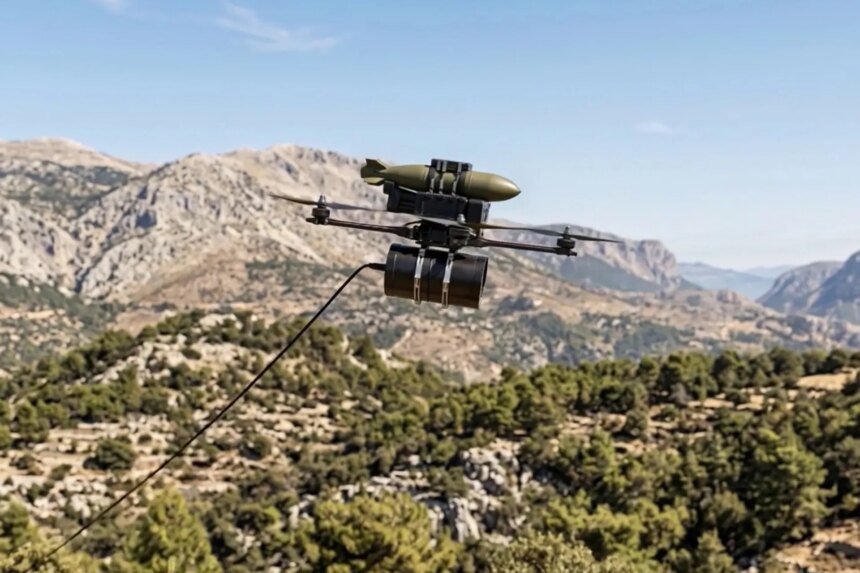
The New York Times says that the ongoing attacks launched by the Lebanese Hezbollah using fiber-optic guided drones have revealed unexpected weaknesses in the Israeli defense system, and have raised a state of anxiety within the military and political establishment in Israel.
According to the newspaper, these drones were used in recent weeks in a series of direct strikes targeting Israeli armored personnel carriers, tanks and air defense systems, while the Israeli army confirmed that the attacks had become almost daily and led to the killing of a number of soldiers.
Read also
list of 2 itemsend of list
The newspaper believes that the effects of these attacks were not limited to military losses, but rather shook the image of Israeli technological superiority and raised growing fears among the Israeli forces deployed inside southern Lebanon.

Early warnings
The New York Times quotes Israeli officials as saying that army officers have warned since 2024 about the possibility of Hezbollah resorting to using fiber-optic guided drones, a technology that has become common in the Russian-Ukrainian war.
These drones are distinguished by the fact that they do not rely on traditional radio signals, but rather are linked to the operator via thin fiber-optic cables that gradually unravel during flight, which makes them largely immune to the means of electronic jamming that Israel previously used to bring down the drones.
Despite these warnings, the newspaper says that the Israeli army did not take sufficient measures to prepare for the new threat. Even when the daily attacks began last April, some simple defensive measures used in Ukraine, such as installing protective nets over fixed sites and military vehicles, had not been widely adopted.
Reserve General Guy Hazot, who participated in efforts to learn military lessons over the past years, says that the security establishment was aware of the danger but did not deal with it with the required seriousness.

Back to the confrontation arena
The newspaper indicates that since 2024, Hezbollah has gradually returned to military action in confronting Israel. After the outbreak of the American-Israeli war against Iran in late February, the party intensified the launching of missiles and drones towards Israel.
The Israeli army responded by invading southern Lebanon and taking control of dozens of border villages, in addition to widespread destruction of infrastructure and buildings.
Despite these operations, Hezbollah was able to continue targeting Israeli forces inside Lebanese territory and along the border, resulting in the killing of at least 10 soldiers and one Israeli civilian since April, according to the newspaper.
On the other hand, the party sought to exploit these attacks as propaganda, as during May alone it published more than 30 video clips showing its marches targeting Israeli soldiers and vehicles. Officials and media figures close to the party also confirmed that these operations affected the morale of Israeli soldiers and demonstrated the limitations of some advanced defense methods.

Greater threats are on the horizon
In the face of mounting internal criticism, Israeli Prime Minister Benjamin Netanyahu announced the formation of a specialized team to find urgent solutions to confront this threat, stressing that the budget allocated for the mission will be open regardless of the costs.
The New York Times explains that the primary means of confronting these drones is to shoot them down with direct fire or cut the fiber-optic cables that connect them to the operator, but the speed of the attack and the close distance give soldiers a very limited time to deal with them before the explosion.
The newspaper adds that Israel tried to benefit from Ukrainian experience in this field. Ukrainian officers previously visited Israel to explain methods for confronting this type of drones, and Tel Aviv recently requested to send a new Ukrainian delegation, but Kiev linked this to increased Israeli support for its air defense capabilities.
Experts who spoke to the newspaper warn that the danger may develop further in the future if Hezbollah adopts techniques similar to those that Ukraine is currently using against Russia, including operating drones over mobile phone networks using communication cards, allowing attacks to be carried out from much greater distances.