Published On 1/6/2026
In the city of Saint-Louis in northern Senegal, the Yang family doesn’t need a picture on the wall to remember their son Mamadou. Whenever family members gathered around the dining table or at a family event, his name would come up in conversations, present despite his absence, as if the five years that had passed since his disappearance had not succeeded in keeping him from their hearts.
Mamadou, as Al Jazeera’s correspondent from Senegal, Zainab Bint Arbih, says, was a young man like thousands of Senegalese youth whose livelihoods were limited. He spent years looking for a job opportunity that would guarantee him a better future, but the doors remained closed in his face. As frustration increased, the dream of immigrating to Europe began to grow in his mind, until it turned into a last hope for salvation from unemployment and poverty.
In the face of his insistence, the family yielded to his wishes despite their difficult financial circumstances. She collected as much money as she could, hoping that this would be the price for his passage to a new life in Spain. The mother said goodbye to her son with her heart heavy with fear, while he was carrying his dreams on a boat crowded with immigrants that set off from the coast of St. Louis towards the unknown.
But the journey that was supposed to lead him to the other side of the Mediterranean ended before it actually began. The boat sank in the open Atlantic Ocean, and Mamadou disappeared with dozens of other migrants. Since that day, no news has reached his family.
His mother says in a voice mixed with sorrow and hope: “They disappeared five years ago, and we have not received any information about them. After all this long waiting, I know nothing about my son.”
The mother did not receive a body to cry over, nor did she receive certain news that would extinguish the fire of waiting. She was stuck between two harsh possibilities: that her son was gone forever, or that he was still somewhere unable to return or communicate.
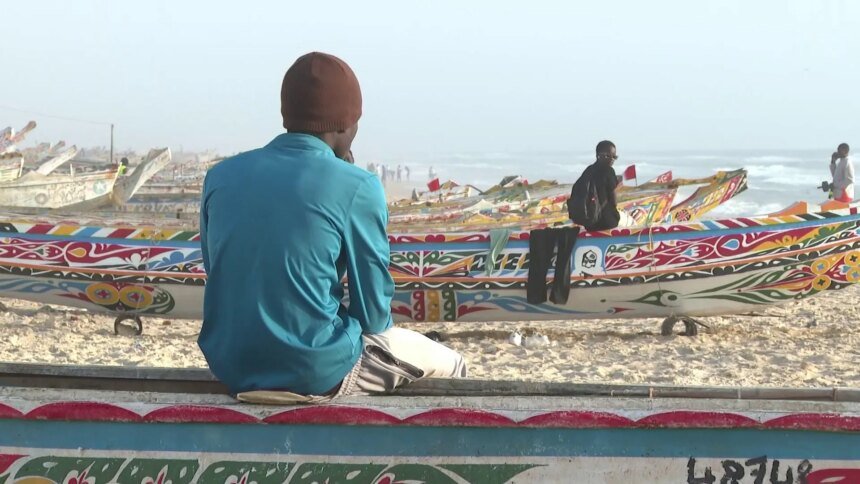
Mamadou’s story is only one of dozens of stories stored in the streets of St. Louis, a city that has transformed in recent years into one of the most prominent departure points for irregular migrants towards Europe. In one of its neighborhoods, women who lost their sons, husbands, or brothers at sea gathered at the invitation of a local organization trying to confront the worsening phenomenon.
There, the talk was not about numbers and statistics, but rather about lost faces, names, and dreams. The women talked about unemployment that drives young people to take risks, about the money that families hard-earned to finance trips, and about loved ones swallowed up by the ocean, leaving behind nothing but questions.
Coastal control
Community activist Mamadou Gueye confirms that tragedies are still repeated in a tragic way, pointing out that the last boat that sank off St. Louis was carrying 245 migrants, more than half of whom died while others remained missing.
In an attempt to stop this human bleeding, the Senegalese authorities intensified their control of the coasts, and formed a ministerial committee seeking to eliminate irregular migration by 2035, through awareness campaigns, providing job opportunities for young people, and pursuing smuggling networks, with financial support from the European Union.
However, the reality on the ground seems more complex. Smuggling networks are still active in some coastal areas, benefiting from the dreams of young people who see in Europe an opportunity that may not be repeated. Abdo, a former smuggler who spent time in prison, admits that he worked for years organizing these trips, which generated huge profits despite their enormous risks.
He says that some boats were carrying more than three hundred people on one trip, without any guarantees of survival, in an adventure in which hope was equal to death.
Between the efforts of the authorities and the temptations of immigration, St. Louis continues to pay the price for this phenomenon. The city has lost large numbers of its youth, leaving profound social and demographic impacts on entire families and communities.
As for the Yang family’s home, the years still passed slowly. The mother is still waiting for news that may or may not come. From time to time, she looks at the door as if imagining the return of her absent son. Five years have passed, but the waiting is not over, because the most difficult loss is not certain death, but rather the absence that leaves behind a small hope that refuses to be extinguished.