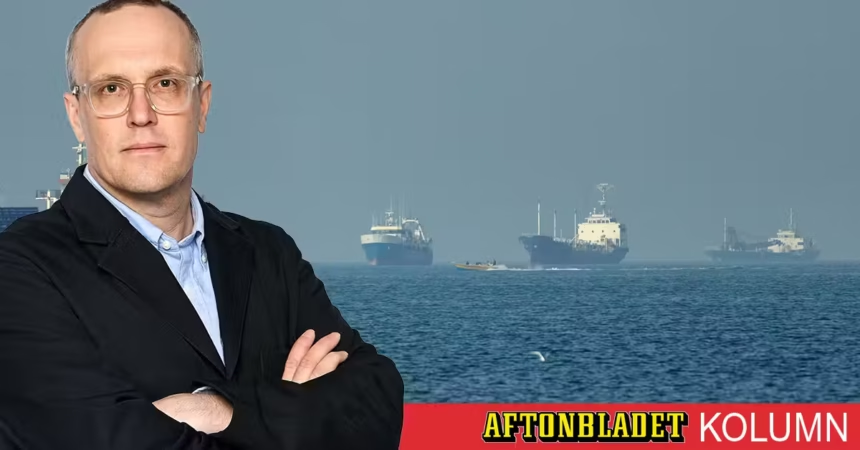
Andreas Cervenka
Reporter and economic commentator
This is a commenting text. Analysis and positions are the writer’s.
Updated 13.08 | Published 12.43

It has been called the worst energy crisis in history.
The conflict in the Middle East is in its fourth month. But for the economy, the consequences have so far been milder than many experts feared.
Where did the crisis go – and what happens now?
Early on Wednesday morning, new reports came of missiles fired from Iran at Bahrain at the same time as the US bombed the island of Qeshm in Strait of Hormuz.
The cease-fire that began in April is still fragile and despite several claims that the US and Iran are close to an agreement, there is no agreement in place.
It has now been just over three months since the US and Israel launched their attacks on Iran, which quickly responded by stopping traffic through Hormuz, where a fifth of the world’s oil passed before the war.
The International Energy Agency IEA warned back in March that the worst energy shock ever threatened – worse than the crises of the 1970s.
Energy analysts flagged both a fuel shortage, a food crisis and a looming recession.

The economy has been affected – inflation has risen in both the US and Europe. A barrel of North Sea oil traded on Wednesday at around 98 dollars. That’s 40 percent higher than when the war began — but below the nearly $120 the price soared to at the start of the conflict and far from the $200 some warned of at the start. Growth has also been affected – GDP forecasts have been written down in Europe, including in Sweden, and the government has introduced several temporary measures such as reduced tax on petrol and halved prices in public transport.
Nevertheless, the really deep crisis has not materialized. What has happened? There are several reasons.
China
China is normally the world’s largest oil importer. Last year, China systematically increased its oil reserves to 1.4 billion barrels, three times more than the strategic reserve of the United States. Now the country has greatly reduced its imports by between 3 and 4 million barrels a day. The loss from Hormuz is 13 million barrels a day, so it eases the pressure on the world market considerably and has contributed to keeping the price of oil down.
Depleted reserves
The world has used its emergency stocks of oil at a rate never seen before, around 4 million barrels a day, which is four percent of the world’s normal consumption. In the US they are down on it lowest level since 2004.
Increased production and reduced use
Countries outside the Middle East, above all the USA, have increased their oil production and exports significantly during the crisis. This applies not least to critical products such as aviation fuel, which otherwise threatened to run out during the summer. Meanwhile, world consumption has fallen by as much as four million barrels per day by some estimates, particularly in poor countries in Asia and Africa that cannot afford the higher prices.

AI Boom, General Optimism and Trump Plays
The financial market has chosen to assume that the crisis will soon be resolved and instead focused on the ongoing AI hype with huge investments. The US and Donald Trump have also been very adept at talking down the price of oil by constantly claiming that everything is going well and that a deal with Iran is close, regardless of whether it turns out to be true or not.
Does that mean the talk of a crisis was exaggerated? No, the warnings were based on a purely mathematical finding that significantly less oil is currently being produced than is being consumed. Sooner or later it leads to price spikes and/or severe recession when demand drops dramatically. Anything done to mitigate the effects are short-term things that cannot continue for any length of time.
What happens now? It is of course impossible to know, but here are three possible scenarios.
1. A peace treaty is concluded
In that case, most things point towards an agreement in which Hormuz is gradually opened and the US blockade against Iran ends, while a period of negotiations begins on the more difficult issues such as Iran’s nuclear weapons program.
Opening Hormuz will take at least a month and it will also take a long time to get production and transports up to normal levels, if at all. The price of oil and chemicals will likely remain at high levels for some time to come, thus pushing up both inflation and interest rates.

2. Hormuz continues to be closed over the summer
What speaks for a continued frozen situation is that both the United States and Iran seem to believe that they are sitting on the strongest cards. A sticking point in the negotiations is also who will control Hormuz in the future. It has proven to be a superweapon for Iran that they probably won’t let go of in the first place.
Thus far, it is oil reserves that have saved the economy. But the oil stocks must maintain a certain level for the system to function. Stocks are already at record lows. When they reach a critical level, the price will inexorably rise sharply.
That time could occur as early as September if Hormuz continues to be closed, according to US research firm Rapidan. For some products such as diesel or jet fuel, this pain point can occur as early as August. Then it quickly becomes much messier and spring’s warnings come true.
3. The war resumes
The most pessimistic scenario is that the conflict turns into a new wave of bombings and drone attacks. It could lead to even worse damage to infrastructure in the Gulf states, such as water desalination plants, which would trigger a humanitarian disaster. Iran has also threatened to stop ship traffic in the Red Sea. A renewed war can end badly for all parties, which is also the main argument against such a development.
In summary, the crisis is not over, but large parts of the world have chosen to look the other way and hope for the best. At a recent conference, Tom Baker, board member of the world’s largest oil trading company Vitol, said that governments in both Europe and the United States are “asleep at the wheel” and pretending everything is business as usual so as not to scare their citizens.
Smart or very stupid? The future will tell.