Published On 4/27/2026
|
Last update: 13:09 (Mecca time)
Israeli analysts did not treat the union of Naftali Bennett and Yair Lapid as a normal electoral move, but rather as an early test of a larger question: Can the “Change” camp produce an organized alternative to Benjamin Netanyahu, or is the coalition giving him propaganda material that will help him stabilize his camp?
Through the articles that discussed the move in Yedioth Ahronoth, Haaretz, Maariv, and Israel Hayom, two opposing trends emerged: the first sees the alliance as a danger to Netanyahu because it ends the opposition’s hesitation and establishes Bennett in the leadership position, and the second sees it as a lifeline and a gift for Netanyahu because it weakens Bennett’s ability to attract right-wing voters.
Read also
list of 2 itemsend of list
In Yedioth Ahronoth, Nahum Barnea, one of the newspaper’s most prominent and veteran political commentators, wrote that the move did not change much in the conflict between the blocs, but it “determined who would drive the bus,” adding that “Bennett is the driver, and Eisenkot is the passenger.”
Barnea’s reading makes the alliance an organizational threat to Netanyahu, because it gives his opponents’ camp clearer leadership, but it does not consider it a decisive electoral threat yet. Barnea summarizes the test with one question: “Will the elections lead to replacing the current government?” He believes that what happened is “an internal event within the bloc” rather than a breakthrough into Netanyahu’s camp.
As for Nadav Eyal, a well-known political analyst in Yedioth and Channel 12, he saw that the alliance “is not a reckless gamble, nor a resounding surprise,” but rather a natural step imposed by the polls and the two parties’ need for each other.

In his reading, the coalition poses a potential danger to Netanyahu because it gives Bennett legitimacy within the change camp, and gives Lapid the opportunity to stop the decline of Yesh Atid, but it marks the most important question: “Where exactly will these votes come from?” That is, can the coalition transfer seats from Netanyahu’s bloc?
On the other hand, Akiva Lamm, a Yedioth commentator who expresses a critical right-wing angle, wrote that Bennett cannot continue to say “I am right-wing” after his alliance with Lapid.
Lam emphasized his most prominent phrase: “You cannot declare: I am right-wing, while you are weaving a deep political alliance with whoever led the center-left camp.” Here, in his view, the alliance becomes a service to Netanyahu because it makes it easier for him to remove the right-wing character from Bennett.
Haaretz: Organized threat
In Haaretz, which traditionally represents the Israeli liberal and leftist movement, the coalition was mostly read as a threat to Netanyahu because he organizes the camp of his opponents. The newspaper’s political analyst, Ravit Hecht, wrote that Bennett “succeeded in neutralizing Eisenkot in a surprising move,” and that Eisenkot “suddenly discovered that he is a leader without soldiers.”
The importance of this reading is that it sees the coalition as an internal strike that reorganizes the change camp, and forces Eisenkot to make a decision instead of continuing to wait.
As for Yossi Verter, one of the most prominent political commentators in Haaretz, he considered that “the elections begin today, April 27,” six months before the legal date.
Werther believes that the alliance “finally eliminates speculation” that Bennett might later join Netanyahu’s government, and from this angle, the alliance represents a clear danger to Netanyahu because it turns Bennett from a bargaining player into a declared opponent.

Maariv: A gift or a deal?
In Maariv, the most divided reading appeared. Anna Barsky, the newspaper’s prominent political analyst, read the alliance as a “calculated political deal” rather than an electoral revolution.
She wrote that Lapid gets a foothold after his retreat, and Bennett gets an existing party, mechanism, and funding. The writer does not see the alliance as a lifeline for Netanyahu and without an end, but rather a deal that will be tested by its ability to bring in new votes.
On the other hand, Matti Tochfeld, a political commentator known for his closeness to the right-wing sentiment, provided the most useful reading of Netanyahu. He described the alliance as “a lifeline for both of them,” and saw it as “the greatest gift to Netanyahu.”
He wrote that “once this alliance was announced, there was no longer any opportunity for Bennett to transfer these votes,” that is, the right-wing votes to the opposition camp. According to the writer, Netanyahu no longer had to convince right-wing voters that Bennett is not a right-winger; The partnership with Lapid did just that.
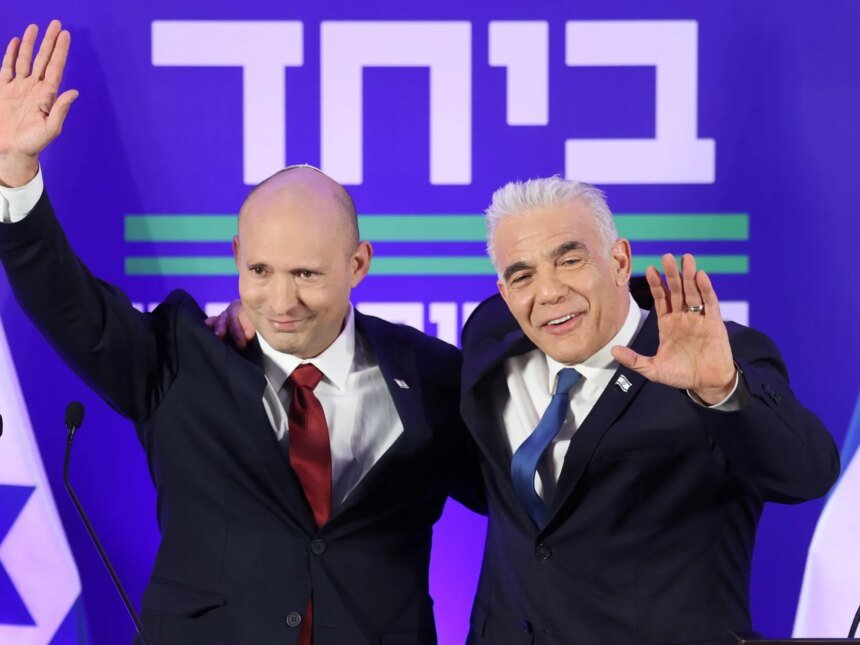
As for Ben Caspit, a prominent political commentator in Maariv and one of Netanyahu’s harshest critics, he went to a symbolic angle, as he saw in the image of Bennett and Lapid evidence that “strong solidarity still exists,” in the face of an internal division that he described as “more dangerous than external enemies.”
According to the writer, the alliance has become a moral danger to Netanyahu because it contradicts his policy of disintegration and polarization.

Israel Hayom: An opportunity for Eisenkot
In Israel Hayom, a newspaper historically affiliated with the right, Eli Zilberberg focused on the internal repercussions within Yesh Atid. He pointed out that “the effects of the political earthquake” were beginning to appear, with the possibility of figures from Lapid’s party heading towards Gadi Eisenkot.
Zilborg’s reading indicates that the alliance has become a double-edged sword: Lapid has secured his position under Bennett’s leadership, but he may lose part of his party, while Eisenkot may become a beneficiary of the disintegration.
Articles in Yedioth Ahronoth, Haaretz, Maariv, and Israel Hayom concluded that the alliance is a danger to Netanyahu if it succeeds in three tasks: installing Bennett as an alternative candidate, including Eisenkot, and transferring votes from the right-wing bloc.
But it is a lifeline for Netanyahu if it remains merely a rearrangement within the opposition “Just No Bibi” camp, or if Likud helps portray Bennett as an ally of the left and Lapid. Therefore, the coalition did not decide Netanyahu’s fate, but it began the battle to determine his replacement.