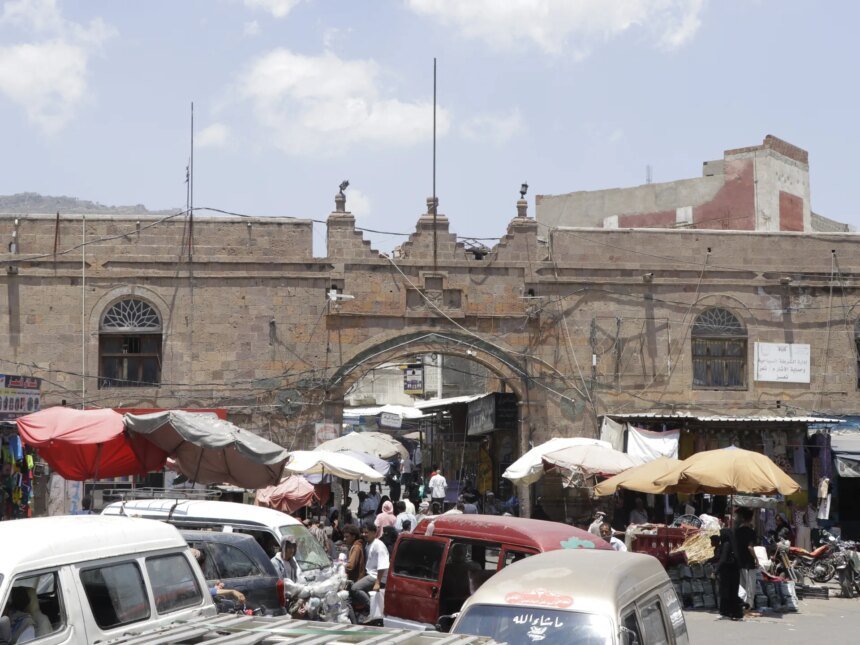
In the city of Taiz, which was not known in its early infancy as a city surrounded by walls or defined by gates, what remains of its ancient wall stands today as a body burdened with accumulated layers of history, and open to the possibilities of oblivion.
These doors are no longer just stone corridors, but have turned into a space where power intersects with architecture, and memory with social transformations in a city that has reshaped itself more than once between openness and closure.
Read also
list of 2 itemsend of list
The scene that today appears as eroded architectural remains was not part of the emergence of Taiz, but rather the result of a relatively late historical moment. The historian Al-Hamdani did not mention it in his book “The Characteristics of the Arabian Peninsula” as a walled city or a complete urban center, but rather mentioned it within a broader geographical context linked to settlements and fortresses.
This reflects their early nature as open communities that did not need walls, where power was distributed between highlands and fortresses, and the idea of a closed city had not yet imposed itself. This is what makes the subsequent appearance of the wall a profound transformation in the structure of the place, and a transition from a flexible urban state to a more disciplined and bounded structure.

Reshaping the city
This transformation took its decisive form with the seizure of Taiz by Imam Al-Mutahhar bin Sharaf Al-Din in 941 AH, corresponding to 1535 AD, in the context of political and military conflicts that pushed towards redefining the city defensively.
Work on building the wall began in the year 943 AH, and continued for seven years and three months until it was completed in 950 AH, using traditional local materials such as “yogurt” and “zabur” and strengthening it with stones from the inside and outside, to form the first actual enclosure of the city and redraw its geographical and security borders. This was not just a fortification project, but a step to reorganize life within Taiz itself.

In this context, Ahmed Jassar, Deputy Director General of the Antiquities Authority in Taiz, said in a special statement to Al Jazeera Net: “Taiz did not have a wall or doors before the Qasimi era, and with the building of the wall the city became more closed and organized, and the doors began to represent movement control points and clear boundaries.”
Jassar adds that this transformation transferred the city from an open space to a monitored entity, controlled by the authority through its entrances and exits. Indicating that the wall was not only to protect the city from external dangers, but was a means of reshaping it politically and socially, and imposing a new style of managing the urban space.
Urban system
With the completion of the wall, a system of doors was formed that redefined the relationship between the inside and the outside. Taiz is no longer an open city, but rather an organized space through specific entrances through which the movement of people and goods is controlled. This intersects with what historian Muhammad Muhammad Mujahid argues, who believes that the development of Taiz as a city was linked to its transformation from a cluster linked to fortresses to a clearly defined urban center, in which doors played a pivotal role in organizing daily life and linking the city to its economic and social surroundings.
After this system consisted of nine sections, only four main sections remain today:
- The big door
- Bab Musa
- Madjar Gate
- Victory Gate
In addition to other outlets, such as the “Hadba” outlet, which later changed its name to “Bab al-Wahda.”

Ahmed Jassar’s testimonies indicate that some of these doors were originally only small niches, as is the case in the “Bab Musa”, which was expanded during the Ottoman era, and this was also repeated with the “Bab Al-Kabir” before it witnessed additional expansions in later stages, including in 1957 during the reign of the Mutawakkilite dynasty, which reflects that these doors were not fixed elements, but rather structures that could be changed, reflecting the shifts in power and the changing needs of the city.
Architecture as an instrument of power
This functional dimension of doors cannot be separated from the nature of the authority that produced it.
Historian Ismail Al-Akwa points out that fortifying cities in Yemen was not only related to confronting external dangers, but rather was a means of tightening internal control and organizing the social sphere.
This concept makes doors daily control tools that control the rhythm of life within the city, and determine who enters and exits, when and under what conditions, so that architecture here turns into a direct extension of the power structure and not just a security response. This explains the continuation of these doors for centuries as symbols of safety and clear boundaries of the city, before they gradually began to lose this role with changing political and social contexts.

From a symbol of safety to a victim of neglect
However, this heritage entered a stage of slow erosion after the establishment of the Republic, in light of the decline in awareness of its historical value and the increasing urban pressures. These monuments were exposed to natural factors that led to their erosion in the absence of regular maintenance work, but the human factor was the most influential. Parts of the wall (especially Nubia) were transformed into random housing inhabited by citizens, including influential people. Others also uprooted stones from the wall and used them to build modern homes, in a gradual process of dismantling an architectural memory that spanned centuries.
Mahboub Al-Jaradi, Director of the Office of the General Authority for Antiquities and Museums in Taiz, confirms in a special statement to Al-Jazeera Net that
“What remains of the city’s wall and gates faces increasing threats as a result of direct attacks and urban expansion, in addition to weak capabilities.”
Al-Jaradi explains that the construction inside the wall and the uprooting of stones led to the loss of large parts of its original features, adding that current efforts are focused on raising awareness and trying to protect what can be saved despite the limited resources, in a scene that reflects a clear gap between the scale of the danger and the scale of the response.

When residents speak
This erosion cannot only be understood through official data, but is also evident in the memory of the residents who lived within these walls.
Saleh Salim, a resident of the old city, said in his interview with Al Jazeera Net: “The doors were not just corridors, but rather part of the details of daily life. Our fathers knew the city through them, and the time was known by opening and closing them, and they represented the limits of safety. What is happening today is a loss of part of the memory, as the places we grew up in are no longer as they were, and some of them have disappeared without a trace.”
This sad description reflects the transformation of these doors from living elements in people’s lives into ruins that can only be recovered through nostalgia, and reveals a growing gap between the past that residents lived and the present that reshapes the place without preserving its memory.
The memory of a city is at stake
In conclusion, what remains of Taiz’s wall and gates cannot be viewed as mere architectural remains, but rather as a living trace of profound transformations in the city’s history. From an open space that was not mentioned as a complete city in Al-Hamdani’s writings, to a fortified entity during the Qasimi era, then to a memory that erodes under the pressure of neglect and urban expansion.
This decline makes the fate of these monuments linked to a question that goes beyond the past to the future, a question that is not only related to preserving the stones but also preserving the meaning itself. The testimonies of officials intersect with the memory of residents to confirm that what is happening is not just urban decline, but rather a gradual loss of a complete spatial identity, which places Taiz at a real crossroads: either restoring this heritage within a conscious project that preserves it, or letting it disappear silently until it becomes just a story told without evidence.