Published On 5/14/2026
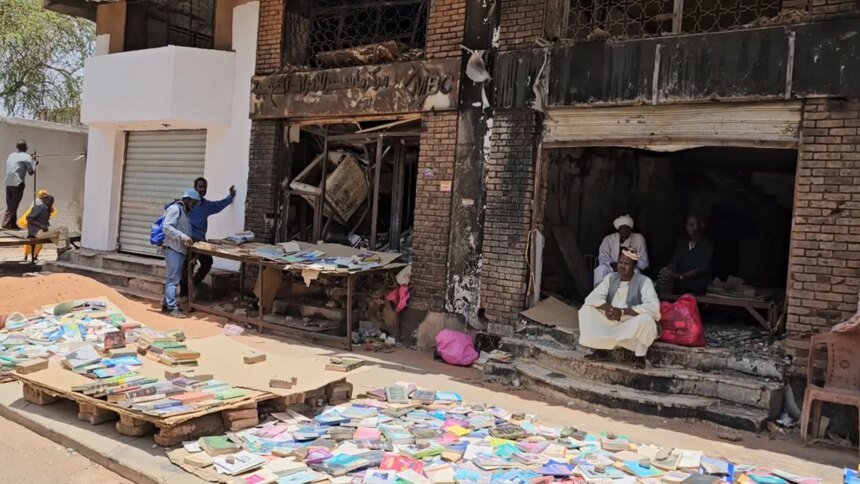
From the midst of the rubble and destruction that befell cultural libraries, new life emerged on the sidewalks of “Freedom Street,” where book sellers spread out on the ground, transforming the sidewalks into a knowledge haven for intellectuals and researchers.
Under the Khartoum sun, Ahmed, the owner of an ancient bookstore that was destroyed by the war, stands next to his merchandise spread out on the ground. Ahmed, who has spent more than 25 years in this profession, says, “Spreading out on the ground was not an easy option, but weak financial capacity and the high cost of building materials prevented us from restoring what was destroyed by the war. We chose the sidewalk to continue our mission and provide a living under these harsh conditions.”
Read also
list of 4 itemsend of list
Pain is not limited to financial loss only; Ahmed describes with sadness the loss of rare and priceless references and manuscripts. He adds: “The worst thing we face is customers asking about books and references that were burned or lost under the rubble, but their happiness at our return, even on the sidewalk, gives us the strength to continue.”
Even major institutions were not spared from the war machine, most notably the Sudanese Book House, which is considered a cultural beacon in the region. According to bookstore owners, their stores were not just points of sale, but rather repositories of memories and human heritage that had suffered a painful blow.
In an attempt to confront this reality, several initiatives have emerged, including youth initiatives to organize mini-book fairs in safe areas, government and state movements to support the return of bookstore owners to their headquarters and attempt to restore what can be saved, and the establishment of support projects aimed at reviving damaged publishing houses.
Despite the extent of the devastation inflicted on the heart of the capital, booksellers in the “Arab Market” confirm that returning to work was inevitable, as it is the only profession and their primary source of livelihood, and with the gradual return of calm, these “leafy people” cling to the hope that their libraries will be reconstructed, so that Khartoum will return to what it was, a city that reads, writes, and prints, thus defying the effects of war and destruction.