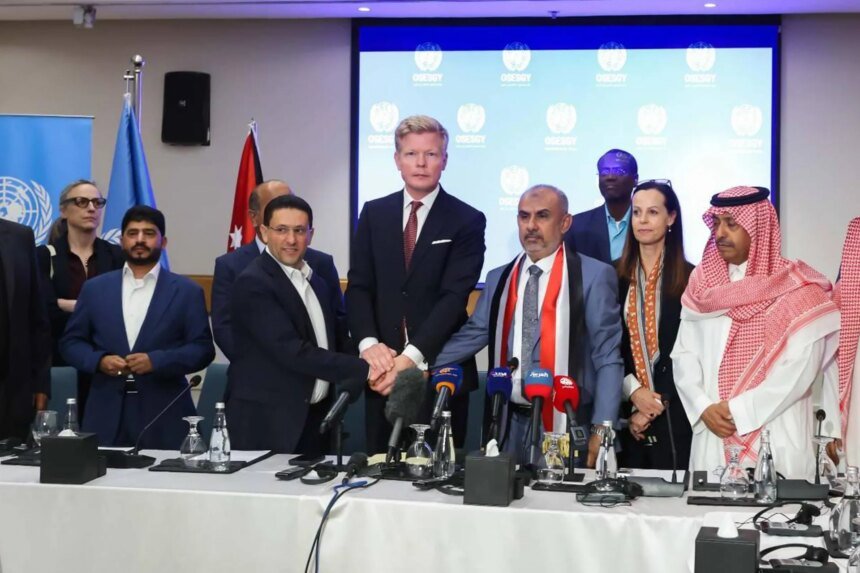
After more than 90 days of negotiations in the Jordanian capital, Amman, the United Nations announced that the parties to the conflict in Yemen had reached an agreement to implement the largest exchange deal for prisoners and detainees against the backdrop of the ongoing war in the country for 12 years.
In this report, we highlight the details of the new agreement that came after the longest round of negotiations between the parties. We also discuss the scenes behind the issue of prisoners and detainees in Yemen, which is considered one of the thorniest issues in the course of the Yemeni crisis.
Who are the parties to the agreement?
The agreement includes three signatory parties: the Yemeni government and the Arab coalition led by the Kingdom of Saudi Arabia on the one hand, and the Ansar Allah group (Houthis) on the other hand.
The agreement was sponsored by the United Nations, while the International Committee of the Red Cross co-chaired the supervisory committee responsible for implementing the agreement to release detainees.

How many detainees will be released?
Data from the parties showed a difference in the number expected to be released. According to the office of the UN envoy to Yemen, Hans Grundberg, the parties reached an agreement to release more than 1,600 detainees related to the conflict.
As for the delegation of the Yemeni government and the Arab coalition negotiating the detainees file, it announced in a joint statement that the agreement stipulates the release of approximately 1,750 detainees from various parties, including 27 from the Arab coalition forces.
The head of the government delegation, Yahya Kazman, had anticipated the statement, and revealed that the agreement includes the release of 1,728 detainees from both sides.
He stated that the agreement stipulates the release of “a number of Arab coalition forces, members of the armed and security forces, and all military and popular resistance formations, in addition to a number of politicians and media figures who spent many years in the detention centers of the Houthi group.”
On the other side, the head of the Houthi Prisoners’ Affairs Committee, Abdul Qader Al-Murtada, indicated that lists of names of prisoners and detainees were signed at the conclusion of the negotiating round.
He revealed that the agreement includes the release of 1,100 prisoners and detainees from the group in exchange for 580 from the other party, including 7 Saudi prisoners and 20 Sudanese prisoners.

Where is the position of the politician Muhammad Qahtan in the agreement?
With every round of negotiations, the file of the leading politician in the Yemeni Islah Party, Muhammad Qahtan, is at the forefront, whose fate is unknown since his arrest by the Houthis in April 2015.
On December 23, the parties reached an agreement to release 2,900 detainees in connection with the conflict, after consultations that lasted 12 days under the auspices of the United Nations in the Omani capital, Muscat.
At that time, the Yemeni government said that the agreement included the Houthis releasing 1,200 detainees, led by Qahtan (who has been hidden for more than 11 years), 7 Saudis, and 20 Sudanese, while the government would release 1,700 Houthi detainees.
But the implementation of that agreement faltered, and the parties entered the recent negotiations in Jordan in an attempt to remove obstacles related to the implementation of the Muscat Agreement, and the negotiations reached an agreement to release only more than 1,600 detainees.

The government agency Saba revealed that the new agreement stipulates the formation of a committee from both parties, with the participation of Qahtan’s family, to go to Sanaa (which is under the control of the Houthis) and verify his fate and take the necessary measures, in the presence of the International Committee of the Red Cross and a neutral mediator, before carrying out the process of releasing the detainees.
The Qahtan file has topped the most important topics on the Yemeni scene over the past few days. Yemeni media published that the Houthi delegation informed the Yemeni government in the Jordanian negotiations that Qahtan was killed in an air strike in 2015, while his family was quick in a statement to deny the story attributed to the Houthis.
The family held the Houthis responsible for Qahtan’s life, and demanded the formation of an international committee with their participation to reveal his fate if he was not released.
When will the new agreement be implemented?
The concerned parties did not reveal a specific date for implementation, but the Houthis said that it would be after completing the International Red Cross procedures.
As for the Yemeni government, the official Saba Agency reported that the implementation of the agreement depends on the completion of the joint committee with the Houthis to verify the fate of the politician Muhammad Qahtan.
What’s the feedback?
In a statement, the UN envoy to Yemen, Hans Grundberg, described the agreement, which came after 14 weeks of direct negotiations, as an important achievement, because it represents the largest agreed-upon release process, and demonstrates that even with deep mistrust and a protracted conflict, dialogue is still capable of achieving results.
He also explained that the agreement brings hope and relief to thousands of families who have waited a long time for the release of their children, stressing that the next decisive step is implementation, as the parties agreed – according to Grundberg – with the International Committee of the Red Cross on an implementation plan to move forward with the release process.
Grundberg expressed his hope that the agreement would strengthen the necessary confidence between the parties to achieve progress towards sustainable peace.
The Qatari Ministry of Foreign Affairs welcomed the agreement, expressing the State of Qatar’s full appreciation for the efforts of the Hashemite Kingdom of Jordan, the United Nations, the International Committee of the Red Cross and the concerned parties, which contributed to reaching the agreement.
Qatar renewed its full support for all regional and international endeavors aimed at ending the Yemeni crisis through dialogue and peaceful means, in a way that serves the security and stability of Yemen and its brotherly people, and consolidates sustainable peace in the region.
In this context, the American Center for Justice (non-governmental) welcomed the concluded agreement, calling on all parties to strictly adhere to the timetable accompanying the agreement, facilitate the tasks of field committees, and work seriously to rid detention centers and prisons of all detainees and forcibly disappeared persons.
Are there new negotiations for the rest of the prisoners?
Contrary to what was expected, the new agreement would include the release of about 3,000 detainees in accordance with the Muscat Agreement, the announced number of detainees revealed the extent of the complexity in the prisoner file between the parties.
The office of international mediator Grundberg said that today’s agreement is based on a previous round of negotiations held in the Omani capital, Muscat, in December 2025.
Regarding the next step, the UN office said that the parties also agreed to meet again regarding further releases, conduct joint visits to their respective detention facilities, and ensure access to all detainees.
What was the last transaction executed?
In April 2023, the government and the Houthis carried out the last exchange deal, under which about 900 prisoners and detainees from both sides, including Saudis and Sudanese, were released through UN mediation, after negotiations in Switzerland.
In October 2020, the government and the Houthi group released 1,056 prisoners, in the largest exchange deal between the two parties since the outbreak of war between them in 2014, in a process sponsored by the United Nations and the International Committee of the Red Cross.
In addition to the two deals, over the past years, the parties have carried out small numbers of exchanges, through local mediation, amid demands from human rights organizations for the release of all detainees.

What will happen to the Stockholm Agreement?
On December 13, 2018, UN-sponsored consultations in the Swedish capital, Stockholm, led to an agreement between the Yemeni government and the Houthis.
The agreement included several aspects related to the governorates of Hodeidah and Taiz, in addition to the release of all prisoners, as the Yemeni government and the Houthis exchanged lists of the names of 16,000 prisoners, with all prisoners to be released on January 20, 2019, but implementation remained faltering amid mutual accusations from both sides.
Since then, the government and the Houthis have participated in negotiations regarding the issue of prisoners and detainees, but most of them have failed to achieve breakthrough and implementation on the ground.
What are the reasons for faltering implementation?
Although the parties reached agreements to close the file of prisoners and detainees, the file remained open and stalled without a real breakthrough despite international efforts.
At the forefront of the reasons for this stumbling is the file of missing and forcibly disappeared persons. While the government has been demanding that the Houthi group for years reveal the fate of figures, led by Mohammed Qahtan, the group in return demands the names of a number of its members, names that the government says are fictitious.
The continuation of the conflict and military skirmishes on several fronts – albeit at a lower rate in recent years – also represents one of the main factors for keeping this file open, with the continuing incidents of captivity and field detention.
Thousands of Yemeni families hope that efforts will succeed in ending the file of detainees, some of whom have spent more than a decade in prison, while many affirm that reaching a comprehensive settlement to the conflict will end this file.