Published on 6/14/2026
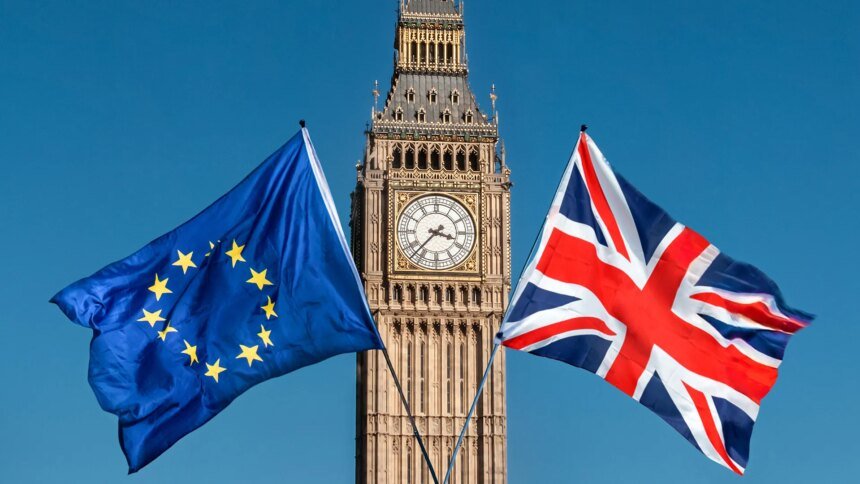
An article in the British newspaper “The Independent” revealed that British conservative politician Michael Heseltine called for reconsidering the possibility of returning to the European Union. Heseltine – the former deputy prime minister in the governments of Margaret Thatcher and John Major – accused the leaders of the Brexit agreement campaign of making misleading promises to voters that quickly proved to be failures.
The “veteran” British politician relied on opinion polls that showed increasing skepticism about the feasibility of Brexit and rising support for closer relations with Europe, an indication of a shift in British public opinion after years of exit.
Brexit officially entered into force on January 31, 2020, followed by a transition period that lasted until the end of the same year.
“Brexit” is a compound word resulting from the merging of the words “British” and “Exit”. The decision to withdraw came after a popular referendum held in June 2016, in which about 17.4 million Britons, representing 51.9% of participants, voted in favor of leaving the European Union.
The Brexit issue returned to the forefront in May 2026, after former British Health Minister Wes Streeting described Brexit as a disastrous mistake and called for Britain’s return to the European Union.
An opinion poll conducted by YouGov in April 2026 revealed that about two-thirds of the British people (63%) want to strengthen relations with the European Union, while 55% of the people want to return to it.
Occupation crimes
In a related context, Haaretz newspaper discussed a remarkable phenomenon represented by the Israelis’ “discovery” – belatedly – of the extent of the crimes and atrocities committed by the occupation soldiers against the Palestinians in the Gaza Strip and the West Bank.
The newspaper attributed this “slight” interest to the emergence of details about the murder of Palestinian infant Sam Abu Heikal by Israeli soldiers’ bullets in the West Bank, an incident that shook Israeli public opinion.
New video clips published by the Israeli human rights organization “B’Tselem” – on the 10th of this month – showed the first moments of shooting at a Palestinian family in the Tel Rumeida neighborhood in the city of Hebron, in the occupied West Bank, in an incident that resulted in the death of the 7-month-old infant, Sam Abu Haikal, and the wounding of his parents with varying injuries.
The organization said that the video recordings document an Israeli soldier shooting at the family’s car as it slowed to stop in response to the soldiers’ orders, stressing that the vehicle was far from the soldiers’ location and did not pose “any danger” to them at the moment of the shooting.
The footage shows the infant’s father, Fahd Abu Heikal, carrying his injured child after being shot in the head, trying to stop the bleeding with his hands in a state of shock and collapse, while the child’s mother, Dania, appeared sitting near the car after she was also shot while hugging her child in the back seat.
The Israeli occupation forces killed the baby Sam last Friday, June 5, when his family was returning to their home after a family visit, before they were shot while inside the vehicle.
The author of the article in Haaretz believed that the interest of some Israeli media in the violence of settlers and the army in the West Bank reflects the beginning of a decline in the state of denial towards the occupation, but he ruled out that this shift would be profound or permanent.
Congo documents
On the other hand, the French newspaper Le Monde discussed the suffering of amputee Ukrainian soldiers, whose number has reached 120,000 since the beginning of the war with Russia.
The newspaper explained that Ukrainian medical associations focus on sports therapy, especially climbing, to help these soldiers rebuild their lives and reconcile with their bodies, which are now equipped with prosthetic limbs.
Regarding the colonial issue, the Financial Times newspaper revealed that the Democratic Republic of the Congo government is exerting intense pressure on Belgium to hand over important documents and maps dating back to the colonial period.
The newspaper explained that Kinshasa is demanding documents and maps of the mineral wealth fields that abound in the Congolese lands, which were plundered during the Belgian colonial era.
The Congolese Minister of Mines met with his Belgian counterpart and his European counterparts to officially initiate this step, and Congo also demands the “digitization” of the required documents and maps, which are currently preserved in the Royal Museum in Brussels.
In light of the wave of European colonization of Africa and the forces’ struggle to seize the continent’s wealth and resources, and in order for the matter not to escalate into devastating wars, the German leader Bismarck called in 1884 to hold a conference of European countries in Berlin.
After 100 days of the conference – in which 13 European countries participated – Africa was divided, and among the results of this was the recognition of the right of Leopold II (King of Belgium) to annex the Congo, whose area was dozens of times larger than the size of small Belgium.
Thus, in 1885, the Free Congo became a company owned and controlled, and the king used economic and nationalist arguments to convince those around him to colonize, and the process began largely under the pretext of humanitarian and missionary work.