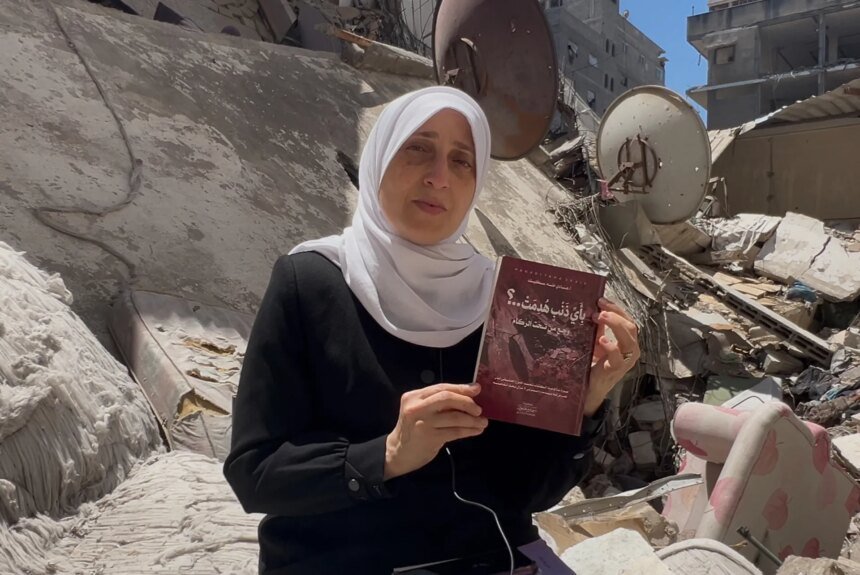
GazaIn the book “For What Sin Was I Demolished?”, pain does not appear to be just a passing human condition, but rather the most present thing in the text. It breaks into homes, redefines family, war, love, survival, patience, and even language itself.
The writer Hanadi Taha Skaik, a social worker and family counselor, and a survivor of the war that destroyed her home and wiped out most of her family members, did not write the book from the position of a distant narrator or neutral witness, but rather from the heart of the tragedy itself.
Sukayk lost 22 of her relatives, including her mother, her husband, her son and his wife, her grandchildren, and a number of her brothers, their wives and their children. She miraculously escaped death after being pulled from under the rubble, launching an attempt through 70 fundamental questions to explore the depths of what happened. Through it, she tries to comprehend the horror of what happened, and to answer the most difficult question: How can a person pull himself together and continue?

“The author relies on numbers, statistics, and vivid testimonies, which make the text go beyond the limits of individual pain to become a mirror of a complete collective pain.”
The book, which flows in a question-and-answer format, sometimes approaches autobiographical literature, but it gradually turns from a personal dialogue into a broad humanitarian archive of the war on Gaza. The writer Skaik is not content with recalling her personal experience, but rather expands the narrative to include details of bombing, displacement, massacres, propaganda and psychological warfare, the performance of the media, and human and material losses, all the way to the psychological and social effects left by the tragedy. The author relies on numbers, statistics, and vivid testimonies, which make the text go beyond the limits of individual pain to become a mirror of a complete collective pain.

The beginning of the tragedy and questions
The chapters of the tragedy in the life of writer Hanadi Skaik, which prompted her to write the book, began very shortly after the outbreak of war, specifically on October 9, 2023, when her house was completely destroyed. She described that moment as the early death of something inside her, as surviving that day was not a joyful matter, but rather the beginning of a long road of tragedies.
With the loss of their home, the family was forced to search for a safe haven, so they moved to take refuge in their son’s house, but the occupation massacres continued during the war of extermination. On October 20, the area around the house was subjected to heavy bombardment, turning it into rubble and a cloud of smoke.
For the second time, the Sukayk family found themselves displaced, so they went to seek refuge in their father’s house, and there the major tragedy occurred on November 13, 2023, when the house, which housed approximately 50 people, was subjected to a direct bombardment that led to its demolition. On that day, the family of writer Hanadi Skaik was almost completely annihilated, and everyone was martyred, leaving only her and one of her brothers.
Sakik emerged from under the rubble with a body heavy with blood, severe injuries, and a broken heart from the pain of loss.
She was subsequently transferred to Baptist Hospital in a dazed state, shifting between consciousness and coma, beginning a new phase of suffering inside the corridors of the hospital, which was also not spared from threats of evacuation and bombing.

Hours after her arrival, she was forced to evacuate the hospital, carrying her bleeding wounds, after the occupation threatened to storm it, to stay with a strange family, who hosted her for a period of time, unable to reach any of her relatives, and at the same time, awaiting news about her son, the doctor, who was trapped in Al-Shifa Hospital.
“Sakik decided to start writing the book not only to cry, but to bear witness, to document, to erase the pain in name and voice, not to explain the tragedy, but to bring it back alive as it passed through her heart.”
Months later, specifically on January 7, 2024, Skaik decided to start writing the book, “not just to cry, but to bear witness, to document, to erase the pain in name and voice, not to explain the tragedy, but to bring it back alive as it passed through her heart.”
Questions of tragedy…and answers of the soul
Through the titles of the seventy questions that Skaik poses in her book, the reader can sense the nature of the journey that the text takes:
- Does the house feel afraid before it is bombed?
- What does it mean for the house to collapse and for us to survive?
- How did you feel when you were under the rubble?
- Did everyone who survived recovered?
- How do we maintain our faith in adversity?
Other questions do not seem to be a search for a final answer, but rather an attempt to save memory from collapse. She says in answer to the question: Does a house feel afraid before it is bombed?
“Yes… I felt his fear trembling in my chest before it collapsed. That night, I put my heart in order before I put my house in order. I said: Tomorrow is better. I did not know that tomorrow would come without a home.”
In her answer to the question: What happens to the soul at the beginning of loss and why do the details become painful? She answers: “At the beginning of loss, the soul goes through a stage of denial and anger, then sadness and acceptance, where the soul is shaken and suffocated, and from that moment it remains searching for something of itself that is no longer there, and the details become painful because every corner, smell, and passing word turns into a witness to the absence that was the fullness of hearing and sight.”
She continues: “Details are threads that connect us to the past, and when the original thread, that is, the person or place, is cut, these small threads continue to pull the heart towards emptiness. The Almighty said: (And the heart of Moses’ mother became empty. her heart so that she may be of the believers” (Surat Al-Qasas 10).
Social and informational dimensions
The book does not remain captive to the emotional dimension alone, but rather enters more complex spaces. Due to her specialization in social service, the writer discusses the psychological and social effects of war, psychological trauma, the disintegration of the concept of safety, the transformations of collective grief, and how the human being is reshaped under fear and loss.
In this regard, it poses a question: What are the psychological, social, economic, environmental and behavioral problems that affected the Gaza Strip from the war? Sakik answers:
“War is not measured only by the number of martyrs or the extent of destruction, but by the depth of the impact it leaves on a person from within; in his psychology, relationships, behavior, and even his outlook on life and the future. The pain does not end with the end of the bombing, but rather continues in memory and in the details of daily life.”
Skaik then reviews the effects of war on the psychological and behavioral levels, explaining that it causes complex traumas that lead to post-traumatic stress disorder, chronic anxiety, and severe depression as a result of constant loss, especially among children and mothers.
This psychological pressure is reflected in daily behavior through the emergence of harsh “survival behaviors,” increased aggressive tendencies or social withdrawal, and loss of passion for the future, which generates a state of apathy, general despair, and poor educational attainment, according to the book.

From a social and economic perspective, the war causes the disintegration of the societal fabric and an increase in the number of orphans, widows, and forced displacement, coinciding with the complete collapse of the economic and service infrastructure. The destruction of factories and facilities leads to unemployment and extreme poverty that makes the population completely dependent on aid, while health and environmental disasters loom on the horizon as a result of water pollution, the accumulation of rubble, the spread of diseases, and the disruption of sewage and electricity networks.
Media questions and deconstruction of propaganda
The book devotes significant space to the media and the war on the novel; The writer stops at the language used in press coverage, the political propaganda mechanisms practiced by the occupation, and some of the media outlets loyal to it, how the victim’s voice is stolen, and his story is told by the perpetrator, how truth is turned into falsehood, horrific crimes are justified, and the way in which the world’s awareness of the victim and the executioner is reshaped.
Some of the questions seem closer to a critical deconstruction of Israeli media discourse, especially when concepts such as safe passage, displacement, and the interpretable narrative are discussed, and how terms sometimes turn into tools to mitigate the impact of crime or redefine it politically.
In this context, she explained that “enemies are trying to change or soften certain names to reduce their psychological impact or to justify their actions before public opinion.” For example, the process of mass destruction of people or the environment is called “military cleansing or removal operation,” with the aim of making it appear to be a legitimate military matter, and the term “temporary evacuation, temporary settlement, or security evacuation” is applied to “forced displacement, which is the forceful displacement of residents without their desire, with the aim of softening the picture and making displacement appear to be an option and not a crime. Likewise, applying the term “limited military operation” to bombing. Civilians and public objects indiscriminately and indiscriminately.
The suffering of prisoners
The book documents the harsh details of the arrest of the freed prisoner (whose name was not mentioned), which began inside Al-Shifa Hospital on March 19, 2024, when he was a displaced person searching for safety, only to find himself led in shackles to the occupation prisons.
The book devotes space to conveying the bitter reality inside the cells, describing the absolute isolation from the outside world, and the systematic attempts that prisoners are exposed to to break human dignity through campaigns of repression, sudden inspections, and continuous physical and psychological abuse. The book also points out that the policy of systematic starvation has become a “permanent companion” to the prisoners from the first moments of their arrest, in an attempt to rob them of their most basic rights and reassurance, and to turn their lives into a daily battle for survival under the weight of threats and desolate isolation.

Information documentation of the war of extermination
Skaik devoted the last part of the book to informational documentation of the war of extermination, as she explained in her interview with Al Jazeera Net that she had communicated with various ministries and institutions, with the aim of obtaining all data on human and material losses from the beginning of the war until April 6, 2024.
The book stated that the death toll reached 72,302 martyrs, while the number of injured reached 172,090 wounded, which is an infinite toll. The numbers highlight the depth of the social tragedy, as the war left behind 64,616 orphans, while the number of widows rose to 26,370. Children paid the greatest price in this confrontation, as reports documented the death of 21,510 children as martyrs, 41,283 wounded, in addition to 24 missing persons whose fate is still unknown, and 864 cases of amputation and permanent disability that will accompany these children throughout their lives.

In terms of infrastructure, residential areas were subjected to widespread destruction, with about 410,000 housing units damaged. This damage was distributed between 335,000 units that were completely demolished and 75,000 units that were partially demolished, while only 100,000 units were classified as partial damage that are still habitable. Places of worship were not spared from direct targeting, as 1,049 mosques were completely destroyed, in addition to 210 other mosques being partially destroyed, which reflects the systematic targeting of religious monuments.
At the end of “For What Crime Was It Destroyed?”, the reader does not come away with complete answers about the war, but rather comes away burdened with major moral and humanitarian questions. About justice, survival, and what it means for a person to lose his family all at once, and then be asked to continue living.