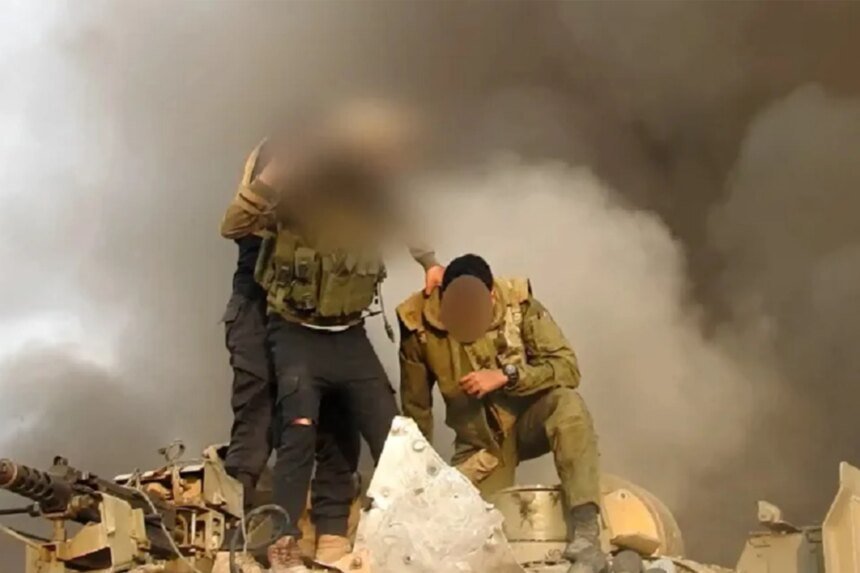
The flood of October 7, 2023 was not just an intelligence or operational failure, but a revealing moment of a deeper crisis in the concept of Israeli national security.
The country that built its security for decades on deterrence, warning, and rapid decisiveness, and then added to it an advanced technological defense layer, found itself faced with a question that could no longer be postponed, which is what happens when the adversary sees the cost and is not deterred, when indicators accumulate and do not turn into a warning, and when smart borders fall in the face of a large-scale ground attack?
Read also
list of 2 itemsend of list
The importance of the Dadu Center, affiliated with the Operations Division of the Israeli army, stems from the fact that it reflects a discussion taking place within the military institution itself.
Foundations of national security
In a study by Major Kim Barr, published in August 2024 entitled “The Development of Military Vehicles in the Concept of Israeli National Security,” it was confirmed that the current war imposes a discussion on the foundations of national security, and that the military vehicles in circulation are deterrence, warning, decisiveness, and defense.
This referral places “October 7” within a conceptual crisis, not within a separate incident. The problem was not only the collapse of a wall or the failure of an intelligence unit, but rather the vibration of an entire system that assumed that force deters, that information warns, and that the army can quickly transfer the war to the enemy’s territory.
It became apparent after the attack that the three episodes could be disrupted together, as the opponent was not deterred, the warning was not transformed into action, and a quick resolution was replaced by a long war.
In a 2017 Institute for National Security Studies memorandum, Udi Dekel and Omer Einav wrote that Israel’s security concept has largely remained a “verbal Torah” (oral rule book), an unwritten system of principles, and that regional transformations require its modernization.
In this sense, “October 7” did not create the debate out of thin air, but rather transformed it from a theoretical debate into a question of survival and sustainability.
The Israeli security concept has remained largely an “oral Torah” (a book of oral rules), that is, a system of principles that is not fully written, and regional transformations require its modernization.
Eroding deterrence
In a study published by the Institute for National Security Studies in March 2024, Amir Lubovici, professor of international relations at Tel Aviv University and researcher in deterrence theories, believes that the attack opened questions about “the deterrence strategy and Israel’s reliance on it.” He argues that Israel bet on deterrence against the Hamas movement, even though its effectiveness against this type of threat was not clear enough.
Here lies the weak point. Tel Aviv interpreted Hamas’ preoccupation with governance and the economy as a restriction that prevented it from taking the initiative, and treated the previous rounds of fighting as evidence that the opponent understood the price.

In fact, the calm was turning into a space for the accumulation of strength, and this is what pushed the Israeli debate after October 7 to go beyond the question, “How do we deter?” Towards the question “How do we prevent the rebuilding of capacity?”
Nevo Spiegel, in the Dado Center article, “Removing Deterrence from the Equation,” published in May 2025, adds a deeper criticism of the concept of Israeli deterrence, considering that it suffers from ambiguity, measurement difficulties, and cognitive failures, and that it is an “ineffective policy tool” that distorts assessments of the situation and leads to circular thinking.
Preventing is expensive
Out of this failure, the logic of prevention emerged, and its clearest expression appears in an article by Meir Ben-Shabbat, former head of the Israeli National Security Council and head of the Misgav Institute for National Security and Zionist Strategy, published in December 2025, entitled “Dispossession and preventing armament is more important than establishing a ceasefire.”
Prevention is not a limited military measure, but it requires longer security control, broader field deployment, permanent intelligence, renewed ammunition stocks, and readiness on multiple fronts.
Ben Shabbat places the primary goal in Gaza and Lebanon in disarmament and disarmament, not in establishing the truce, and he believes that Israel must thwart the attempt of Hamas and Hezbollah to buy time, even if this leads to renewed fighting.
With this formulation, the center of gravity shifts from deterring the opponent from using force to preventing him from reproducing it. However, prevention is not a limited military measure, but rather requires longer security control, wider field deployment, permanent intelligence, renewed ammunition stocks, and readiness on multiple fronts.
Here, Brigadier General Reserve Meir Finkel, head of the research area at the Dadow Center, warns that armies emerging from failure or shock tend to quantitatively expand incomplete capabilities, but going too far on this path may drain the resources and administrative attention needed to build a new response.
This observation hits the essence of the Israeli dilemma. Israel may expand its army, fortifications, and capabilities, but without resolving the strategic dilemma.
Realistic prevention means weakening adversaries, reducing their ability to do harm, prolonging periods of calm, and preserving freedom of military action.
Reality of prevention
The study by Professor Ephraim Inbar, a senior researcher at the Jerusalem Institute for Strategy and Security (JISS), published in June 2026 entitled “Designing a Realistic National Strategy for the State of Israel,” adds a necessary constraint on the prevention discourse.
He warns against turning the military achievements after “October 7” into a broad strategic illusion, and writes: “As a small country operating in a region characterized by radicalism, nuclear ambitions, and a limited strategic margin for maneuver, Israel must match its ambitions with its resources and act with strategic caution.”

This quote gives the report its analytical key that Israel can improve its security position, but it does not necessarily have the ability to reshape the Middle East.
Realistic prevention means weakening adversaries, reducing their ability to do harm, prolonging periods of calm, and preserving freedom of military action.
As for prevention, when it turns into an open project to change the region, it becomes beyond the capacity of a small country that relies in part on the United States, Western weapons, global trade, and an eroding external legitimacy.
Inbar goes further when he considers that phrases such as dismantling Hamas or Hezbollah express desirable goals, but they are “not achievable goals now.”
Therefore, it reconsiders, in a realistic form, the logic of mowing the lawn: repeated use of force to erode the capabilities of the opponent, no promise of a final resolution of the conflict.
Israel can improve its security position, but it does not necessarily have the ability to reshape the Middle East
Sustainability brakes
The shortage of soldiers alone does not stand in the way of “prevention,” although it is the most obvious obstacle. Yedioth Ahronoth reported last month, citing data presented to the Foreign Affairs and Security Committee, that the army lacks at least 12,000 soldiers, including about 7,500 in combat positions.
This means that prevention not only confronts external adversaries, but also the limits of the human capacity of a small state fighting a multi-front war.
The second inhibitor is social will: the discussion about Haredi recruitment is no longer an internal file separate from national security, but rather has become a test for distributing the burden.
If the new security requires longer service and more reserves, the continued exemption of a broad social bloc turns “prevention” into an unbalanced burden on the regulars, reserves, and the middle class.
The third brake is economic: Bank of Israel estimates published in the Cluster Economic newspaper on March 20, 2026 stated that the cost of the war since “October 7” amounted to about 352 billion shekels (about 120 billion dollars), before subsequent waves of escalation, and this turns security from an emergency cost into a permanent spending structure.
The fourth inhibitor is the external ally: This does not mean that Israel has lost Washington’s support, but it can no longer assume that ammunition, spare parts, financing, and diplomatic cover will be without limits or without conditions.
Therefore, Israel’s crisis is not that it does not know what it wants militarily, but rather that it does not necessarily have the society, economy, time, or ally capable of financing what it wants.
In conclusion, the concept of “deterrence” has not disappeared in Israeli thinking, but it has lost its status as a sufficient guarantee. Despite the ban, it gives Israel a temporary disruptive ability, but it needs a larger army, a broader economy, and a stable ally.
Therefore, the concept of Israeli security after “October 7” seems closer to open exhaustion than to a new security stability doctrine.