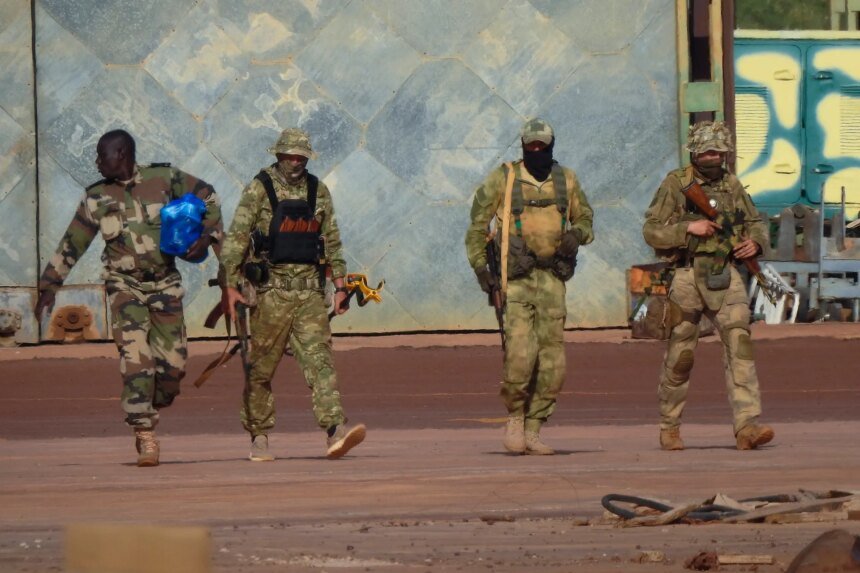
Russia, which concludes defense partnerships with countries in the African Sahel region, faces questions about the reality of its role and the effectiveness of these agreements, following reports of the withdrawal of Russian forces from the strategic city of Kidal in northern Mali, which witnessed the largest coordinated and simultaneous attack by armed groups on the Malian armed forces last Saturday.
On Saturday, the Front for the Liberation of Azawad, allied with the “Support for Islam and Muslims” group affiliated with Al-Qaeda, took control of the city of Kidal, after battles with the army, in a development that casts a shadow over the future of the military junta, as anticipation prevails after the killing of Defense Minister General Sadio Camara.
After days of large-scale attacks, the council’s leader, General Assimi Goita, said on Tuesday that the situation was “under control”, with Russian forces providing air support to prevent rebels from seizing key sites, including the presidential palace in the capital, Bamako.
But the security situation in the West African country remains volatile, as the government struggles to regain control of towns and cities from Tuareg fighters and fighters linked to Al Qaeda, who have vowed to carry out a comprehensive siege of the capital of Mali.
Last Monday, the Russian African Legion (formerly the Russian Wagner Special Military Group) confirmed that its forces had withdrawn from Kidal, but stated that the decision was taken in conjunction with the Malian government.
Malians and conflict analysts wonder how strong Russia’s defense support is for Sahel countries, including Burkina Faso and Niger, which are led by armed forces and have seen a surge in armed attacks in recent years.
Here is what we know about the Russian fighters in Mali, and the questions being asked about their role:
General background
The Malian government, headed by Assimi Goeta, took power after two coups in 2020 and 2021, with a pledge to restore security, but it faces difficulties in achieving this.
Like its counterparts in Niger and Burkina Faso, the military government in Mali severed its relations with the former colonial power France and a number of Western countries, moving towards strengthening political and military cooperation with Russia.
The Russian Wagner Group, which has fought alongside the Malian forces since the end of 2021, announced the end of its mission in June 2025, to be replaced by the “African Corps” directly under the Russian Ministry of Defense.
The military junta pledged to hand over power to civilians by March 2024, but in July 2025 it granted Goeta a presidential term for a period of 5 years, renewable “as much as necessary” and without holding elections.
The African Legion was deployed in Mali after Goeta asked the French forces of more than 4,000 soldiers to withdraw from the region in 2022.
In 2023, Mali, Burkina Faso, and Niger formed the Sahel States Alliance, amid the deteriorating security situation, following their withdrawal from the Economic Community of West African States (ECOWAS), which criticized the coups in the Sahel countries.

What happened to Russian fighters in the Mali attacks?
Mali has witnessed escalating armed violence since 2012, and there have been about two thousand Russian fighters in the country for approximately 5 years.
Many Wagner fighters remained within the Afrika Korps, but analysts point out that the main difference between the group and the Corps on the ground was in the combat approach.
While Wagner’s fighters were more aggressive and willing to take risks, the African Legion was more defensive.
Russian fighters, the Malian army and armed groups are accused of targeting civilians in what human rights organizations say may amount to war crimes.
Amid the attacks that took place on Saturday, Russian fighters were seen leaving the captured city of Kidal in trucks, after their exit was negotiated through neighboring Algeria.
The fighters disarmed some Malian soldiers and captured them, while the Malian army did not reveal the number of captured soldiers.
What does the Russian government say?
Africa Corps said in a statement that its decision to withdraw was taken in coordination with Bamako.
The statement read: “In accordance with a joint decision of the leadership of the Republic of Mali, the African Legion units that were stationed and participating in the fighting in the town of Kidal withdrew from the region along with members of the Malian army.”
The statement continued, “The wounded soldiers and heavy equipment were evacuated first, and the individuals continue to carry out their combat mission assigned to them, and the situation in the Republic of Mali remains difficult.”
The Africa Corps forces claimed that they provided air support to the Malian forces, and helped thwart the attacks on the presidential palace in Bamako. Likewise, the Russian Ministry of Defense stated that about 12,000 fighters launched an attack last Saturday, and said without evidence that they had received training at the hands of Ukrainian and European mercenaries.
The Malian army did not comment on Russia’s claims regarding the withdrawal.
The governor of the Kidal region warned the Russian mercenaries 3 days before the attack, but they “did nothing,” according to what Radio France Internationale reported from a senior financial official, adding that the African Corps may have previously negotiated their withdrawal.

How did the attack affect Russia’s standing?
When the French began to withdraw in 2021, Russia portrayed itself as a non-colonial liberation force in the Sahel as mercenaries arrived in the region.
Analysts point out that Moscow has long sought to use the Wagner Group, and later the African Legion, as a tool to influence African governments.
Russian fighters have long been present in the Central African Republic, and reports indicate their presence also in Libya and Sudan.
As for the countries of Niger and Burkina Faso, neighboring Mali in the Sahel region, where armed violence practiced by groups affiliated with Al-Qaeda and ISIS has spread, members of the African Legion are present to a lesser extent, and in a more supervisory role.
About 100 Russian soldiers are deployed in Niger and between 100 and 300 soldiers in Burkina Faso.
The Wagner Organization has had mixed results in Mali, however, and its mercenaries are credited with helping to defeat the fighters and establish government control in the Tuareg stronghold of Kidal in 2023.
However, the widespread attacks last Saturday and the killing of Defense Minister Camara – who helped build the partnership with Russia – have dealt a heavy blow to Russia’s campaign in the Sahel, analysts say.
Military Commander Goeta appeared for the first time after the attacks in a video clip last Tuesday, after speculation about his safety. He did not mention Russian fighters in his speech, but stressed that “security measures are tight, and security operations are continuing.”
‘He lost his credibility’
“The Africa Corps has really lost its credibility,” says Ulf Lessing, head of the West Africa program at the Bamako-based Konrad Adenauer Research Foundation.
He told Al Jazeera, “They did not put up any resistance on Saturday and left Kidal, which is a very symbolic stronghold for the Tuareg. They left behind a lot of equipment, and a whole drone station. This gives the impression that they don’t really care, but maybe they were outnumbered.”
The remaining Malian forces and civilian officials have reportedly left Kidal for Gao, the largest city in the north.
It is still unclear what location the Russians will try to protect now, after the group to support Islam and Muslims announced the siege of Bamako.
The Russian Ministry of Defense claims that operations against armed groups are continuing, and has published video clips that appear to show the Africa Corps targeting fighter positions, but this has not removed doubts among many about Russia’s effectiveness in the region.
“Russia will have difficulty attracting new agents to the Africa Corps because they simply did not do their job,” Lessing says. “It damaged their reputation.”