Published On 4/29/2026
King Charles III did not go to Washington as a political opponent of US President Donald Trump, and was not able, by virtue of his position and the traditions of the British monarchy, to engage in a direct debate with him.
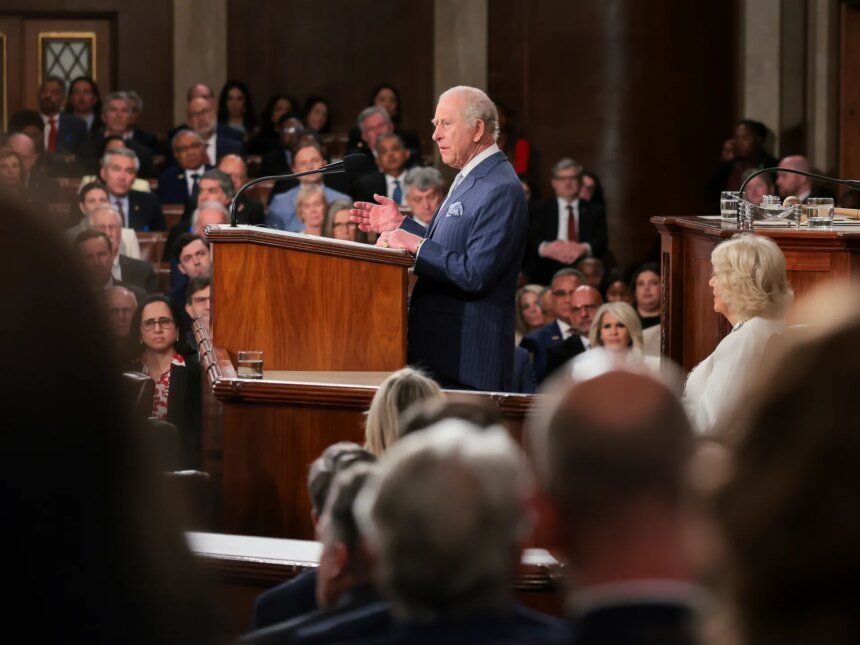
However, the reading presented by several American newspapers of his speech before Congress and of his public stops in the White House converged on one conclusion, which is that the king did not mention the president by name or attack him explicitly, but rather inserted into his speech a series of polite messages that seemed, taken together, closer to a high-protocol rebuke of an American president who is shaking – in the eyes of many – the foundations of the Atlantic alliance and the traditional rules of governance.
Read also
list of 3 itemsend of list
Power constraints
What most attracted American newspapers was not what Charles said about the common history and ancient reconciliation between the two countries, but rather his choice to remind from within Congress that executive authority is subject to checks and balances.
According to the Washington Post, the king deliberately intended to remain above partisan polarization, but he painted a picture of America’s role in the world that contradicts in its essence what Trump is pushing for. He pointed to an independent judiciary, balanced institutions, and diverse societies that are a source of strength, not a place of weakness.
As for Politico, it saw that invoking the Magna Carta was not an innocent historical detail, but rather a clear reminder that even the king himself is not above the law, at a moment when Trump’s opponents accuse the president of expanding executive authority at the expense of other institutions.
In the same context, the New York Times saw that Charles inserted these messages into a speech that was characterized by lightness and discipline, but did not leave much doubt about their meaning.
Ukraine and NATO
The message did not stop at the American interior, as the king – according to the Washington Post and Politico – went further when he stressed that “unrelenting resolve” was still required to defend Ukraine, and recalled that NATO activated Article Five after the September 11 attacks, in an indirect response to Trump’s repeated disdain for European allies and his insinuations that the alliance was no longer doing enough for the United States.
The Wall Street Journal read this part of the speech as a veiled appeal to the American president not to turn his back on the transatlantic alliance, nor on the special relationship with Britain, at a moment when fears are growing in London of a more isolated American mood and less concern for Europe.
As for the New York Times, it noted that Charles went further when he restored his old service in the Royal Navy, weeks after Trump belittled British military capabilities, as if he was responding gently to what London considered repeated public insults.

Special relationship
All of this gains weight because the visit did not come at a moment of clarity, but rather at a time that American newspapers described as one of the most tense times in the Anglo-American relationship in decades.
According to the New York Times, London is still angry about Trump’s pressure on Britain to engage in the war against Iran, and the British have not forgotten his repeated attacks on Prime Minister Keir Starmer nor his mockery of British aircraft carriers.
In the same vein, the Wall Street Journal indicated that Britain does not see the king’s visit merely as a celebration of the 250th anniversary of American independence, but rather as a diplomatic attempt to exploit the position of the crown in softening the position of a president known for his penchant for monarchy, symbolism, and showmanship.
Therefore, in the eyes of these readings, Charles was not celebrating the special relationship as much as he was trying to restore it or at least prevent its further erosion.
Even when, during the state dinner, the king recalled the Suez crisis in 1956 as a “difficult moment” in the relationship, the newspapers read this as a calculated hint that this partnership had previously known deep crises, and that today it is experiencing a new crisis, even if the language and circumstances are different.

Trump is smiling
The irony was that Trump himself did not show public dissatisfaction with the speech, but rather was quick to praise it, as the Washington Post and the Daily Beast reported that the president described Charles’ speech as “wonderful,” and said, in a tone mixed with joking and jealousy, that the king had succeeded in making the Democrats stand up for him, which he himself had not succeeded in achieving.
But this warmth did not erase – in the eyes of the newspapers – the counter-messages contained in the speech, because the warm applause from both parties was not just a greeting to a visiting king, but also a response to terms such as Ukraine, NATO, and restrictions on power, all of which are titles that attendees know lie at the heart of the dispute with the White House.
That is why Charles appeared – in the eyes of some commentators – as if he had used the sobriety of the crown and the dignity of the occasion to say what British politicians do not usually say from this position, and on this stage.

Reproach without Saddam
In the end, Charles’s speech was not a frank confrontation with Trump, nor a rude departure from the traditions of the British monarchy. Rather, it was something more subtle, a complete message said in language that did not appear to hurt but did not hide its intent.
From within Congress, in an official moment of celebration filled with symbols, the king recalled Ukraine, NATO, institutions, and the transatlantic relationship, presenting before the American president another narrative of what America should be in the world. Therefore, in the eyes of many, he did not seem like a guest complimenting his host, but rather a king rebuking him politely.
It is precisely in this that the strength of the visit lies for many observers. Although it did not fix everything, and perhaps it will not fix anything in the long term, it succeeded – even for one day – in reminding Washington of what some of its circles are trying to forget, that the “special relationship” is not based on banquets and smiles alone, but rather on alliances, values and institutions, and that the king, while joking and recalling history, was saying to Trump without naming him: “Do not let what made this partnership collapse.”