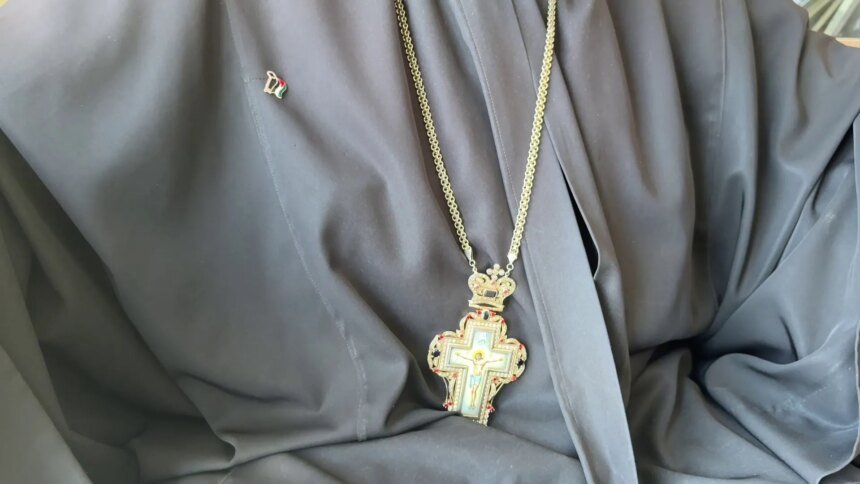
Ramallah- With Italian roots and a solid Palestinian identity, Father Abdullah July stands today as a national voice that crosses sectarian and geographic divisions.
After a long journey in which he moved between the churches of Palestine, July, who sees the Palestinian issue as his spiritual and existential compass, says, “Palestine for me is the dream that we seek to achieve. My church is no longer limited to a place, but rather it is all the streets and all the people.”
Father July does not separate his personal history from the history of his country. He recalls how the Arab Christians received the Islamic call in Damascus, Baghdad and Jerusalem, and how the Christian stood alongside the Muslim in the Battle of Mu’tah, then in the face of the Crusades, all the way to the Great Arab Revolt. He says: “The Christians present today in Palestine are the heirs of these Christian Arabs. Our church speaks and prays in Arabic, and learns and dreams in Arabic.”

Everyone is a target of occupation
But this deep affiliation does not protect today from a targeting that July describes as greater than a passing “occupation,” but rather a “project” that seeks to fragment the region by inciting sectarian strife, and making Christians feel like “the son of a persecuted minority” in their homeland, in preparation for their displacement. July speaks to Al Jazeera Net about repeated settler attacks, and soft social isolation policies that separate Christians from their Muslim neighbors through sectarianly separated schools, neighborhoods, and clubs.
In his speech, he brings to mind the price of the word in the history of the local church, and stops at the name of Bishop Hilarion Capuche specifically, who was arrested by Israel and thrown into prison and then exiled because of his defense of the cause of his people: “I remember Bishop Capuche – may God have mercy on him – who defended his people and paid the price with imprisonment and exile.”
In the same context, he also recalls the name of the martyr journalist Sherine Abu Aqla, “She is from our church and was active, and I never asked if she was a Christian or not? Because she is a daughter of Jerusalem and a daughter of the cause,” indicating that national affiliation precedes any sectarian classification for him.
Father July, who holds the position of advisor in the Palestinian presidential office, does not hide that his local church itself is experiencing a division in discourse, between churches “administered by Palestinian Arabs” and others “administered by foreigners with a different discourse.” He believes that his religious duty goes beyond the borders of his sect. “It is my duty to protect Al-Aqsa, just as it is a Muslim’s duty to protect the Church of the Holy Sepulcher. We are not prisoners of a sect or sect, because God is the Lord of the worlds.”
He also recalls how Christians and Muslims were displaced together in 1948, and were dispersed in Lebanon and elsewhere, where some sometimes tried to separate Christians into their own camps, such as the “Dbayeh Camp” in Lebanon, while the rest of the camps remained mixed, and he concludes: “We are the children of this people, and the price must be paid for the sake of survival and unity.”

The attacks affect the land and existence
The head of the International Jerusalem Center and the founder of the Islamic Christian Organization for the Support of Jerusalem and the Holy Sites, Hassan Khater, believes that attacks on Christian holy sites are subject to the same approach as targeting their Islamic counterpart, as it is “targeting the Palestinian people, both Muslims and Christians.”
He told Al Jazeera Net that a large part of the attacks of the first Nakba were not documented at all, as they affected more than 500 destroyed villages, but the attacks recorded after 1948 exceed 110 to 120 documented attacks, between burning churches, robbing monasteries, stealing religious jewels, and looting contents.
However, what is more dangerous, as Khater describes it, is the confiscation of church property and extensive lands, through fraud and forgery operations that affected churches, including the Orthodox, whose lands in Palestine may exceed 80 thousand dunums (a dunam = 1,000 square metres), and “there are still big question marks” about their fate.
Khater details this confiscation mechanism by saying that the churches “have large areas of land, real estate, and private endowment properties in them,” and that “Israel defrauded them and confiscated much of it, and it is still confiscating it today,” through “deals” and “forgery” that specifically targeted the Orthodox Church in Jerusalem in recent years.
He acknowledged that ambiguity still surrounds the fate of these properties, even within the Christian ranks: “Even among our Christian brothers, there is no single answer to this issue,” adding, “A lot of church properties in the Palestinian territories have been looted.”
Displacement is a systematic policy
Khater directly links this systematic plundering of the land to the actual displacement of the population, considering that talking about empty church buildings is worthless as long as their owners are gone. He wonders, “What is the benefit of talking about existing empty buildings that have no value and no presence in them at all?”
This continued Israeli restrictions are “a systematic policy that led to the displacement of most Christians in Palestine,” according to Khater, and he directly links this to the demographic decline, saying: “If before 1948 Christians numbered from 11 to 14%, today their number does not exceed 1%, and perhaps less,” stressing that the stone remaining without its owners is in essence “one of the greatest forms of aggression against the Christian presence in Palestine.”
Khater believes that the daily attacks on Christian clergy, from spitting and throwing eggs to beatings in the streets of Jerusalem, have become so frequent that they are not even counted among the documentation lists, in addition to the closure of the Church of the Holy Sepulcher and the prohibition of celebrating Palm Sunday on repeated occasions.
He concludes that these attacks are no longer “reactions to extremist organizations, but rather organized policies of the occupying state,” which officially defines itself as a “Jewish state,” in which neither a Muslim nor a Christian has any right.

Diversity of attacks, same goal
From his position as a member of the Supreme Presidential Committee to follow up on church affairs in Palestine, Omar Awadallah places what is happening in a broader context: an Israeli attempt to transform the political conflict into a religious conflict between Jews and Muslims. He told Al Jazeera Net, “We are the living stones of the Palestinian land and the Palestinian people.”
He explains that Muslims and Christians are both harmed by the occupation policies, and Israel has greatly focused its pressure policies to displace Christians, within the framework of a project whose main title is either extermination or forced displacement. He gives an example with terrifying numbers: “If 100,000 Christians are displaced out of 200,000, this is a very huge percentage and makes a difference.”
The most prominent attacks documented by the committee, according to Awadallah, include:
- targeting people; Women and nuns are targeted because of their clothing.
- The repeated practice of “spitting” on Christian men and women in the streets of Jerusalem.
- Exploiting the land in Jerusalem, Bethlehem, Beit Jala, and Taybeh, leading to its confiscation, such as attempts to control lands belonging to the Greek Orthodox Patriarchate in the town of Silwan.
- Direct attacks on churches, burning and breaking crosses, while “Israel’s greatest crimes began targeting the Baptist Hospital” in the Gaza Strip.
A step for protection and defense
Regarding efforts to confront this targeting, Awadallah explains that the primary mission of the Supreme Presidential Committee is “to protect the Christian presence in Palestine, and then in the East,” because the region is “homogeneous and there is a common historical legacy,” by “supporting Christian institutions, supporting our people to survive,” and creating “special projects” in education, health, and housing, in addition to seeking to pass “laws that protect them and their property.”
He points out that the committee, headed by Dr. Ramzi Khoury, holds periodic meetings with “international institutions concerned with the affairs of churches in the world,” and organizes foreign tours to explain the reality of Palestinian Christians, pointing out that some countries “become more attentive when we say that Christians are persecuted, killed, and arrested, and their homes are being demolished, and the wall is stealing their land.”
Awadallah reveals a parallel battle that the Presidential Committee is waging on the intellectual level, to confront what he calls “Zionist Christianity,” a movement that he believes “came to change even the Christian religion,” stressing that this movement “has no connection to the Christian religion or what our Master Jesus, peace be upon him, brought.”
He concludes by stressing that the issue is being raised internationally from the perspective of the unity of destiny between Muslims and Christians, not as a separate sectarian issue, so that “this issue remains on the international and local Palestinian agenda.”
The numbers document the decline
On the eve of the Palestinian Nakba in 1948, the number of Christians in historic Palestine was approximately 145 thousand people, or about 7.6% of the total population of about 1.9 million people at the time, according to demographic estimates from before the occupation.
Today, according to the general population census conducted by the Palestinian Central Bureau of Statistics in 2017, the number of Christians in the West Bank, East Jerusalem, and Gaza Strip combined does not exceed 47 thousand people, or only about 1% of the population of the Palestinian territories, after their percentage was estimated at about 8% in 1946.
According to estimates by the Supreme Presidential Committee for Follow-up of Church Affairs in Palestine, their number today reaches 50 thousand people in the West Bank and Jerusalem alone, most of them concentrated in the Bethlehem Governorate (22-25 thousand), followed by Ramallah and Al-Bireh (about 10 thousand), then East Jerusalem (8-10 thousand), while their number in the Gaza Strip did not exceed a few thousand before the last war of extermination, and declined further as it continued.
Since October 7, 2023, the Latin Patriarchate of Jerusalem and local church institutions have documented a series of attacks that affected all three churches in Gaza:
- The Baptist Church adjacent to the Baptist Hospital, which was bombed by Israel days after the genocidal war, leaving hundreds dead and wounded, according to the health authorities in Gaza, while the Israeli army denied responsibility for the explosion.
- St. Porphyrios Orthodox Church, where about 18 people sheltering there were killed in the same month.
- The Holy Family Latin Church, inside which an Israeli sniper killed a mother and her daughter on December 16, 2023, before it was subjected again to tank shelling on July 17, 2024, killing 3 civilians and wounding about 14 others, including the parish priest. The Israeli army then announced the opening of an investigation into the incident.
In the West Bank, the Presidential Committee recorded dozens of settler attacks on churches, monasteries, and Christian cemeteries in Bethlehem, Beit Jala, and Taybeh, in parallel with continued attempts to seize church land in Jerusalem, most notably in the Silwan neighborhood.