Published On 4/27/2026
|
Last update: 16:52 (Mecca time)
At dawn on Saturday, a car bomb, driven by a suicide bomber, stormed the security checkpoint of the military city of Kati, located about 15 kilometers northwest of Bamako, where interim President Assimi Goeta resides, and then exploded in front of the house of Defense Minister General Sadio Camara. The violent explosion completely destroyed the minister’s residence, and his fate remained unknown for an entire day, until financial government sources confirmed the news of his death, yesterday, Sunday.
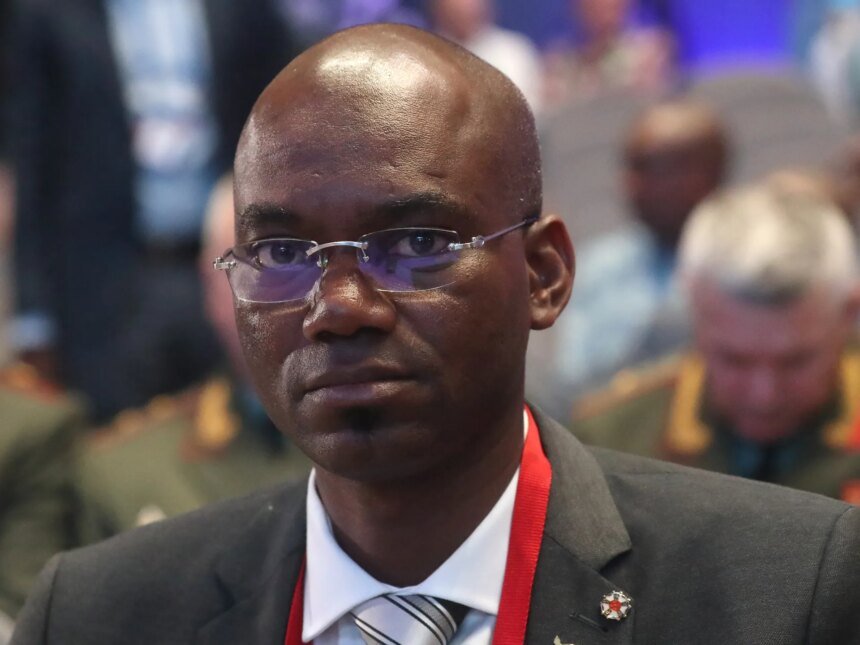
Thus, the curtain was drawn on the career of one of the most prominent officers of the military generation that has been ruling Mali for five years. Al Jazeera correspondent Nicholas Hack described him as one of the most influential figures within the ruling military leadership, and he was widely viewed as the backbone of the military council and the godfather of its move toward Moscow.
Sadio Camara was born on March 22, 1979 in the same city where he was killed, which is the stronghold of the Malian army and the symbol of its successive coups. He graduated from the Joint Military School, and when the August 2020 coup took place, he was receiving military training in Russia.
This detail of the man’s biography later gained importance. According to The Africa Report magazine, Kamara chose the Russian destination after poor results in the entrance exams for Western military colleges. He traveled to Moscow in late 2019 as part of a three-year training program, but the coup in which he participated in 2020 cut short his completion of the program.

From a coup to a “coup within a coup”
In August 2020, Kamara – along with Assimi Guita, Malick Diao and Ismail Wague – participated in the overthrow of elected President Ibrahim Boubacar Keita. In October of the same year, he was appointed Minister of Defense in the transitional government headed by Muktar Wan. But he did not last long in office. In May 2021, he was excluded from the new government formed by interim President Bah Ndaw.
This exclusion was the spark that set off what is known as a “coup within a coup.” Goeta moved and arrested the president and his government in May 2021, then returned Camara to the Ministry of Defense on June 11 of the same year. Since that date, he remained in his position without interruption until his death, establishing his image as an indispensable partner for Goeta, and indeed the maker of his own military legitimacy.
Moscow arm in Bamako
Camara contributed to formulating the largest strategic transformation in the contemporary history of Mali, by breaking with Paris and “plunging into the Russian embrace,” as the French press describes it. A sanctions document issued by the US Treasury Department in July 2023 indicates that Kamara planned and organized the deployment of the Wagner Group in Mali, and made multiple visits to Russia in 2021 to conclude the agreement with Bamako. American sources estimated at the time that about 2,000 Russian mercenaries were active in the country.
According to The Africa Report, Kamara was the architect of the council’s military strategy, and devoted a hard line against armed groups, especially since the strengthening of the partnership with Russian actors. When “Wagner” was transformed in mid-2025 into the “African Corps” placed directly under the command of the Russian Ministry of Defense, Camara remained the approved link between Bamako and Moscow, while all French soldiers and UN forces were expelled during his reign, and the “MINUSMA” mission closed its doors permanently.

The war of the wings within the military council
The relationship between the two men – Goeta, the president, and Camara, his powerful minister – was not always harmonious, and in recent months, the silent rivalry turned into an almost open struggle behind the scenes. In August 2025, dozens of officers, including two generals, were arrested on charges of involvement in an attempted coup, many of them from the National Guard led by Camara. Kamara has become seen in Bamako’s narrow military circles as a growing opponent of President Goeta, despite their shared history of two coups.
According to the Financial Africa website, Goeta then announced the recruitment of 124,000 new soldiers as part of “Operation Dogokoloko,” which observers saw as the building of a parallel force outside the control of the Minister of Defense. A number of those close to Kamara were also arrested, including General Famuki Kamara, Chief of Staff of the National Guard, and this was interpreted as an actual rupture between the two heads of military authority.
What does his absence mean?
The assassination of Camara opens three thorny files at once:
- A leadership vacuum at the height of the battle: The man was not only Minister of Defense, but he was the architect of the relationship with Moscow, the distributor of sensitive positions to those loyal to him, and the actual supervisor of the file of operations in the field. Therefore, his absence is expected to have a significant impact on the Ministry of Defense at the height of an unprecedented coordinated attack launched simultaneously by the “Jama’at Nusrat al-Islam wal Muslimin” group and the “Front de Liberation de Azawad” in Kati, Bamako, Gao, Kidal and Sevare.
- Re-engineering the military junta: Goeta finds himself facing two contradictory possibilities. Either he will benefit from the absence of a rising competitor to strengthen his individual grip, or he will suddenly find his inner circle facing a vacuum that is being fought by figures of varying weight: the head of the National Transitional Council, Malick Diaw, the Minister of Reconciliation, Ismail Wague, the Director of Intelligence, Modibbo Kony, in addition to the Prime Minister, General Abdullahi Maiga. In both cases, redistributing roles in the midst of an open battle is extremely dangerous to the cohesion of governance.
- The symbolism of the strike: The jihadists and Tuareg did not target the Minister of Defense inside a distant capital, but rather in the Malian army stronghold of Kati, where Goeta himself resides. This strike does not only attack one man, but also the myth of “Fortress Katy” on which the military council’s security contract has been based since 2020, and it publicly raises a question about the ability of this council to protect its senior leadership, as well as its citizens.
Will the killing of Sadio Camara, the architect of the Russian alliance and the driver of the 2020 and 2021 coups, mark the disintegration of the solid core of the Bamako Military Council, or a stage that will push Goeta to take more control of the decision in the face of an enemy knocking on the doors of the palace? An open question in a country that has experienced repeated security crises over the past fifteen years.