Published On 4/27/2026
|
Last update: 4/28/2026 00:00 (Mecca time)
In the heart of the Old City of Jerusalem, where stone alleys intersect and stories intersect as do houses, memory stands as a witness to a century of transformations that did not change the place as much as it changed its narrative.
A few steps away from Damascus Gate, the story begins, as told by Al Jazeera’s correspondent from Jerusalem, Mona Al-Omari… the story of a city that is not read from its modern maps, but from the faces and voices of its residents.
Mona Al-Omari says at the beginning of her report: “If you had stood 100 years ago at this famous intersection in the Old City of Jerusalem, which is fifty meters from Damascus Gate, and asked people: Where is the Jewish Quarter, the Christian Quarter, or the Muslim Quarter located? They would have looked at you with a look of amazement: Where did you get these names from?”
With this phrase, it opens a wide door to understanding a city that did not define itself according to the templates that were imposed on it later.
A resident of the Old City confirms, in a testimony that summarizes the changes of time, and how the Jews were forcibly replaced in the homes of Arabs, saying, “We are here, we are only the Arabs in this house, this house, and in a house a little while ago… at the bakery. This area was all Arabs, who is this place now? The Jews.”
Simple words, but they carry the weight of an entire century of demographic and political changes.
Division of neighborhoods
Mona Al-Omari explains that “the idea of dividing neighborhoods in the Old City based on religion is a new idea that came with the Europeans by analogy with the ghetto neighborhoods in which Jews were forced to live in Europe,” adding that this division remained in effect serving the “divide and rule” policy that served the policies of the British Mandate and the Israeli occupation.
In a city like Jerusalem, which grew up on a natural intermingling of people and beliefs, separation has never been easy or even possible.
In the vicinity of Al-Aqsa Mosque, Islamic neighborhoods extend, while churches are clustered around the Church of the Holy Sepulcher, but urban overlap remains the dominant feature. Mona Al-Omari points out, explaining: “These mosques are located in the Christian neighborhood, and these churches are lined up as an extension of the Path of the Passion of Christ located in the Muslim Quarter,” in an image that reflects a complex reality that transcends any theoretical division.
As for what is known today as the Jewish Quarter, Al-Omari points out that until 1948, it did not exceed 13% of the Honor Neighborhood, and that part of it was houses rented from Muslim property. But what happened after that radically changed the features of the place, and she continues, “Later, after the setback, the Israeli occupation demolished the Al-Maghariba neighborhood and the surrounding non-Jewish properties within the Neighborhood of Honor.”
Al-Omari Mosque
Amidst this transformation, the Omari Mosque stands as a silent witness. Mona Al-Omari says, “This Al-Omari Mosque is the last witness to what was known here as the Neighborhood of Honor. The neighborhood was demolished and the Jewish Quarter was built in its place, and next to it is this synagogue with a dome known as the Dome of Tiferet Israel.”
But the story does not stop at redrawing geography, but rather extends to a complex legal and humanitarian conflict. In the early 1970s, Israeli forces stormed the home of the Burgan family, which had owned its home for 200 years, and tried to force them to evacuate. The family barricaded themselves with proof of their ownership of the property dating back to the Ottoman and Mandate periods.
Although the Supreme Court recognized the family’s ownership, it included a clause stating, “For the sake of coexistence in the Old City, non-Jews are prohibited from living in the Jewish Quarter.”
A legal paradox that sums up the essence of the conflict, especially when compared to a later decision to evict a Palestinian family from their home outside the borders of the same neighborhood.
In this context, lawyer Muhammad Dahlah, an expert in constitutional law and a specialist in settlement issues in Jerusalem, explains that “these settlement outposts have a high cost because they are located within Arab and Islamic neighborhoods,” noting that “settlers do not live in these outposts unless there is guarding on more than one level: 24-hour cameras… in addition to heavy police guarding seven days a week.”
He added, “This is costly for the settlement associations themselves and also for Israeli taxpayers.”
Despite all this, Nazmi Al-Jubeh, a researcher specializing in Jerusalem affairs, believes that the settlement project did not fully achieve its goals. He says, “This place was not attractive for Israelis to live in,” explaining that the majority of the buildings are either religious schools with temporary students, or are owned by wealthy Jews living in different regions of the world, which makes the neighborhood empty of residents except for visitors and tourists.
The truth in numbers
The numbers reveal another side of the story. Mona Al-Omari points out that 192 properties are the number of Jewish properties monitored by the Jordanian government between 1948 and 1967, which represents only 2% of all properties in the Old City. However, control later expanded through various means, including searching old documents to prove previous ownership.
In the face of these pressures, one of the real estate owners, known as “Abu Khadija,” recounts his experience, saying: “The first offer we were offered was for 98…we rejected. The second offer…we rejected. The third offer was worth $40 million.”
Then he asks his painful question: “Oh good people, how do we want to sell something that we do not own? How do we want to sell something that is an Islamic endowment? We are just guards here.”
Mona Al-Omari adds that the battles for existence inside the Old City are united by a war under the title “demography and control of public space,” a war that is not only fought with laws or real estate, but with symbols and identity.
In this context, Muhammad Dahla says: “The city’s arches… the language of the people… the city’s minarets… the sounds of the call to prayer… all of this speaks of an Arab-Islamic civilization,” adding that “the occupation is trying to highlight the Israeli identity through fabricated symbols: flags, weapons, and soldiers.”
Matalat War
The confrontation does not stop in the alleys, but extends to what Al-Omari describes as the “War of the Mountains.” She recounts that, “More than ten years ago, a delegation from the Israeli Ministry of Tourism stood and explained about Jewish identity,” and one of those present responded: “No one can be deceived by this,” referring to the clarity of the city’s identity from any vantage point.
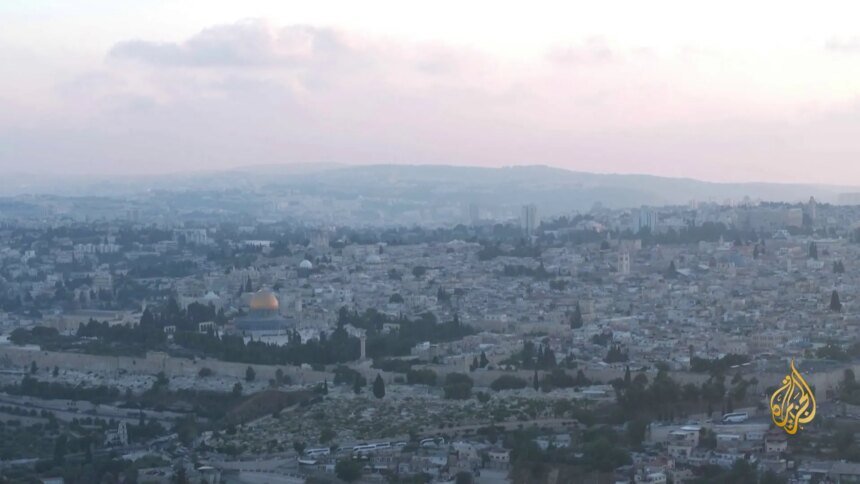
She continues: “Years later, two Jewish domes appeared on the scene: the Dome of Tiferet Israel… and the second was the Dome of the Synagogue in the Temple Destruction, which is only 300 meters away from the Dome of the Rock,” in an attempt to reshape the city’s visual landscape.
But despite all these transformations, the relationship between man and place remains difficult to change. One of the residents says: “There is no one to sell a house here in Jerusalem… Every person wishes to live under a staircase in the Old City… The important thing is that he does not come out.”
Thus, the Old City does not appear to be just a geographical space, but rather a continuous story, written every day between one stone and another, between a memory that tries to remain, and a reality that seeks to reformulate it.
It is the story of a city that still resists being reduced to the names of its neighborhoods, or being rewritten outside of its original spirit.