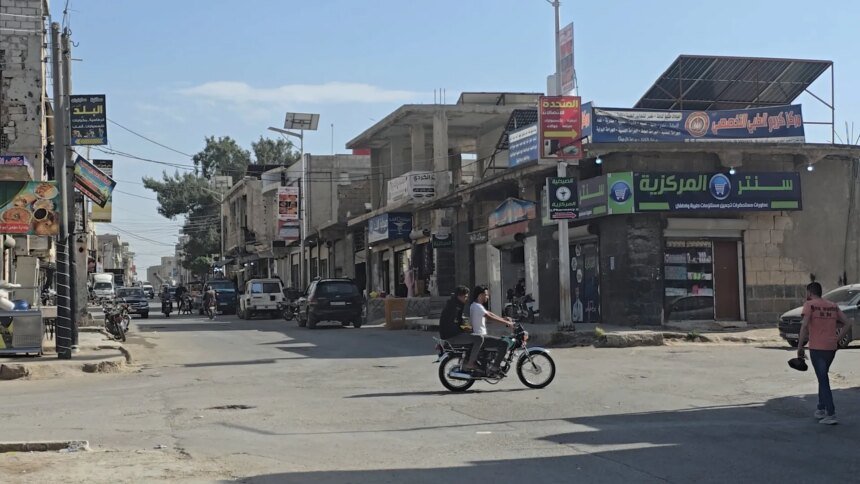
Daraa- “I never imagined that I would see him behind bars,” with these words Muawiya Sayasneh, one of Daraa’s children who was arrested in 2011, summed up his feelings as he sat inside the trial room of Atef Najib, the former head of the political security branch in the city, in a scene long awaited by many victims for more than a decade.
Sayasna told Al Jazeera Net that he was among the children who were arrested and tortured at the beginning of the protests, pointing out that this moment was “like a dream” for him. He added that he left Daraa for Damascus one day before the session was held, traveling about 100 kilometers, for fear that he would miss attending the trial of those directly responsible for his suffering.
He recalled the features of that stage, which began with writings on the walls of a school in the city, before it turned into a spark of widespread protests following the arrest and torture of a number of children, an incident that left a deep impact on the memory of the city and its residents.

The beginning of justice
In parallel, the case of the child Hamza Al-Khatib returns to occupy a prominent place in the conscience of Syrians, as one of the most symbolic cases in collective memory.
Sarraqa Al-Khatib, Hamza’s brother, said in his interview with Al Jazeera Net that he followed the proceedings of the trial, expressing his satisfaction with the step that “pleases the mind,” indicating a state of optimism prevailing among the people that justice can be achieved, and that this trial represents the beginning of a broader path to hold all those involved in the violations accountable.
He continued that Atef Naguib was considered one of the most prominent officials responsible for the torture of his brother, explaining that the practices of the security services at the time, including the torture of children, were among the main factors that sparked the protests.

Evoking pain
For Amina Abazid, the trial of Atef Najeeb was not a passing event, but rather brought to the forefront painful details from the killing of her nephew Murshid, who lost his life during the storming of Daraa al-Balad in April 2011.
Abazid stated that Murshid, who was not more than 17 years old, had been suffering from cerebral palsy since birth, and his mental age was not more than 4 years, before he was hit by bullets during the storming.
She explained that he was transferred to Al-Sanamayn Hospital under complicated circumstances, where she accompanied him for two days, before security personnel asked her to leave the place, after which there was no news of him completely.
She added that the family received a severe shock on May 24, 2011, when his body was found inside the refrigerator of Daraa National Hospital, noting that there were “unnatural” effects on his body, including a stitch in the abdominal area and the absence of some internal organs.
She confirmed that the family is today following the proceedings of Atef Naguib’s trial, and sees it as the beginning of restoring the rights of a child who “had no connection to what happened,” and that his suffering was doubled between the illness and the harsh conditions that surrounded him.

The beginning of a long path
For his part, Mazen Abu Nabout, a resident of Daraa Al-Balad, told Al Jazeera Net that he followed Atef Najib’s trial session on television, considering that the latter “is responsible for the first massacres in the Syrian revolution, especially in Daraa Al-Balad, most notably the Al-Omari Mosque massacre in March 2011.”
Abu Nabut added that he expected the trial to proceed at a faster pace, expressing his surprise at the decision to postpone, and stressing the need to speed up judicial procedures.
He also stressed the importance of the trial revealing the parties that issued orders to shoot civilians, which led to the deaths of hundreds at the beginning of the revolution.
He affirmed his confidence in the Syrian government and its ability to ensure a fair trial, but at the same time he called for not prolonging the procedures and accelerating the path of justice “in a way that contributes to healing the hearts of the families of the victims who were shot by security forces affiliated with Atef Najib.”

A general mood between hope and anxiety
Atef Najeeb’s trial session did not pass as passing news in Daraa, but rather became the focus of daily conversation in the streets, councils, and among families, where residents expressed mixed feelings that combine relief at the start of the process of accountability, and concern that the proceedings will drag on without reaching decisive results.
The session brought back memories of the first years of the protests, with its details widely circulated on social media and among families.
Moayad Abu Aoun, a resident of the city of Daraa, told Al Jazeera Net that his feelings during the follow-up of the session “were contradictory between joy and sadness.”
He explained that the feeling of joy stems from the accountability of one of the most prominent symbols of the regime of ousted President Bashar al-Assad, who was responsible for several massacres that claimed the lives of dozens of civilians at the beginning of the revolution, but at the same time this moment brought back all the painful memories, as if they had happened all over again.
For his part, Milad Zatima, speaking to Al Jazeera Net, believes that the trial of Atef Najib is an “important but insufficient step,” calling for a full disclosure of the chain of responsibilities, and not just trying one person. He pointed out that the families are looking forward to knowing who issued the orders to kill their children, who carried them out, and who should be held accountable, expressing his hope that this trial will constitute the beginning of a broader path of justice that does not stop at this case.
Who is Atef Naguib?
Atef Najib is the cousin of the ousted Syrian President Bashar al-Assad. He served as head of the Political Security Branch in Daraa until 2011, when the agency he led played a prominent role in pursuing demonstrators, especially during the incident of arresting children, which constituted a pivotal turning point in the course of events in Syria.
This incident sparked a widespread wave of popular anger at the time, and demands rose for the release of children and for those responsible for torturing them to be held accountable, before the protests expanded in Daraa and later extended to other regions.
In January 2025, Public Security personnel affiliated with the Syrian Ministry of Interior were able to arrest Atef Najeeb during a security campaign in Latakia Governorate, in a step that was considered one of the most prominent arrests of former security officials.