Published On 4/27/2026
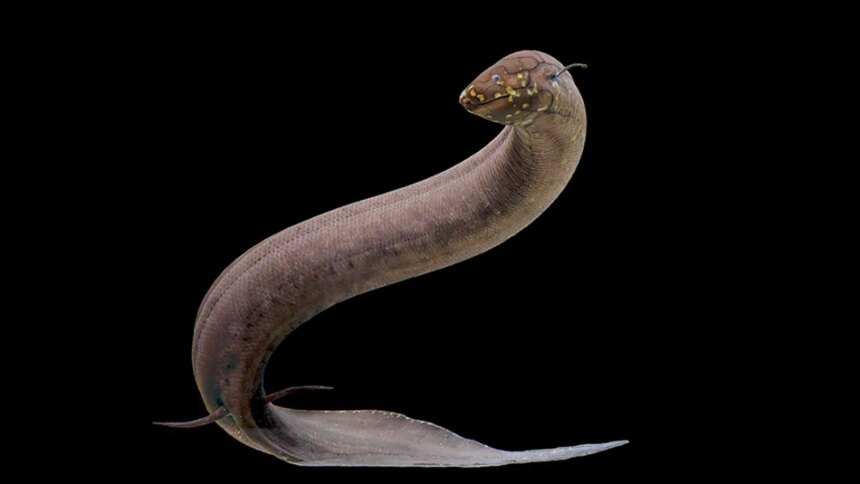
Deep in the tranquil waters of South America lives a fish known as the South American lungfish, which has the ability to breathe with rudimentary lungs and also possesses one of the largest genomes ever observed in an animal world, about 30 times larger than the human genome, which opens a new window to understanding the complex relationship between DNA size and biological complexity.
The size of the genome of this fish is about 91 billion genetic units (ribonucleic acid base), compared to only about 3 billion in humans. Even more amazingly, it has 19 chromosomes, 18 of which (individually) are larger than the entire human genome.
But the scientific paradox here is that this huge size does not mean that it is a more complex organism, as the actual number of genes that make proteins is not much different from humans.
The secret of this large genome lies in “replication.” A large part of it consists of repetitive genetic elements known as “jumping genes,” which are sections of DNA that are able to copy themselves and spread within the genome over time.

The C-value paradox
This discovery revives an old question in biology known as the C-value paradox, where scientists have not yet found a direct relationship between genome size and the complexity of an organism. While we might expect more complex organisms to have larger genomes, the reality is the opposite: relatively simple organisms, such as some fish or amphibians, have many times more DNA than humans.
This contradiction has prompted scientists to rethink the function of the genome, as it has become clear that the bulk of it does not participate in encoding proteins, but rather consists of repeated sequences and mobile elements that have accumulated over time through ancestors.
So far, there is no clear evidence that this huge size gives the fish a direct advantage. On the contrary, it may be biologically expensive, because copying DNA of this size requires more energy and time during cell division.
However, this inflation may have indirect benefits, such as providing raw material for genetic adaptation and thus increased resilience to extreme environmental changes that could wipe out another organism, but this remains within the realm of hypotheticals.

Various objects
The South American lungfish is not the only one that confronts scientists with the mystery of the “C-value paradox.” There are other creatures, no less strange, that show that the size of the genome does not necessarily reflect the complexity of the organism.
The most prominent of these examples is the axolotl salamander, an amphibian famous for its ability to regenerate limbs, which has a genome approximately 10 times larger than that of humans.
In the plant world, the paradox becomes more acute with the Paris japonica plant, which carries one of the largest genomes ever known, exceeding that of humans by dozens of times. However, it is just a simple herbaceous plant in appearance and function, which raises the question of the feasibility of this genetic amplification.