Published On 4/26/2026
|
Last update: 13:22 (Mecca time)
The judge of the Criminal Court in Damascus decided to postpone the trial session of Atef Najib, head of the Political Security Branch in Daraa Governorate, and a number of figures of the former regime, until the tenth of next May, as part of the first cases in the transitional justice process in Syria.
The postponement decision came after a session held at the Palace of Justice in Damascus, which included a detained defendant and others fugitives, according to what the judge announced.
The trial began amid tight security measures and the presence of local and international media, and witnessed the presence of the families of the victims coming from several governorates, most notably Daraa.
Amid tight security measures, former security official Atef Najeeb was transferred to the Palace of Justice in Damascus, where security forces were deployed and barriers were set up on the roads leading to the court, while those entering the session hall were subjected to a thorough search that lasted a long time.
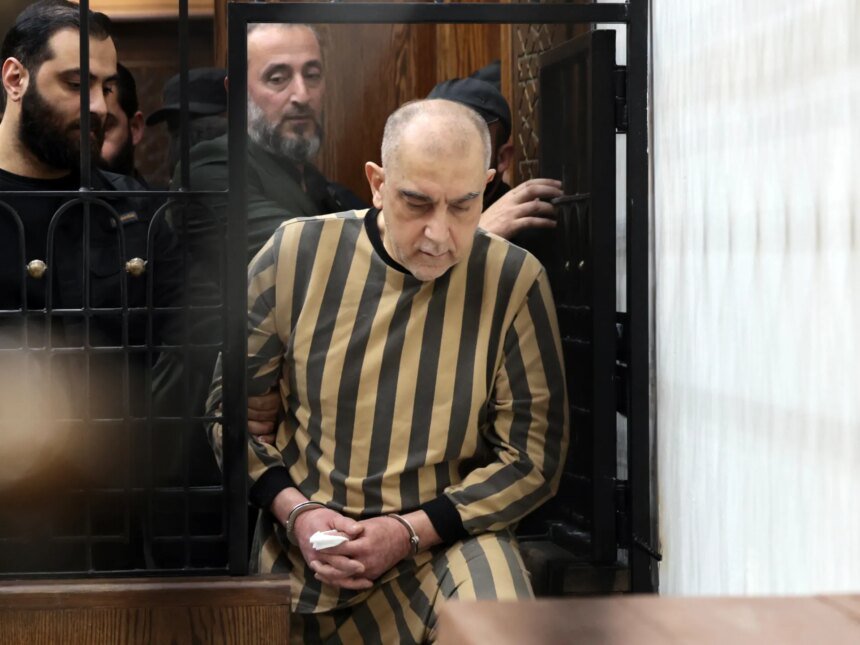
Upon his arrival, Naguib appeared inside a security vehicle designated for transporting detainees, wearing a striped prison uniform, before he entered the Palace of Justice building to complete the session procedures.
The trial of the head of the former Political Security Branch in Daraa is the first public trial of a prominent official in the regime of ousted President Bashar al-Assad.
Minutes before the start of the session, Naguib appeared in the dock, and both Bashar al-Assad and his brother Maher were called in absentia as defendants in the case.
Najib is a relative of ousted President Bashar al-Assad, and previously served as head of the Political Security Branch in the Daraa Governorate in the south of the country, the region that witnessed the start of popular protests in 2011. Najib was accused of being responsible for a campaign of repression and widespread arrests of protesters in that early stage of the revolution.
Transparency and independence of the judiciary
A spokesman for the Syrian Ministry of Justice told Al Jazeera’s correspondent directly from inside the Justice Palace in Damascus that this trial came after all necessary legal procedures had been completed.
He added that this type of case requires time to collect evidence and testimonies and complete the legal process, noting that holding the trial publicly comes within the framework of enhancing transparency and independence of the judiciary, and within the transitional justice stage.
The Syrian official confirmed that this session represents the beginning of a series of trials that will not stop, and include a number of those involved in serious violations.
“blood guardians”
A number of the victims’ families came to the courtroom to follow the proceedings of the session, as some of them confirmed that they had come from Daraa as guardians of blood, demanding justice, while a number of them called for the execution of Atef Najib by hanging in the courtyard of the Omari Mosque in Daraa, as it was the place that witnessed the first massacres at the beginning of the events.
Since the fall of the previous regime in December 2024, a number of its symbols have been arrested, while a number of them have fled to other countries, and the authorities are seeking to recover the fugitives, led by the ousted president, who took refuge with a number of his aides in Russia.
The new administration that came to power in December 2024 announces, from time to time, the arrest of military and security officials from the previous regime, involved in committing crimes against Syrians during the years of the revolution.