Published on 4/22/2026
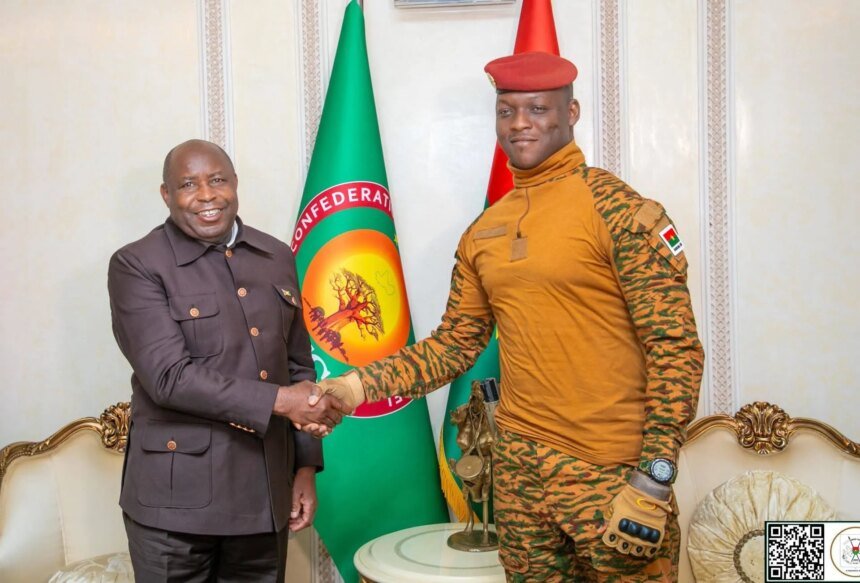
Burundian President Evariste Ndayishimiye – the rotating president of the African Union – pledged to submit an “objective” report to his African counterparts with the aim of strengthening cooperation with the Sahel countries, at the conclusion of a visit to Ouagadougou that he began last Monday, during which he held talks with the President of Burkina Faso, Captain Ibrahim Traoré, the rotating president of the Sahel countries, which includes Mali, Burkina Faso and Niger.
The meeting that brought together the two rotating presidents of the two African organizations at the Burkinabe presidential palace led to discussing ways to build a “strong bridge” that reconnects the Burkinabe people and institutions with the African Union, and redefines the relationship with the coalition, according to a statement by the Burkinabe presidency, while Ndayishimiye praised the “cohesion of Burkinabe society” and its support for the authorities in the face of terrorism.
The visit, which was officially described as “friendship and work,” goes beyond its protocol character to touch on an effort to reconnect what has been cut off between the African Union and Burkina Faso since its membership was suspended following the January 2022 coup.

From commenting to trying to merge
The African Union had suspended Burkina Faso’s participation in its activities in early 2022, after the overthrow of President Roch Kabore, stipulating a return to the constitutional system to lift the suspension. The gap deepened with the September coup that brought Traoré to power, and then with the withdrawal of Ouagadougou – along with Bamako and Niamey – from the Economic Community of West African States (ECOWAS) and the establishment of the Sahel Alliance.
Despite previous attempts, diplomatic channels remained almost frozen, as the former head of the Union Commission, Moussa Faki, visited Ouagadougou in February 2023, to explore a road map for a return to constitutional rule, and the Union also sent its envoy Antonio Tite on a reconnaissance mission in 2025, but without achieving an actual breakthrough.

Omnidirectional messages
The visit acquires additional connotations with the fact that Ndayishimiye also holds the position of Special Envoy to the Sahel region since 2025, which gives him a double mandate between the presidency of the Union and the mediation mission.
Observers believe – according to what was reported by the West Africa Weekly website concerned with West African affairs – that his personal move reflects the Union’s willingness to engage directly with the Sahel Alliance, instead of leaving the issue exclusively to the Western regional bodies whose relations with Burkina Faso have practically been severed.
However, the gap remains large between the “rehabilitation” speech and the decision to lift the suspension, as the union’s founding charter stipulates the return of constitutional rule, while the transitional authorities in Ouagadougou are betting on a sovereign path that places security priority in the face of armed groups, and reformulates external partnerships away from traditional ECOWAS calculations.
Open bet
The bet depends on what Ndayishimiye will bring to the next African summit, and on his ability to transform the language of openness he demonstrated in Ouagadougou into institutional decisions that will end the isolation of Burkina Faso, and perhaps Mali and Niger later.
However, this path collides with the legacy of sanctions whose effectiveness has been proven limited by studies of the Institute for Security Studies (based in South Africa), as the suspension of membership since 2019 has not prevented the recurrence of coups in Sudan, Mali, and Burkina Faso itself, which makes the “recognition of the reality on the ground” approach called for by the Burundian president an option that may be the most realistic for rebuilding bridges, even if its institutional impact is delayed.