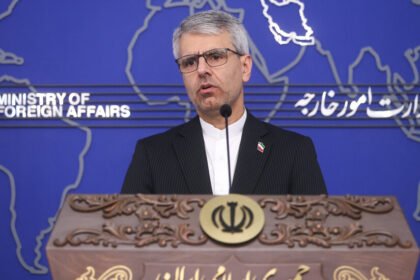
US President Donald Trump’s announcement of canceling his country’s delegation’s visit to the Pakistani capital, Islamabad, has reshuffled the issue of tense relations with Iran, and revealed the extent of the discrepancy in narratives and estimates between the parties concerned, at a time when the paths of war and negotiation are intertwined, and doubts are rising about the feasibility of any diplomatic path at the current stage.
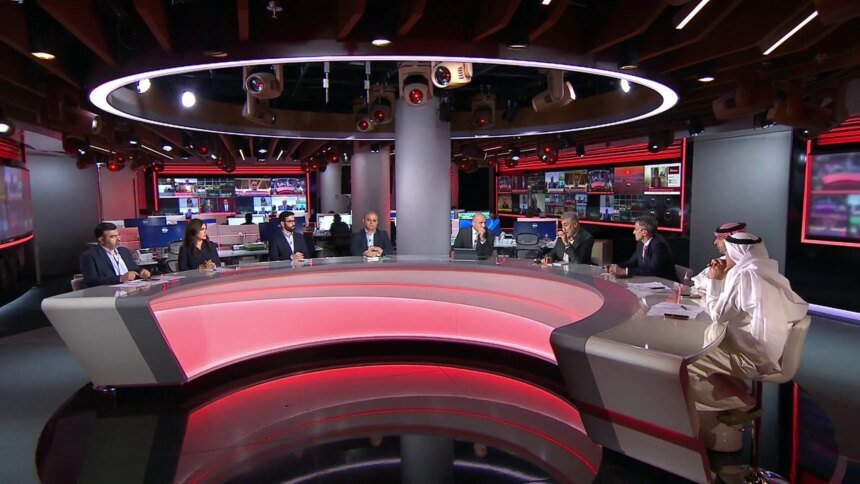
At the beginning of the discussion, the presenter of the “Discussion of the Hour” program, Hassan Jammoul, presented a general picture that reflects the state of stalemate that governs the scene, describing it as a state of “no war, no peace, no negotiations, and no agreement,” indicating that this state appears to be the only point on which everyone agrees, in addition to the continued manifestations of indirect escalation such as the mutual detention of ships.
Jammoul wondered about the reasons for the failure of the second round of talks, and how the visit of Iranian Foreign Minister Abbas Araghchi moved from the framework of a diplomatic tour to a station in which responses were provided that Washington described as “nothing.” He also wondered about the source of the confidence with which Trump had previously spoken about his expectation of an Iranian offer that would meet American demands, before he came back and later confirmed that he did not know who was truly responsible for the decision inside Iran.
In this context, Ambassador Joey Hood, former US Deputy Assistant Secretary of State, presented two possible explanations for what happened, based on his diplomatic experience, as he believed that one of the reasons may be a misunderstanding in communications, especially since the bulk of communication between the United States and Iran takes place away from the limelight, which opens the door to conflicting messages.
He also did not rule out that Trump received signals indicating an Iranian willingness to enter into talks, before this position changed later on the Iranian side. He also raised another possibility: “over-enthusiasm” on the part of Pakistani mediators, who may have exaggerated in conveying positive expectations to Washington about Tehran’s readiness to respond.
Lack of trust
On the other hand, Hassan Ahmadian, professor of Middle Eastern studies at the University of Tehran, rejected this proposal, stressing that Araghchi’s visit was not related to negotiations with the United States, but rather came within the framework of interaction with Pakistani mediation.
Ahmadian attributed the failure of the second round of indirect talks between Iran and the United States in Pakistan to structural factors related to Tehran’s rejection of American proposals and the lack of accumulated trust between the two parties, stressing that this failure was not surprising but rather a natural result of a negotiating path that Iran considers useless in light of the conditions presented.
He pointed out that Tehran denied from the beginning its intention to hold direct meetings, despite the American side’s announcement of sending envoys. He added that Iran dealt with the mediation by providing responses to proposals that were conveyed to it, which took about ten days of internal discussion, which reflects a debate within decision-making institutions about the feasibility of responding in light of the conviction that the American proposals are unacceptable.
He considered that Washington is trying, through these proposals, to appear as a party that has not failed militarily, by putting forward conditions that it knows in advance that Iran will reject, which has prompted Tehran to deal cautiously with any negotiating path, and to view it as an extension of the war through political and diplomatic means.
He also pointed out that the experience of the 2015 nuclear agreement represented an important shift in Iran’s outlook, as it began to believe that any new concession might open the door to additional demands affecting its independence, which explains its adherence to a high negotiating ceiling no less than the 2015 agreement.
Regarding the regional escalation, Ahmadian stressed that threats to use force, including nuclear options, remain within the framework of mutual deterrence, warning that any escalation may lead to broader responses in the region. He also pointed out that the conflict has shifted towards more complex tools that include economic pressures and unconventional movements, such as attempts to infiltrate across borders.
He stressed that the lack of trust, the discrepancy in goals, and continued pressure make it difficult to resume effective negotiations soon, suggesting that the situation will continue within the “no war, no peace” equation, with the confrontation remaining open and unresolved.
A detailed reading of the scene
For his part, Mahjoub Al-Zwairi, an academic and expert in Middle East politics, provided a detailed reading of the scene, considering that the Pakistani mediation carried written visions to Tehran, which were later conveyed to Washington.
He explained that the Iranians needed about ten days to prepare their response, which displeased the Pakistani mediator. It is likely that the Iranian response conveyed by Araghchi did not meet American expectations, especially in two basic files:
- The issue of transporting enriched uranium outside Iran.
- Nuclear enrichment levels. These are two points that Washington considered essential for any progress. He concluded that this stumble led to the collapse of the second round and gave a clear impression of its failure.
In an assessment of the nature of the stage, Hisham Al-Ghanem, a research fellow at the Carnegie Endowment for International Peace, believed that what is happening cannot be described as real negotiations, but rather is closer to a preliminary stage that precedes the negotiation, in light of the deep lack of trust between the two parties.
He pointed out that there is “cultural and political mistrust, doubt, and misunderstanding,” to the point that the language used in communication between the two sides seems not to be shared, which complicates any progress. He also pointed out that both parties do not appear to be in a rush to reach an agreement, as each of them believes that they can achieve greater gains through the field.
Quick concessions
In turn, Liqaa Makki, the senior researcher at the Al Jazeera Center for Studies, considered that what happened brought things back to square one, indicating that American expectations were inclined that Iran would make quick concessions, which did not happen.
He stressed that the Iranian response was expected, and reflects Tehran’s adherence to its ability to reject American conditions. He also raised the possibility that Iran is seeking to improve its negotiating conditions through continued field pressure, considering that the next stage may move towards one of two options:
- Either a new escalation in a different form.
- Or the continuation of the stalemate between war and non-war.
In the same context, Saleh Al-Mutairi, head of the Al-Madar Center for Political Studies, said that what is happening does not reflect the absence of war, but rather its continuation with different tools, indicating that both parties are seeking to achieve gains without sliding into a comprehensive confrontation.
He suggested that the United States would resort to military operations with limited time and objectives, similar to what he described as the short war model, to achieve political goals without widespread escalation.
For her part, Nigar Mortazavi, senior researcher at the Center for International Policy in Washington, presented a broader analysis, considering that the crisis between Washington and Tehran is based on two basic problems:
- The first relates to the negotiation method, as Iran rejects a direct meeting without a prior understanding of the results, while Trump prefers public negotiations that provide political and media gains.
- The second problem relates to the essence of the dispute, as there is a large gap between the goals of the two parties.
She pointed out that the current war is unpopular within the United States or at the international level, and that its continuation may lead to long attrition, especially with the possibility of Iran escalating in unconventional ways.
Clogged options
In a strategic reading, Ali Murad, an academic and political researcher, described the current stage as managing a blockage of options, as war does not represent a solution, and negotiation does not seem possible at the present time.
He pointed out that what is happening reflects an ongoing interplay between war and negotiation, which may continue for a long time, with potential effects on countries in the region that may find themselves the biggest losers in this conflict.
As for the nuclear file, it has emerged as one of the most prominent points of disagreement, as Ahmadian stressed that Iran’s adherence to the gains of the 2015 agreement is not only due to it being a precedent, but rather to a loss of confidence in the United States, which may withdraw from any future agreement.
On the other hand, Liqaa Makki warned that returning to the 2015 formula may not be acceptable regionally, and may lead to an arms race in the region.
On the military side, Joey Hood considered that the war has not actually stopped, but is continuing at different levels, whether through maritime movements or regional tensions, warning that the United States still has additional escalation options, despite the risks associated with that, especially in light of the sensitivity of the energy issue and the Strait of Hormuz. Concerns have also been raised about the use of more dangerous tools, including scenarios related to nuclear escalation, although these are currently unlikely.