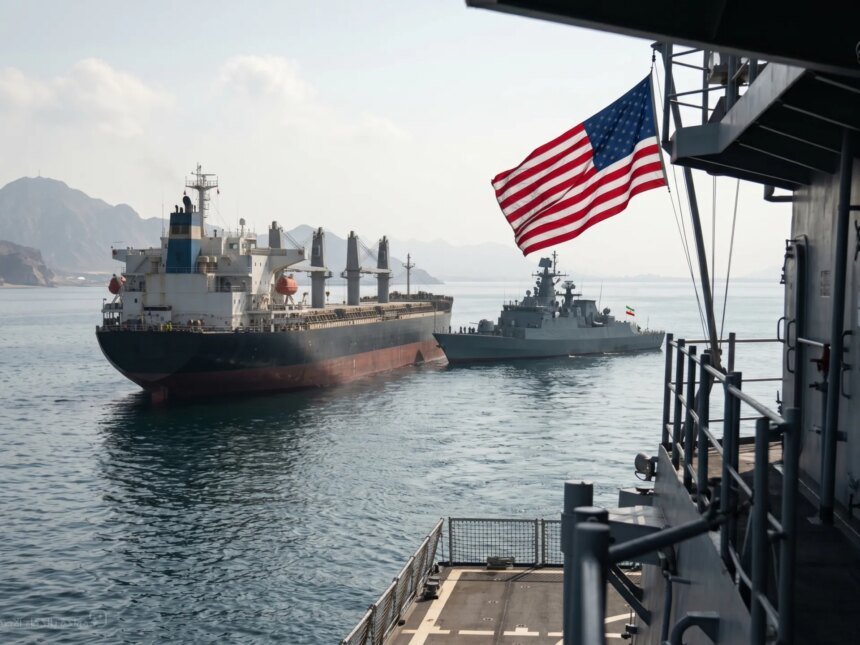
US President Donald Trump said that Iran is “collapsing financially” and that it is losing hundreds of millions of dollars daily due to the naval blockade imposed by Washington on Iranian ports.
In a post on his “Truth Social” platform last Tuesday evening, Trump wrote: “Iran is collapsing financially! They want to open the Strait of Hormuz immediately. They are starving for cash! They are losing $500 million a day. The army and police are complaining about not receiving their salaries.”
The US naval blockade of Iran began on April 13. Since then, US forces have boarded three Iranian ships and redirected at least 33 ships at sea that were carrying cargo to or from Iran, according to the US Defense Department.
In response to the US naval blockade, Iran closed the Strait of Hormuz and detained several foreign-flagged ships.
In this report, we monitor – in the form of a question and answer – how long can Iran withstand the US naval blockade? How long can the United States continue this blockade? How is the world affected by it?
How does the naval blockade harm Iran?
Iran exports oil, gas and other commodities, including petrochemicals, plastics and agricultural products, by sea. Analysts say that the US naval blockade of its ports could affect this trade.
Shortly after the start of the US-Israeli war on Iran on February 28, the authorities in Tehran implemented a virtual closure of the Strait of Hormuz, the passage through which 20% of the world’s oil and liquefied natural gas supplies were shipped.
The almost complete closure of this vital corridor sent global oil and gas prices soaring, and since then Iran has controlled the strait, but has nonetheless continued to export its energy products through the waterway.
Iranian oil exports – through the Strait of Hormuz – represent about 80% of its total oil exports. According to Kpler, a business intelligence company, Iran exported 1.84 million barrels per day of crude oil last March, and shipped 1.71 million barrels per day – so far – this April, compared to an average of 1.68 million barrels per day in 2025.
From March 15 to April 14, Iran exported 55.22 million barrels of oil. The price of a barrel of Iranian oil did not fall below $90 per barrel during the past month, and on many days the price exceeded $100 per barrel.
Even according to a conservative estimate of $90 per barrel, Iran has earned at least $4.97 billion over the past month from its ongoing oil exports.
By contrast, in early February – before the war began – Iran was earning about $115 million a day from its crude oil exports, or $3.45 billion a month.
Simply put, Iran earned 40% more from oil exports last month than it did before the war.

How much has crossings of the Strait of Hormuz decreased?
Ship crossings through the Strait of Hormuz have declined sharply due to the Iranian and American blockade, while security incidents involving ships have doubled, according to data.
After reaching a peak in transit operations that included 26 tankers on April 18, the number fell to the lowest level since the start of the war, according to data from Kpler.
From April 19 to 22, only 18 ships crossed the strait, at a rate of 4.5 ships per day. In comparison, between March 1 and April 17, about 9 ships crossed each day.
About 120 crossings were recorded daily during peacetime, according to maritime information website Lloyd’s List.
Consequently, transit traffic has now decreased by more than 96% from normal levels.
How many security incidents have been reported since the war began?
The UK Maritime Trade Operations Authority (UKMTO) and security company Vanguard Tech have recorded 7 attacks or incidents since last Saturday.
Since the beginning of the US-Israeli war on Iran, 38 incidents have been recorded by UKMTO and Vanguard, or the International Maritime Organization.
Can the United States continue the blockade for a long time?
In an interview with Al Jazeera on April 14, Frederick Schneider, a senior visiting fellow at the Middle East Council for Global Affairs, said that US President Trump will face a legislative challenge by May 1, when the 60-day period during which he can continue a foreign attack without the approval of Congress expires.
He said that there were reports of harsh conditions on ships implementing the blockade, and it remains to be seen how China will react to the continued detention of ships carrying any cargo belonging to it.
China considered – through its Foreign Ministry spokesman – that the United States’ attempt to impose a blockade on the Strait of Hormuz represents a “dangerous and irresponsible act.”
Schneider added that Iran’s closure of the Strait of Hormuz “harms America’s allies in the region and the world, even if it does not harm the United States itself much, which increases pressure on Trump.”
For his part, former US ambassador to Bahrain Adam Early told Al Jazeera English’s “This is America” program that while the US blockade of Iranian ports and detention of ships transporting Iranian oil “seems logical” as a policy, it may not work as planned due to internal political considerations in the United States.
Earley told Al Jazeera, “The Iranians have prepared for this. They have their own plans, and they have alternative means to store or sell their oil.”
He added: “Even if they run out of oil, they have ways to escape a very harsh blockade and sanctions regime, and I frankly believe that it will last longer than Trump’s patience and the patience of the American people.”
Experts at the American Soufan Center believe that the Iranians are “betting that the prolonged rise in global energy prices and the increasing shortage of some commodities will put increasing pressure on Trump to force him to yield to Iran’s demands and end the war… leading to the withdrawal of American forces from the region,” according to what was reported by Agence France-Presse.

Can Iran store oil after America’s blockade?
The capacity of Iran’s domestic refineries is 2.6 million barrels per day, according to consulting firm FGE Energy. Its oil and gas production facilities are concentrated in the southwestern provinces: Khuzestan Oil, Bushehr Gas and condensates from the South Pars gas field.
Iran is also the third largest oil producer in the Organization of the Petroleum Exporting Countries (OPEC), and exports 90% of its crude oil via Khark Island for shipping through the Strait of Hormuz.
The US naval blockade means that Iran must store more oil, and storage spaces may become tight.
Moyu Xu, senior crude oil analyst at Kpler, told Al Jazeera that future Iranian shipping and exports are expected to slow, increasing pressure on Iranian onshore reserves and eventually forcing it to reduce production.
She added: “However, given the availability of storage capacity onshore, we expect any reduction in production to be gradual over the next week, with a greater possibility of acceleration in May.”
Can Iran continue to generate revenues from oil?
Yes, analysts say, for several months Iran could continue to generate revenues from oil already in transit at sea.
Former Iran analyst for the Congressional Research Service in Washington, DC, Kenneth Katzman, said that Iran does not export new oil in light of the American blockade of Iranian ports, but Tehran has between 160 and 170 million barrels of “floating” oil on ships around the world currently.
Katzman told Al Jazeera that these supplies – which crossed the Strait of Hormuz before the imposition of the American blockade – are on board hundreds of tankers and awaiting delivery.
Katzman stated that an Iranian academic told him that – based on these supplies – revenues could flow to Tehran until next August, despite the US naval blockade.
However, Iranian ships will have to avoid US warships in the open ocean, as the US Navy recently intercepted ships carrying Iranian cargo.
The US Defense Department (the Pentagon) announced – last Thursday – that American forces had boarded the ship “Majestic X”, indicating that it was carrying oil from Iran. This came after the US Navy announced – a few days ago – that it had intercepted the ship “Tiffany” for transporting Iranian oil, as it claimed.

How can Iran earn revenue in other ways?
In addition to oil revenues, Iran currently receives revenues from the “toll gate” system it imposed in the Strait of Hormuz last March.
Last Thursday, Hamid Reza Haji Babaei – Deputy Speaker of the Iranian Parliament – said that the Central Bank in Tehran received the first revenues from fees imposed since the beginning of the war, according to the semi-official Tasnim news agency. It is not clear how much revenue these fees amount to.
According to Lloyd’s List, a media outlet specializing in shipping news, at least two ships that have transited the strait so far have paid duties in the Chinese yuan currency. Lloyd’s List reported that “one crossing was mediated by a Chinese maritime services company acting as an intermediary, which also handled the payment process to the Iranian authorities.” However, it is not clear how much those ships paid.
How does Iran seize ships in the Strait of Hormuz?
Iran used a squadron of small, fast-moving boats to seize two container ships near the Strait of Hormuz, in an action that undermines claims that US forces have disrupted its maritime threat.
Trump acknowledged – last Monday – that while Iran’s conventional naval fleet had been largely destroyed, the “fast attack ships” were not considered a major threat.
Greek maritime security company Diablos told Reuters that speedboat attacks now form part of a “multi-layered threat system”, along with “missiles launched from the coast, drones, mines and electronic jamming, to create uncertainty and slow down the decision-making process.”
Maritime security specialists estimate that Iran possessed hundreds – if not thousands – of these boats before the war, which were often hidden in coastal tunnels, naval bases, or among civilian ships.
A senior Iranian security official told Reuters that Iranian speedboats now form the “backbone” of Iran’s maritime strategy, and are able to deploy quickly as part of its “asymmetric war against the enemy.”
The official added, “Thanks to their very high speeds, these boats can successfully carry out hit-and-run attacks without being detected.”

How long does it take to clear the Strait of Hormuz mines?
The Pentagon estimated that clearing mines from the Strait of Hormuz would take up to six months, according to the Washington Post.
The newspaper quoted three Defense Ministry officials as saying, “Members of Congress were informed that Iran may have planted 20 or more mines in and around the Strait of Hormuz.”
According to a secret presentation presented by officials in the Ministry of Defense, a number of these mines were placed using geographical positioning technology (GPS), which makes their detection more difficult, and the other number were placed using small boats.
The Revolutionary Guard warned – in mid-April – of the presence of a “dangerous zone” of 1,400 square kilometers in the waters of the Strait.
How can the current supply disruption be measured in terms of magnitude?
The International Energy Agency said – earlier this month – that the peak supply losses resulting from the current crisis exceed 12 million barrels per day. This equates to 11.5% of global oil demand, which is expected to average about 104.3 million barrels per day this year.
The agency added that the direct daily losses in supplies are greater than the total previous losses, which amounted to 4.5 million barrels per day during the Arab oil crisis in 1973 and 1974, and 5.6 million barrels per day during the Iranian revolution in 1978 and 1979, as well as higher than the peak of supply losses estimated at 4.3 million barrels per day during the Gulf War in 1991.
The current disruption is not limited to crude oil and gas only, but has extended to include fuel markets. The war disrupted the production and export of millions of barrels of fuel daily from refineries in the Gulf, causing shortages of jet fuel and diesel.
Reuters calculations indicate that the current crisis has deprived the market of an estimated 624 million barrels, assuming a loss of 12 million barrels per day since the first day of the war.
Even if the parties reach an agreement to end the war quickly, the disruption to oil supplies is expected to continue for months, and for gas, for years, which will raise the final cumulative impact to a much higher level.