Published on 4/25/2026
|
Last update: 20:16 (Mecca time)
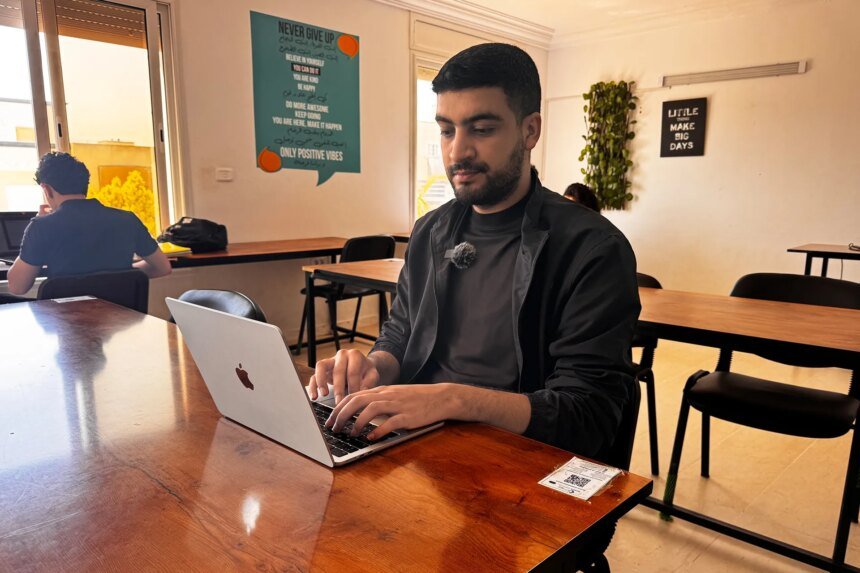
Tunisia – Sabah Osama Sabahat does not resemble many young people in Tunisia. In a co-working space in the capital, he sits in front of his computer, not to join a job in his country, but to complete the design of a video game that he is working on for a foreign company outside the country.
He is preparing to meet the “heroes” of his new game, characters inspired by a Tunisian comedy series, through which he attempts to combine local identity with an open global market.
Read also
list of 4 itemsend of list
Osama tells Al Jazeera Net that he is not thinking about leaving the country, adding, “Staying in Tunisia gives me a better opportunity in my field compared to the intense competition abroad.”
Osama chose to establish a startup to facilitate receiving his financial transfers from abroad, but this was not without complications. The tax rate on these transfers may reach 20%, indicating that he was unable to benefit from the “self-initiator” system launched by the state to support independent workers.

Migrants without bags
The stories of remote workers are not the same, but they have one path in common: working abroad but from inside Tunisia.
Khalil Al Majidi, a software engineer, moves between his home and shared work spaces. He is bound by a contract with a company in the United States, which imposes on him a different rhythm of life that takes into account the time differences between the two countries.
Khalil told Al Jazeera Net, “I provide services to a company outside Tunisia. I am actually an immigrant, but inside my country.”
Despite the challenges associated with the time difference and long working hours, he expresses his pride in his experience, which enabled him to improve his financial situation and open up to international professional experiences.
Late organization and challenges
Official data indicate that the phenomenon is expanding. A study issued by the Tunisian Ministry of Higher Education in 2025 concluded that there are more than 120,000 freelance contractors in Tunisia, facing challenges related to taxes, obtaining transfers from abroad in international currencies, in addition to the absence of health coverage and social protection.
In this context, the Tunisian authorities launched several incentive programs to move contractors from the informal economy into the organized economy, the most prominent of which is what is known as the “self-initiator” system, with the aim of regulating this type of work.
This system includes tax exemptions with legal protection and the opportunity to enjoy health insurance to protect contractors from the problems of transfers from inside and outside the country.

The director of the “self-initiator” program in the Tunisian Ministry of Employment, Muhammad Al-Kafi Al-Rahmani, said in statements to Al Jazeera Net that the number of people participating in the platform (self-initiator) is still limited, as it did not exceed 9,000 young people.
Al-Rahmani adds that the program provides tax exemptions and legal cover, in addition to facilities for using hard currency to cover professional needs.
Al-Rahmani pointed out that the Ministry is working to raise the financial value of hard currency for emerging companies and even contractors on an independent and individual basis.
Stage before migration
This model does not always prevent thinking about immigration in light of many determinants related to the specificity of each case, and the connection to a stressful general climate and global horizons that may be more welcoming and encouraging.
In this café, we meet Hamza, a software engineer who works with a company in Belgium. He says that he was not planning to emigrate for family reasons, “but the tax pressure is pushing me today to think about that.”
Hamza explains to Al Jazeera Net that the tax rate may reach 35% in some cases, a rate imposed on annual salaries that range between 30 thousand dinars ($10,398) and 50 thousand dinars ($17,330) annually in Tunisia.
He added, “I pay these taxes for no real return, neither in terms of services nor in terms of the professional environment.”
This testimony reflects a growing paradox in Tunisia, which is that remote work may be an alternative to immigration, but it may also turn into a preparatory stage for it.

Untapped opportunity
In a country under financial pressure and searching for sources of hard currency, some experts see this phenomenon as an opportunity for many young people.
Economist Jamal Al-Owaididi told Al-Jazeera Net, “Digital immigrants may become an important tributary to the economy in the future, and they could be a partial substitute for traditional remittances.”
Al-Uwaididi stresses the need to support this group through incentive policies, instead of pushing them to leave the country permanently, considering that this type of work represents “a new form of exporting services.”
Between staying and leaving
The irony is that remote work may give some people a reason to stay, while prompting others to think about leaving.
In both cases, migration is no longer linked only to geographical movement, but rather to place of work and economic affiliation.
Among those who see it as a new brain drain, and those who see it as an opportunity to reshape the economy, “digital migration” in Tunisia remains a phenomenon open to all possibilities.
In a country searching for a new development model, the question may not be whether talent is leaving, but rather how to benefit from their survival as they work for the world.