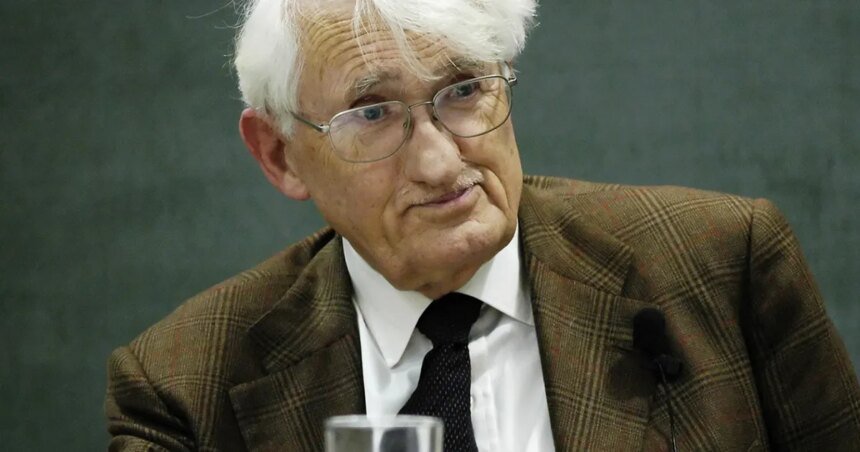
The death of the prominent German philosopher Jürgen Habermas (1929-2026) at the age of 96, while at the height of his international fame as an outstanding critical thinker of his time, cannot be measured by ordinary standards.
He lived as a symbol and left as a symbol. Whether we agree with him or disagree, he was an extremely influential philosopher, and we should all deal with his philosophy with care and seriousness.
Habermas was an exceptionally influential social theorist among his contemporaries, rooted in the tradition of critical theory, deeply concerned with the fate of European civil society, protecting the achievements of the Enlightenment that he saw as yet to be completed, and preoccupied with the vitality and effectiveness of the European public space.
As doctoral students at the University of Pennsylvania in the late 1970s and early 1980s, my friends and I used to go to nearby Haverford College to attend Habermas’s lectures, where he had been invited by the prominent American philosopher Richard Bernstein (1932-2022), who was teaching at the same college at the time (and later moved to the New School), and he was instrumental in introducing the German philosopher to his American readers.
Habermas held academic positions at Heidelberg University and Goethe University in Frankfurt, directed the Max Planck Institute in Starnberg, and wrote books of exceptional importance and profound influence among his generation.
Habermas’s dialogue with Cardinal Ratzinger, who later became Pope Benedict
His ideas about integrating Muslim immigrants into the fabric of European society were more tolerant than the growing feelings of hatred against Muslims that prevailed in his time, especially among his European contemporaries.
Public space and communicative action
Among Habermas’s pioneering works, The Structural Transformation of Public Space (1962) and its central concept of “public space” have had a widespread influence on our understanding of potential conflicts between the bourgeoisie (the middle merchant class and intellectuals in 18th-19th century Europe) and state power (governments and kings).
This idea arose and remained confined within Habermas’s usual Eurocentric tendency, but it left a decisive imprint on other thinkers who had a more comprehensive conception that transcended national borders of public space, including me in my formulation of the concept of “semi-public space.”
But it was his book The Theory of Communicative Action (1982), in which he sought to address the obstacles to the mind’s ability to think logically in mass societies, that made his influence felt outside Europe.
In his pivotal work The Philosophical Discourse of Modernity (1985), he presented the most sustained arguments in defense of European modernity, although he still maintained that it was an incomplete project.
Shortly after the American invasion and occupation of Iraq, Habermas and the French philosopher Jacques Derrida published an important article in the form of a manifesto entitled “Old Europe, New Europe, Nuclear Europe: The Birth of a United Europe” (2003).
Two years later, that essay became the focus of a book called Old Europe, New Europe, Nuclear Europe: Transatlantic Relations after the Iraq War (2005), which included prominent European philosophers such as Umberto Eco and Gianni Vattimo.
The central issue of these discussions was to determine the unique nature of Europe compared to the United States, which at the time, under the leadership of the neoconservatives, was blatantly warming to Afghanistan and Iraq.
Habermas was born on June 18, 1929 in the city of Düsseldorf, western Germany, and grew up in Gummersbach, near Cologne, during the last period of the fall of the Nazis.
His commitment to Enlightenment ideals of reason and freedom was deeply influenced by his experiences as a European during World War II, so his relentless criticism of European postmodernism was rooted in his own feelings.
Weaknesses of the European superiority philosopher
Habermas died on March 14, 2026, two weeks after Israel or his favored Israeli settler colony committed another mass slaughter of Iranian civilians, as it had done before in Palestine, Lebanon, Syria, and Yemen.
But philosophically, Habermas had died two years earlier when he and his colleagues openly declared their support for Israeli genocide in Palestine, completely ignoring the horror of non-Europeans suffering under its yoke.
That was the time when Habermas died for false ideas and a false reputation. He thought he had something to teach the world beyond his narrow, local German outlook.
This regional tendency was not his fault, but rather it was our fault, as we, non-Europeans, should never have invested intellectually in those local tendencies that are innocent of any philosopher, and which he and other Europeans embrace.
The tribalism of European philosophy has been falsely generalized, not because of virtues inherent in its cognitive structure, but because of the force of globalized colonialism that accompanied it.
This interconnectedness made European philosophers presented as heirs of Greek philosophy, while a vast philosophical heritage produced by generations of non-European philosophers in languages such as Pahlavi, Syriac, Arabic, Persian, and Hebrew was ignored.
The description of “Islamic philosophy” in itself was an Orientalist fabrication aimed at giving a local character to parallel philosophical worlds, confining it to the (European) center, and subjecting it to what was classified as “Western philosophy.”
The false and misleading formation of what is called “Western philosophy” was in itself a colonial framing that granted itself imperial hegemony over the rest of the philosophical heritage, and claimed to be the legitimate heir of Greek philosophy.
While Western philosophy carried itself on the wings of European and American fighter planes and gunboats to impose its universality with extreme violence, the counter-philosophical movements in Asia, Africa, and Latin America did not, until recently, have an official frame of reference to confirm their presence other than through an anthropological classification known as “ethno-philosophy,” that is, racial philosophy.
Editing the idea of ”philosophy”
Habermas’s departure represents a historical moment in which European and Eurocentric philosophy – which he represented in the best and most eloquent way – settled into its tribal specificity that it had succeeded in repressing for a long time.
Today, philosophers such as Y. F. Modimbe, Suleiman Bashir Diagne, Achille Mbembe (Africa), Enrique Dussel and Walter Mignolo (Argentina), Kojin Karatani (Japan), Abdulkarim Soroush and Mohammad Mojtahed Shabestari (Iran), Wang Hui (China), Louis Ricardo Gordon (Jamaica) or W. E. B. Du Bois and Cornel West (African Americans) – in radically changing our overall perception of the world of philosophy and recovering, from Then, the word “philosophy” itself.
These and other philosophers have more serious and broader arguments than Habermas or any other European philosopher.
Today, of course, we must continue to read Habermas, as we read all other European philosophers before and after him, with respect and admiration, but with a firmer anthropological outlook that is more appreciative than European and American anthropologists have ever shown in approaching our moral and cultural particularities.
Habermas has often been called the “last European,” that is, the prominent critical thinker who remained a believer in the ideals of the European Enlightenment, in particular distinction from the United States. This is indeed the best way for the world to remember him also as the last European philosopher, who perhaps unfortunately failed to see the rise of a completely different world of philosophy.
The opinions expressed in the article do not necessarily reflect the editorial position of Al Jazeera Network.