Tehran- A hundred days ago, Mahran (47 years old) used to go every morning to the school where he taught, but now he opens his laptop in a corner of his modest apartment, where his destination has become the screens of his students distributed throughout the Iranian provinces since the adoption of distance education due to the American-Israeli war on his country. He says, “Life did not stop here as some might think, but it took a different rhythm.”
To find out the new rhythm in the lives of Tehranis after the Ramadan war, Al Jazeera Net accompanied Mahran on a long day during which he moved between his virtual classroom, pharmacies whose shelves had run out of dozens of types of medicine, a market in which prices rose from one hour to the next, and free transportation that was more crowded than before.
One day sums up the Iranians’ attempts to live a normal life, while the war refuses to leave its mark on everything.

Distance education
Mahran begins his day in a modest room that he turned into a virtual classroom. He struggles daily to connect to the “Shad” e-learning platform after the educational system turned virtual since the second week of the war, despite the international internet being cut off at the time.
He says with a tired smile, “The national Internet, although available, has become annoyingly weak due to the increase in users. My voice comes in intermittently sometimes, and suddenly dozens of students disappear from the educational platform.”
In his modest apartment in the Amirabad neighborhood in the center of the capital, Tehran, the day turns into an exhausting race with intersecting voices. He says, “From a corner of the living room, my daughter Mehraneh (14 years old) is trying to follow her lessons on an old tablet computer, while my youngest son Sam, who is eight years old, clings to his mother’s mobile device in the narrow corridor leading to the kitchen, to be close to the strongest Internet signal near the window.”
In the second room, his wife, Azadeh (41 years old), follows up on the accounts of the private company she works for, and her work has become entirely remote from the first week of the war until last month.
Mahran wonders, “The weak Internet can hardly support one stable connection, so how about three or four simultaneous connections? Not to mention the narrow apartment space and the lack of privacy, which increases the suffering.”
Health bill
After the virtual classes are over, Mahran goes to the “Al-Shifa” pharmacy near his home to buy medicine for his mother, who suffers from a weak heart muscle. The packages on the shelves appear arranged and varied, but dozens of types of medicine have disappeared and been sold out for more than a month, while prices have doubled several times for internal products and imported models alike, according to the young woman Mahri, who works in the pharmacy.
Mahran pays for the monthly medication and quietly puts it in his bag, then comments, “The medications are now eating up a quarter of my salary, after their prices did not exceed 7% of it.” Then he quickly thanks God because they are still available, while “many of the other patients’ families are complaining of a severe shortage of some items as a result of supply chains being obstructed by the naval blockade and the suspension of many air destinations.”

Market and prices
From there, we move with Mahran to the “Jumhuri” market for electronics and electrical goods, in order to buy a television before the start of the upcoming World Cup matches, confirming that his old device was already damaged by a wave of explosions that occurred near his house during the last week of the “Ramadan War.”
While he suggested using the metro instead of taxis to go to the market, he said, “Public transport buses and the metro have been transporting passengers for free since the beginning of the war to alleviate traffic crises and reduce gasoline consumption. As you can see, the streets are still crowded with private cars, but there are no scenes of queues of cars in front of gas stations.”
In one of the many electrical goods stores, one of the sellers says, “The war has made transportation priceless, but it has raised the prices of all goods, especially food,” adding that the prices of all electrical appliances in this store have risen in the past hours by 40 to 60 million Iranian riyals (the dollar is equivalent to 1,750,000 riyals) due to the rise in the price of hard currency since this morning until three in the afternoon only.
In another TV stand store, the store owner, Ali Murad (59 years old), confirms that their prices have doubled since last winter, even though they are entirely produced at home. He attributes the reason to the rise in wages, raw materials, and rents, in contrast to the decline in the number of customers due to the high cost of living and the shrinking purchasing power of citizens.

Public parks
After two hours of moving between stores, we stopped in the “Aosta” public park near the market to take a short break, where the scene seemed as if it was taken from another time, with children jumping around colorful toys, families lying on the grass under the shade of ancient trees, and young men taking turns on public exercise equipment with tireless energy.
In a quiet corner near the fountain, an elderly woman was sitting, flipping the pages of a paper book with captivating concentration, surrounded by the noise of life that bore no resemblance to war. Mahran said, his gaze fixed on the scene: “For a moment, I forgot that we live under siege, when I see Tehran taking away its right to live, even from the teeth of the breaking news of the ongoing war despite the truce.”
But this calm is “just another face of a city learning to dance on the brink of crisis,” according to the young woman, Mona (22 years old), who believes that the people in the park are no longer the same as they were a hundred days ago. They are now looking for a free breathing space after their budgets have been exhausted by the doubled internet and food bills.
Speaking to Al Jazeera Net, Mona believes that “the woman reading the book may have chosen the garden because her apartment became crowded with the sounds of her grandchildren’s virtual lessons. And young people who practice sports may have found in public devices an alternative to club subscriptions that they can no longer afford.”
She likened the park-goers to someone who “hides his exhaustion behind a façade of calm, as if they have collectively decided to give themselves a break from the idea of war and its breaking news, even if that does not last more than an hour before they return to their homes.”

Popular gatherings
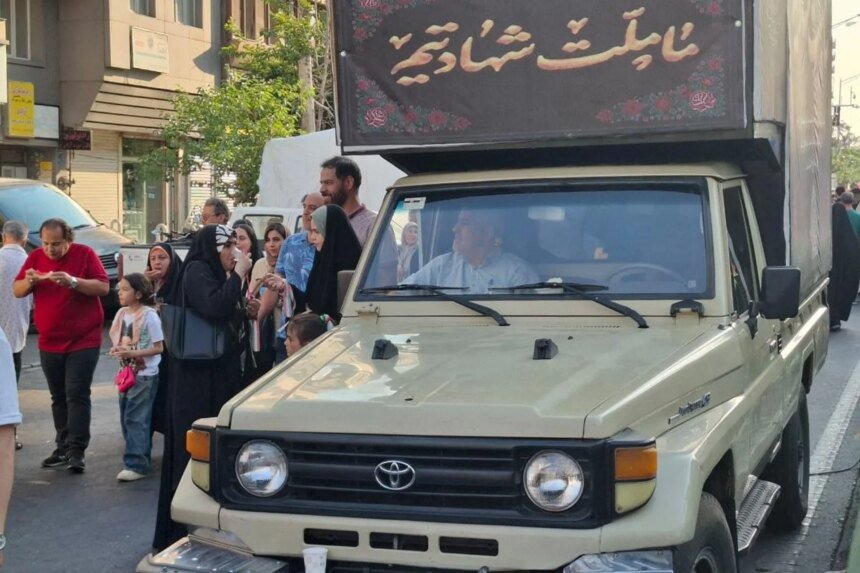
As the sun sets, Mahran does not head directly home, but rather to “Revolution” Square near Tehran University in the city center to participate in nightly gatherings in support of the regime and its armed forces in the face of any aggression targeting his country’s sovereignty, where hundreds of men and women gather every evening, chanting national slogans and singing enthusiastic songs.
He says enthusiastically, “These meetings make us feel that we are in one trench. We may not have stealth fighters or warplane carriers, but we have our presence and our word,” adding, “I know that the war stole our peace of mind and well-being, but it brought back to us something important, which is popular solidarity and unity, and that nothing can stop our lives as long as we remain in the arena.”
Mahran continues to explain his story with the popular gatherings: “Until the tenth night, I came here out of duty. And on the thirtieth night, I started coming because I was looking for faces I knew. As for the hundredth night, I realized that this gathering was no longer just a political stance, but had turned into a daily fabric that gave us a stable rhythm in a time when every other rhythm was shaken.”
When we were sitting on the edge of the sidewalk, he picked up a small pebble from the ground, turned it between his fingers, then added in a contemplative voice: “Wide segments of Iranians, including university professors, workers, engineers, and housewives, have been coming over the past months, not only in support of the regime, but also in search of the warmth of the community on cold nights.”
“We sometimes ask ourselves: What if these meetings stopped suddenly? Where would we go with our energy, our conversations, our anger, and even our hope? Will we know how to fill that void, or will the silence be heavier on us than the sounds of the bombing?”
At the end of this long day, the sun in Tehran sets on a city that has not surrendered to the war, but has not yet resolved it, as the specter of war still looms over its sky.
One hundred days have passed, and a new scene of life has been imprinted in the memory of Iranians, in which the weak Internet mixes with the laughter of children in public parks, and high medical bills overlap with the sounds of nightly chants that have become closer to a communal ritual.
Between Mehran’s apartment, which is crowded with virtual lessons, and the old woman’s chair reading her book in the shade of the garden trees, and the loudspeakers that fill the public squares at night, one question is formed that does not leave the eyes of passers-by in the streets of the Iranian capital: How long will this thin line between adaptation and collapse last?