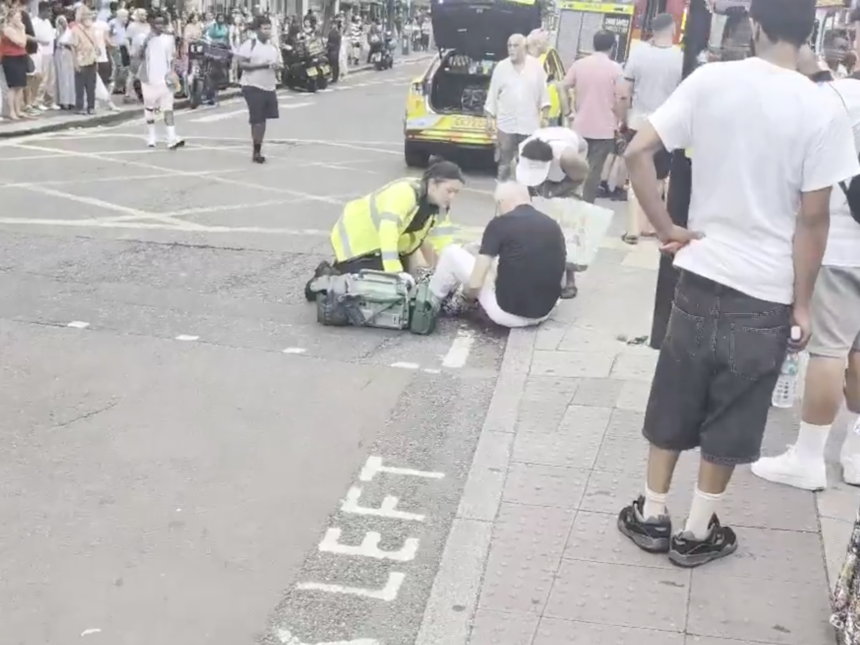
A hit-and-run accident that occurred in the Ealing area, west of London, sparked a wide wave of interaction on social media platforms, after video clips showed a car hitting a number of pedestrians, before the British Metropolitan Police announced the arrest of a Briton of Somali origin on suspicion of dangerous driving and attempted murder.
The police said that 5 people were injured in the accident, two of whom were treated on site, while 3 others were taken to the hospital, stressing that the injuries did not pose a threat to life. Although counter-terrorism officers were involved in the initial investigation, the police clarified that the incident is not being treated at this stage as a terrorist act, and that the motive is still under investigation.
Read also
list of 2 itemsend of list
But the announcement of the suspect’s background quickly turned the incident into material for widespread incitement from right-wing accounts, which linked the incident to immigrants and Muslims, and called for deportation, expulsion, and tightening immigration policies.
Ealing ran over
Video clips spread on social media platforms documenting moments of the accident that occurred on a public street in the Ealing area, west of London, and some scenes showed a white car in the middle of the road, while a number of passers-by were trying to approach it or intercept it after it collided with people in the place.
Other footage also showed a state of confusion at the accident site, with passers-by gathering around the injured and the arrival of ambulances and emergency vehicles, while the police closed parts of the road and began their initial procedures at the scene.
Local accounts initially treated the clips as field documentation of the incident, before right-wing accounts entered the circulation and reconnected the scenes with issues of immigration, Islam, and internal security in Britain.
Police statement
In its statement, the Metropolitan Police said that the driver did not stop at the scene of the accident, before he was later arrested in a nearby area, and stated that he was a British man born in Somalia, aged 34, and was arrested on suspicion of committing crimes related to dangerous driving and attempted murder.
The police explained that local officers were cooperating with officers from the Counter-Terrorism Department in the initial investigations, but at the same time confirmed that the incident was not being treated as a terrorist act.
This detail charts the course of the subsequent reaction; The inciting accounts did not focus on the number of injured or the course of the investigation, but rather on the origin of the suspect and on the police’s statement about not classifying the incident as terrorist.
Driver’s ID
After the police statement, the identity of the suspect became a major focus of discussion. Instead of treating him as an individual subject to a criminal investigation, right-wing accounts presented him as evidence of what they describe as the failure of immigration and asylum policies.
Expressions were repeated in the comments challenging his being British, even though the police described him as British born in Somalia. Other posts also linked the incident to Muslims and immigrants in general, without waiting for the results of the investigation or announcing a clear motive.
Here the direction of the story changes; From a limited hit-and-run accident in one area, to a broader debate about identity, immigration, and national belonging.
Expulsion letter
Lawrence Fox, the English actor and leader of the right-wing Reclaim party, was one of the most prominent people who used the incident in an inflammatory speech. He refused to describe the suspect as British, and described him in sharp religious and political terms, including a “fanatic jihadist,” before calling for the expulsion of those he described as “savages.”
In the same vein, right-wing activist Scott Jones called for “mass deportation” and used the phrase “Third World” in his comment on the incident, moving the discussion from an individual incident to a general position on immigrants and refugees.
As for blogger Martin, he presented the incident as evidence of what he called “endless violence” practiced by immigrants on a daily basis, a formula that generalizes the accusation to a broad category rather than limiting it to one suspect.
Accusing the police
The wave of interaction was not limited to attacking immigrants and Muslims, but also extended to questioning the police statement. Right-wing activist Chris Newton criticized the police’s announcement that the incident was not being treated as a terrorist act, considering that this contradicted its statement that anti-terrorism officers were participating in the initial investigations.
This objection was used to cast doubt on the way the authorities dealt with the incident, as comments appeared accusing the police of downplaying the description of the incident or avoiding describing it as terrorism because of the suspect’s background.
Thus, the police statement itself became part of the wave of incitement, and not just an official source of primary information. Its wording was used to confirm a ready-made narrative among these accounts that British institutions are lenient with suspects when they are from immigrant or Muslim backgrounds.
Mass criminalization
In other posts, the rhetoric went beyond attacking the suspect to criminalizing entire groups. British journalist and researcher Mike Jones described immigrants and Muslims in terms linking them to crime and disorder, using language that did not distinguish between an individual suspect and millions residing in Britain.
The responses and quotes repeated phrases that hold immigrants and Muslims wider responsible for the violence in the country, and call for collective punitive policies, such as deportation, halting immigration, or reviewing naturalization.
This type of comment turned the accident from a criminal case into a tool for spreading accusations against religious and ethnic groups, although the investigation has not yet determined the driver’s motive or the background of the accident.
Politicization of the incident
Partisan politics also entered the line of interaction. Right-wing activist Rael Braverman blamed British voters, considering that the continued voting for the Labor, Conservative and Green parties was what led to such results, due to not adopting more stringent policies towards refugees and Muslims.
Thus, the incident turned into an electoral material used to attack the main parties and push for tougher right-wing options on the issues of immigration, asylum and security.
This wave comes in the context of an increasing presence of right-wing populist discourse in Britain, amid fears of its impact on Muslims, immigrants, and minorities, especially when criminal incidents under investigation turn into rapidly spreading political fuel.