
Published on 6/28/2026
|
Last update: 09:38 (Mecca time)
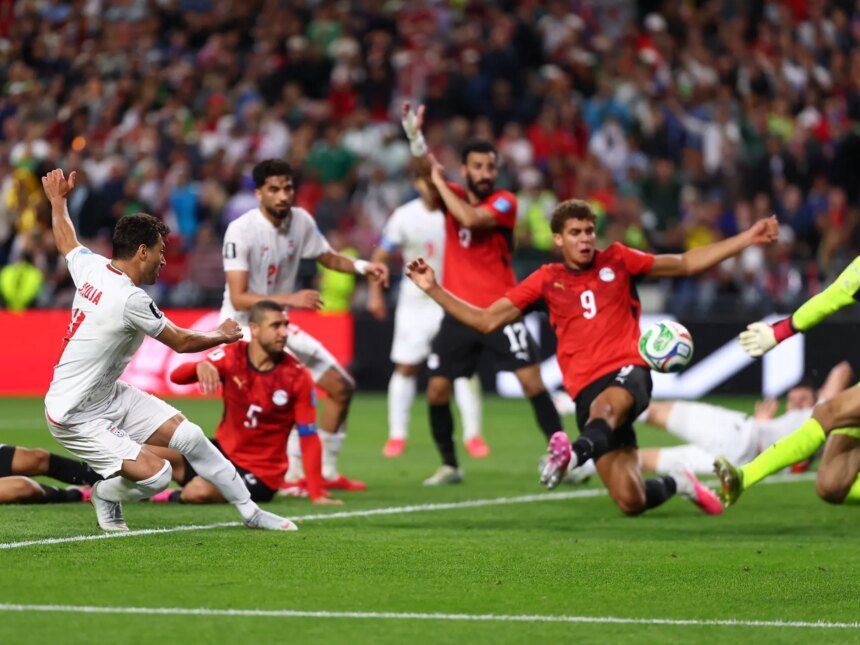
The secrets of the offside law are the main reason for the controversy and objections that accompanied the cancellation of Iran’s fatal qualifying goal against Egypt in the 93rd minute, even in the presence of video technology. Although the vast majority of fans memorize the general rule that “the striker must not precede the second last defender,” this phrase lacks legal accuracy, and hides subtle secrets that were the direct cause of one of the most dramatic moments in the 2026 World Cup.
In the following lines, we explain the secrets hidden in the offside law that referees and video technology (VAR) rely on, and which many even players and coaches may not know about:
Read also
list of 2 itemsend of list
First: The term “The Second-Last Opponent”
The most important point that determines complex offside cases is that the legislator at the International Football Association Board (IFAB) does not use the term “goalkeeper” or “last defender” to define offside, but rather literally stipulates that an attacker is offside if he is closer to the goal line than “the second last opposing player.”
In a normal situation: the goalkeeper is positioned in his own goal (player No. 1 is from the back), and the center back is standing in front of him (he is the second last player). Therefore, an imaginary offside line is drawn at the defender.
The exceptional situation (the case of Iran’s goal against Egypt): In the 93rd minute, amidst massive confusion inside the penalty area and the Egyptian goalkeeper Mustafa Schubert leaving his goal to stop the ball, the situation was reversed. The goalkeeper advanced, and the ball fell at the feet of the Iranian players, and Shoja Khalilzadeh shot it into the net.

This explains why Polish referee Shimon Marciniak canceled the goal after returning to video technology (VAR). Because the moment the ball came out and was passed into the crowd, the goalkeeper was ahead, and there was only one Egyptian defender (Yasser Ibrahim, for example, or someone else) standing to cover the goal. This defender has become the “last player”, and his presence alone is not enough to break the offside. There must be another defender next to him (or the goalkeeper) as he is the “second last player”. Since the Iranian striker was overtaking the second-last player at that moment, he fell legally and explicitly offside with part of his foot, as the precise video technology image showed, and the joy of Iranian qualification was lost and Egypt escaped the surprise.

Second: The ball covers offside
Another legal point that almost only referees pay attention to, even though it decides many attacks and breaks the offside trap, is the “ball” itself. The law stipulates that the offside line is determined by either “the second last player” or “the ball”, whichever is closer to the goal line.
This means that if the ball is ahead of the receiving player at the moment it is passed, there is absolutely no offside. In simpler terms, if an attacker breaks the offside trap and passes all the defenders and the goalkeeper, and is completely alone, and a teammate is running alongside him but behind the ball, and passes the ball to him (back pass or late cross), then that teammate is never in an offside position. The ball here is the one that drew the offside line parallel to the goal line, and since the recipient is behind the ball the moment it leaves, the goal is 100% safe.