Published on 6/27/2026
|
Last update: 16:23 (Mecca time)
The initial understandings between Washington and Tehran faced their most critical practical test recently, following the return of military tension to the Strait of Hormuz and the emergence of sharp differences regarding the mechanisms for implementing the joint memorandum of understanding.
Within an analytical discussion on Al Jazeera, specialists and politicians dismantled the dimensions of the financial and technical dispute over the frozen balances, and its repercussions on the 60-day deadline set for technical negotiations in Geneva, amid an Iranian threat of an “overwhelming” response, in exchange for an American-Gulf warning against taking international shipping traffic hostage to regional accounts.
In the context of his explanation of the background of Iranian rigidity, the Director of the Arab Center for Iranian Studies, Dr. Muhammad Saleh Sadeqian, pointed out that the crisis of mistrust between Tehran and Washington is not born today, but rather its roots extend back to 1953, that is, more than 70 years of continuous hostility.
Sadiqian made a strategic comparison between the 2015 nuclear agreement negotiations and the current situation, explaining that the previous Obama administration was adopting political messages characterized by respect and diplomacy with the Iranian leadership and committed not to impose any sanctions throughout the 3 years of negotiations.
Sedqian added that the current scene is affected by the behavior of US President Donald Trump, who sends threatening messages and contradicts what he signs on the ground. The first clause of the memorandum stipulated the immediate release of funds in conjunction with the end of military operations, but Tehran faced what he described as “deception” represented by statements by American officials confirming to the American street that they had not given Tehran a single penny.
He stressed that this American policy intersecting with the Israeli position puts pressure on Iranian diplomacy and directly supports the options of the extremist movement that dominates the decision-making centers in the Supreme National Security Council, which made the Revolutionary Guards resort to the “will to force” option to extract demands.
Surprise numbers
On the other hand, former US Deputy Assistant Secretary of State Joey Hood refuted the Iranian narrative, stressing that the Lebanese-Israeli framework agreement is not a violation of the memorandum but rather a step in the implementation process.
Hood revealed clear financial data proving the good intentions of America, explaining: “The American President took courageous practical steps and lifted the sanctions related to oil and ports, which allowed Iran to export oil worth more than $2.5 billion in the last period immediately, so what right do they have to talk about non-compliance?”
He explained that the memorandum of understanding does not contain a clause that imposes a conditional timeline (meaning ending the first clause before moving on to the second), but rather that all paths and obligations must proceed simultaneously and at the same time.
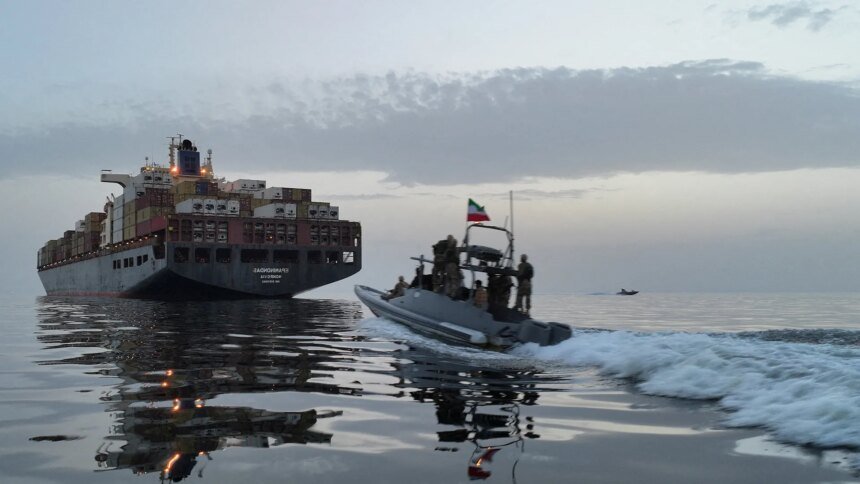
Hood denounced the Revolutionary Guard’s resort to bombing unarmed commercial ships in Oman’s territorial waters, describing it as “subversive behavior,” and wondering why Iran neglected the technical and supervisory committees assigned to each item and the absence of coordination through the joint hotline formed to resolve disputes.
“Platinum Card”: Hormuz versus Syria
For his part, the academic and expert in Middle East politics, Mahjoub Al-Zwairi, presented a structural reading of the situation, stressing that the Strait of Hormuz represents for Tehran a “platinum card” and not just a gold card, and it will not abandon it no matter the cost.
Al-Zwairi linked the current escalation to regional changes, noting that the decline in Iran’s regional influence following its exit from Syria on December 8 last year prompted it to try to reposition itself politically and impose its conditions on the entire world through the maritime security portal to compensate for its land losses.
He explained that Iran sees the Sultanate of Oman’s provision of an alternative sea corridor and its coordination with the International Maritime Organization as an American attempt to circumvent Iranian power cards, and a reproduction of the previous American “Freedom 1” project that failed to impose its maritime equivalents.
Therefore, Tehran insists, through its loud speeches and statements issued by a member of the Expediency Discernment Council, that the final say in the Strait must pass through direct coordination and prior approval with it.
The technical argument: “There is no justification for piracy.”
Speaking about the Iranian justifications related to the necessity of “prior coordination,” the head of the Al-Madar Center for Political Studies, Dr. Saleh Al-Mutairi, refuted those allegations with technical and technical evidence for international navigation.
Al-Mutairi confirmed that automated systems for managing global ship movement are already guaranteed and implemented in the strait. The electronic Automated Identification System (AIS) works regularly to inform the authorities of the identity of ships, their cargo and numbers, in addition to the Vessel Traffic Control System (VTS), which is internationally designed to avoid collisions.
He stressed that the Iranian invocation of the need for direct coordination is a weak excuse through which Tehran is trying to turn the Strait of Hormuz into a weapon and collect fees outside international law, with the aim of mortgaging global energy corridors with files related to other arenas in Lebanon, Palestine, or Yemen.
He explained that the attack on the Singaporean tanker in Omani territorial waters is an unjustifiable violation, and that the Iranian insistence on imposing the “prior political approvals” equation will place Tehran in an open and zero-sum confrontation with the entire international community and not with the Gulf states alone.
Oman initiative and the Gulf position
In the context of the official positions on the ground, the Secretary-General of the Cooperation Council for the Arab States of the Gulf, Jassim Mohammed Al-Budaiwi, praised the Sultanate of Oman’s announcement of providing the option of using a temporary sea lane for ships in the Strait of Hormuz in coordination with the International Maritime Organization.
The statement issued by the General Secretariat in Riyadh explained that this Omani initiative aims to launch a plan to evacuate more than 11,000 stranded sailors, in a way that enhances the freedom of maritime navigation and the flow of supply chains to the regional and global economies in accordance with international law and the law of the sea without restrictions or conditions.
On the other hand, Al-Budaiwi expressed the GCC countries’ rejection and condemnation in the strongest terms of Iranian allegations and threats to the freedom of movement of ships in the strait following the announcement of this initiative, amid Gulf assurances to support all efforts aimed at establishing maritime security and reducing tensions in the region.