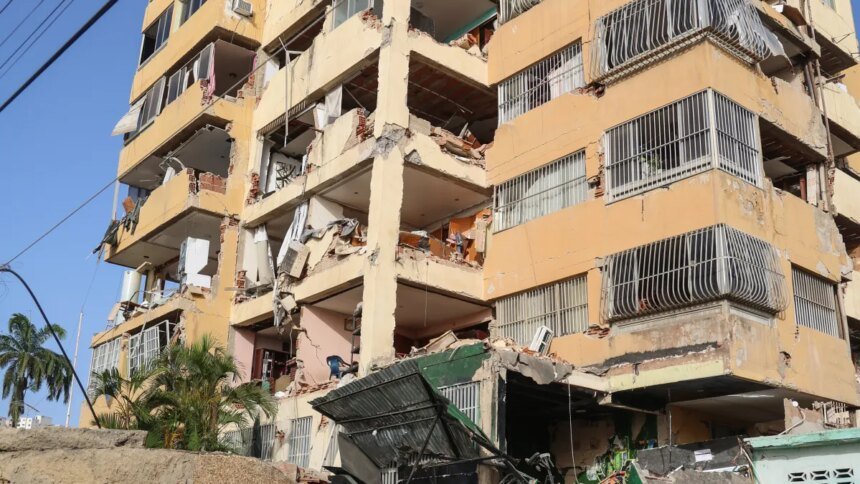
At a time when the administration of US President Donald Trump was seeking to present Venezuela as a model for the success of its new policy in Latin America after the overthrow of President Nicolas Maduro at the beginning of this year, the double earthquake that struck the country last Wednesday turned the scene upside down.
This natural disaster put the transitional government headed by Delcy Rodriguez before its first existential test, and Washington put itself before an equally difficult test to prove that its promises to rebuild the exhausted state were not just political slogans or bets related to oil.

Popular solidarity and government deficit
In light of the inability of state agencies to respond to the repercussions of the two earthquakes, residents were forced to organize self-rescue operations, using their bare hands to remove the rubble, while motorcycles and private cars turned into means of transporting the injured and delivering water and supplies in the absence of official rescue teams for long hours.
Read also
list of 2 itemsend of list
The Wall Street Journal quoted a resident of the Catia La Mar area as saying that “the greatest response came from the people themselves,” in an expression that summarized a widespread feeling among Venezuelans that the state was not present to the extent required during the first hours after the double earthquake.
It stated in its report that the two recent earthquakes showed how little change had occurred in the state apparatus since the United States overthrew President Nicolas Maduro last January.
She pointed out that international relief agencies reported that the country has since been suffering from a severe humanitarian crisis, food insecurity, as well as public services that have been unable to meet basic health needs.
The challenge was not limited to the scale of the humanitarian disaster, but extended to the political dimension, as interim President Delcy Rodriguez found herself facing a test that may shape her political future.
Since assuming power following the removal of Maduro, Rodriguez has tried to present herself as a “more pragmatic face” capable of reintegrating Venezuela into the global economy, by encouraging foreign investment and openness to the United States after years of estrangement and confrontation, according to the American newspaper’s report.

Statements that contradict reality
The Wall Street Journal discussed statements made by Rodriguez, during an interview with her on state television on Friday, in which she confirmed that the army and state agencies were being mobilized to confront the crisis, announcing the provision of food and water to the affected areas, and assigning the administration of La Guaira state to the armed forces.
She also stressed that rescue teams were able to pull dozens of people alive from under the rubble, in an attempt to reassure public opinion and demonstrate the government’s ability to deal with the disaster.
However, these official messages collided with field testimonies and reports that spoke of the slow response and lack of heavy equipment, which prompted many analysts – according to the Wall Street Journal – to consider the first hours after the earthquake as a moment revealing the truth about Venezuelan state institutions after years of economic collapse.
The newspaper believes that the disaster may turn into a turning point for both Rodriguez and the Trump administration together, as the government’s success in managing the crisis may give it broader political legitimacy, while any failure or accusations of corruption or misdistribution of aid may lead to a new wave of protests in a country that already suffers from high levels of popular discontent.

Relationship under test
For its part, The Washington Post said that the double earthquake puts the relationship between the United States and Venezuela to the test. After the two countries were hostile to each other, they may now turn into “wonderful friends.”
Politicians and analysts believe that there is an opportunity for Washington and Caracas to transform their relationship into something resembling an alliance, within the framework of a diplomatic breakthrough that may represent one of the fastest geopolitical transformations in contemporary history, according to Terrence McCoy, international investigative correspondent for the Washington Post.
In this context, the reporter quoted Venezuelan opposition leader Freddy Guevara as saying that the crisis represents an opportunity to prove that cooperation with the United States is not limited to commercial interests, but also extends to supporting the Venezuelan people and promoting the values of democracy, considering that the success of the relief efforts may contribute to changing the traditional image that many Venezuelans have regarding Washington.
But this bet is not without complex challenges. The Trump administration had restructured the US foreign aid system, and eliminated or reduced a number of institutions that had historically been responsible for managing humanitarian relief operations, which raised questions about Washington’s ability to implement a large-scale response with the speed and efficiency it pledged.
In statements reported by the Washington Post, Michael Van Rooyen, director of the Humanitarian Initiative at Harvard University, pointed out that the current crisis represents the first real test of the United States’ ability to manage major relief operations in the post-USAID era, warning that any failure could turn aid into a mere political show rather than an effective humanitarian response.
The newspaper notes that many Venezuelans do not yet feel that the political change that occurred in their country after the overthrow of the Maduro regime has not reflected positively on their living reality.
Diplomatic relations with Washington have improved, and foreign investments have begun to flow into the oil sector, but inflation is still high, public services are suffering a sharp decline, and the average citizen has not seen a real improvement in his standard of living.
Hence, the success of relief operations may be the first opportunity to convince the street that the political transformation can be translated into practical results, not just into political and economic understandings.
The United States now has multiple pressure tools, including influence over oil revenues, the threat of legal measures against Venezuelan officials, as well as the possibility of resorting to military options if the relationship between the two parties deteriorates.
A remarkable political shift
From another angle, Newsweek magazine argued that the disaster revealed more clearly the nature of the unbalanced relationship that has arisen between Washington and Caracas since Maduro was removed from power.
She saw in a news report that the speed with which Interim President Delcy Rodriguez welcomed American support, and her public praise of President Donald Trump, represents a remarkable shift for a politician who has spent many years attacking American influence, reflecting the extent of the change that has occurred in the balance of power within Venezuela.
The magazine quotes researcher Maria Puerta Riera as saying that the American administration linked the new government’s survival in power to the extent of its cooperation with Washington and its implementation of reforms that serve American economic interests.
She considered that the earthquake disaster might give the White House greater influence over the Venezuelan government, so that humanitarian aid would become an additional tool to enhance this influence.
This estimate is based on a series of developments witnessed in recent months, including opening the oil sector to foreign investments, expanding security cooperation between the two countries, in addition to repeated visits by American officials and representatives of energy and defense companies to Caracas.
The report also indicates that the United States now has multiple pressure tools, including influence over oil revenues, the threat of legal measures against Venezuelan officials, as well as the possibility of resorting to military options if the relationship between the two parties deteriorates.

Imminent danger
However, the most severe criticism of the United States’ dealings with Venezuela came in a report published by the American website The Intercept by its chief correspondent, Nick Teres, who believes that the Trump administration finds itself directly responsible for the current crisis after it had previously announced that it had become the one with the highest say in Venezuela following the overthrow of Maduro.
Teres said that the US President moved from talking about running the country to simply describing the Venezuelans as “new friends,” wondering whether Washington was ready to bear the consequences of the role it chose to play.
A US government official told The Intercept that Trump’s offer does not meet the required level, because Venezuela has now become, in his words, “a state subordinate to the United States.”
The official – who spoke on condition of anonymity – asked, citing previous statements by Trump in which he said: “Aren’t we the ones running that country? This is a commitment that goes beyond mere friendship.”
In its report, the news site touched on a letter that Venezuelan-American organizations and groups defending progressive foreign policies intend to publish, in which it called on the US administration to provide broad and unconditional humanitarian aid, in addition to the release of frozen Venezuelan oil revenues and the easing of remaining sanctions that may hinder reconstruction efforts.
In the opinion of these organizations, the responsibility of the United States is not limited to urgent relief, but rather extends to addressing the economic effects left by years of sanctions, which – according to the letter – contributed to weakening the infrastructure, hospitals, and facilities that collapsed under the weight of the earthquake.

Relief or media show?
These developments bring to mind the mudslide disaster that struck La Guaira state in 1999, when the late President Hugo Chavez rejected American offers of assistance for ideological reasons.
However, the biggest challenge today – in the opinion of Michael van Rooyen – lies in distinguishing between what is real relief work and what is just a show in front of the media, warning that “if things are managed poorly or clumsily, the whole scene may appear as a kind of exploitation and opportunism.”
However, signs of moving forward with this aid represent a major shift in the course of recent US-Venezuelan relations, according to the Washington Post.
The newspaper pointed out that in the past, when heavy rains caused floods and mudslides that killed tens of thousands in what is now known as the state of “La Guaira,” the United States was prepared to deploy 450 soldiers to help rebuild a local highway, but then Venezuelan President Hugo Chavez, who had risen to power attacking American “imperialism,” rejected that aid.
Today, the worst repercussions of the disaster are again concentrated in the state of La Guaira itself, but the difference is clear in the way the current government is responding to the prospects of American aid.
This is what political analyst Eugenio Martinez pointed out in his statement to the Washington Post, saying: “There is a clear contradiction between what happened in 1999 and the results that resulted when international aid was rejected for ideological reasons, and what is happening at the present time, as the government opens its arms to receive any kind of support, regardless of the ideological orientations of the donor country.”
Analysts believe that there is another danger looming on the horizon, which is the specter of corruption. If humanitarian aid turns into a gateway to favoritism and embezzlement instead of alleviating suffering, this may double the state of frustration and disappointment experienced by the people towards their political leadership, a possibility that the Washington Post believes still exists in a country with a long history of political favoritism.
Source: The Intercept + Newsweek + The Washington Post + Wall Street Journal