Criticism of immigration and order in state finances are not enough
It doesn’t start All good, because just outside Stenkumla I am waved in by the police. I drove 73 kilometers per hour on a 60-mile stretch. It’s all so embarrassing.
Do you accept your fine, asks the friendly constable.
I do, and I give the cunning Gotland police every penny they can suck out of Stockholmers this week. But above all, I ask myself what I’m actually doing here, a few kilometers outside Visby.
Last time I was on Gotland during the Almedal week, I took part in a panel on online hate where the audience was surrounded by Nazis during the conversation. I met a friend afterwards who was scared and sad, a few meters away people were standing drinking rosé. It was several years before Ing-Marie Wieselgren was murdered, and a couple of years after that the journalist Margaret Silberstein described how she became frightened. “The black-clad men stood there as a startling contrast to the clear, beautiful, wonderfully green Swedish summer,” she wrote. Silberstein, who is Jewish, found it difficult to take lightly the Nazi presence and strategy of intimidating and harassing dissenters.
I simply had enough of the combination of right-wing extremism and PR consultants. The whole thing felt disgusting, I felt disgusting and vowed never to come back.
But it is well with me as with Ulf Kristerssonafter all, a sacred vow is mostly an expression of a feeling in the moment.
So now I’m sitting here, spoiled in the car, already late for my first program item.
The reason I want to go to Visby is curiosity. No, not on the election campaign itself, because it is, to put it plainly, largely decided. If nothing completely insane happens, it will Ulf Kristersson and Jimmie Åkesson to lose.
What I wonder about is what will happen next. Maybe I’m looking for a candle? A context, an idea?
In the morning attend me in a conversation about public education. Moderator is the former Social Democratic Minister of Education Anna Ekström. Everything feels pretty good when I listen to her, she is steady and ideological. I think of her decision to keep the Swedish primary school open during the pandemic. Is it possibly the bravest and most important thing a Swedish politician has done in modern times?
But then I talk to several acquaintances with good insight who all say the same thing: they don’t think there will be any major difference in the area of culture if the Social Democrats come to power. The slaughter will stop but there is a lack of ideas, they say. Or as another person puts it: if the sassos put the same people in the Ministry of Finance as last time, nothing will happen.
The strange and terrible thing about Swedish politics is that no one, ever, seems to be able to learn from either history or the present.
Think, for example, of Great Britain. There, Labor won the general election just two years ago, and Keir Starmer became prime minister. He rode a wave of discontent with the failed Conservative Party. But after the election, the government pursued a centrist neoliberal policy, combined with repression against climate and Palestinian activists.
A few weeks ago Starmer was thoroughly humiliated in the important local elections and in some respects more left-leaning Andy Burnham will now try to find new energy in the old Labor Party. Will it work? It seems difficult, I have no idea. My point is that there is a lesson to be learned from this, for those who look up a little.
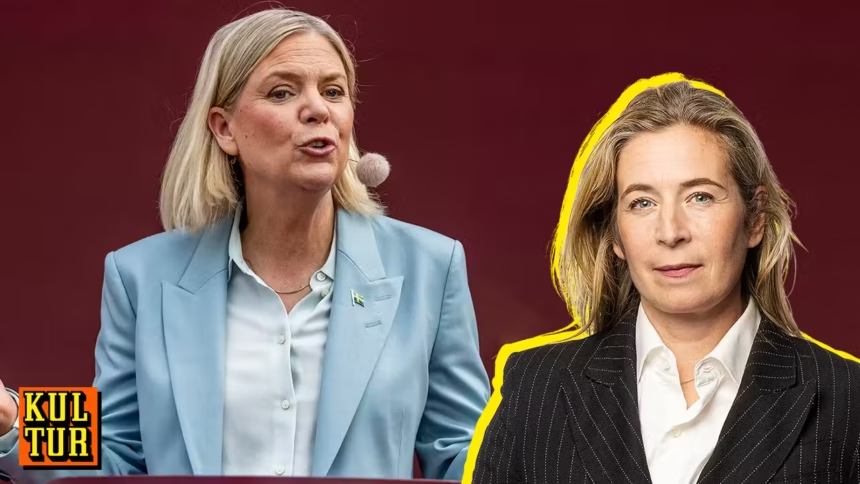
It is: it is not enough, today, for a social democratic government to combine austerity policies and criticism of immigration with order and order in state finances. Look at Britain, look at Germany. Watch Sweden below Magdalena Andersson’s last government period.
In Almedalen itself I sit down on the grass with a pasta salad when Jimmie Åkesson is about to speak. He paints a dark, almost claustrophobic picture of Sweden and his political vision. In the center is the fictional couple Magnus and Susanne. Their dream is freedom, says Jimmie, and defines it as the right to build a plank, to be left alone. He speaks like a man who has ruled Sweden for four years, and he has.

There are many people present when Jimmie speaks, but the applause is muted. This project is running idle, it feels like that. Partly because Jimmie got through a lot of his racist politics, but also because they lost their political tact. The protests against the psychopathic teenage expulsions must be understood as a reaction against a political project stuck in its own echo chamber. Jimmie is no longer an angry outsider, he is a puffed-up politician who, by all accounts, is about to lose.
In port underway at the same time something called We are Swedenthere are a number of artists who gather around a call for climate and democracy. On stage performing Titiyo, Thomas Stenström and others. The message is that the politicians must “take the researchers and civil society seriously”. There are a lot of people there too, but the artists have a hard time really getting the audience going in the heat. Maybe because the call is at the same time overly clear and a bit odd?
In the afternoon, I sit in another panel dealing with “democracy’s fateful moment”, this time with the professor and the academy member Åsa Wikforss and the liberal Birgitta Ohlsson. I think they get stuck in clichés about everything being the fault of the algorithms (much is, but not all) and the importance of “standing up to anti-democratic forces”. I get irritated, possibly get caught up in a fairly predictable explanation myself and possibly kill myself.
It is this year ten years after Brexit, ten years after Trump’s first election win. Everything has changed, but what I perceive in Almedalen is nevertheless a strange standstill, a state of waiting. The big project of the last four years, Tidölaget’s dark mixture of racism, tax cuts and repression is coming to an end. Even I can feel a kind of simple joy at the thought of seeing escape Birgitta Eds embarrassing daisies in pictures from various state visits. But to my question about what comes later, after, I can’t find any answers. When I listen to Magdalena Andersson’s speech online the next evening, she talks about the pensioners. Nothing wrong with that, but any vision for a time of extreme divides, AI revolution, democratic backsliding and climate catastrophe does not carry her story. The activists who protest are quickly and efficiently removed.
I had thought stay longer in Visby, but I can’t take it anymore. I have a sore throat and feel dull. I drive carefully, follow the speed limits slavishly. On the car radio, I listen to reports that people are dying in the heat of Europe. Yellow, already withered birch trees line the road, the sky is so beautiful in the evening that the heart aches. This was the last time for me in Almedalen, I think. At least for a while.
Karin Pettersson is Aftonbladet’s culture director.