
One recent misty morning at Rockaway Beach in Queens, midway through the installation of six artist-designed Ping-Pong tables on the sand, Gabriela López Dena from Public Art Fund said: “I have nightmares where the ocean comes and washes the exhibition away!”
López Dena had been up all night in the rain supervising a crane hoisting these new commissions, conceived to withstand heavy use and the harsh environment, as well as soft serve the artists’ ideas about the democratic landscape of a public beach.
The tables are part of “Between Tides,” kicking off Saturday at Beach 67, with demonstration matches by table-tennis pros and free ice cream and cotton candy at the public opening. The exhibition remains open for public play through Sept. 13. Paddles and balls will be free to borrow at a kiosk Fridays through Sundays, and beachgoers are welcome to bring their own on other days.
The show salutes table tennis’s evolution from Victorian parlor game to Cold War diplomacy tool to Olympic sport — and most recently the backdrop for Timothée Chalamet’s star turn as a champ in the “Marty Supreme.”
“Ping-Pong is a game that allows very different kinds of people to come together across race, class, backgrounds, gender,” said López Dena. She was inspired to organize the show — her organization’s first on a New York City beach — by her love of the game and the tradition of artists including Július Koller, Gabriel Orozco and Rirkrit Tiravanija creating fanciful Ping-Pong tables.
Orozco’s 1998 “Ping Pond Table,” shaped like a clover, with rounded sides abutting a square lily pond at the center, is currently near the entrance of the Pérez Art Museum Miami. It’s part of “Get in the Game: Sports, Art, Culture,” through Sept. 13, and gets regular public use.
“There’s this beautiful history of play that people forget is a part of the experience of art,” said the Pérez director, Franklin Sirmans, an organizer of the exhibition.
For Rockaway Beach, López Dena invited artists and collectives to make sculptures that are playable.
All had memories of the sport. Here’s how each reimagined the game.
Moko Fukuyama, ‘Old School’
Throughout childhood vacations in Japan, “my summertime joy was to play Ping-Pong in this hotel lobby,” said Fukuyama, an artist who lives in Brooklyn and whose large sculptural installations often have a land-water relationship. “My family was dysfunctional, but with Ping-Pong we could get back together.”
Fukuyama has collided her table with an 1958 aluminum boat named “Old School” salvaged from a nearby marina. Psychedelically painted tentacles pierce and grip the two objects as though a giant sea monster is bursting through the sand.
Such creatures exist in folklore “to make sense of unknown things in the ocean,” said Fukuyama, a boat owner who learned to fish in the Rockaways. “The ‘old school’ can be a wonderful thing, but hanging on to nostalgia and resistance to change is causing a lot of friction in current society,” she said. “I wanted to make a sculpture that represents where we are now.”
One fat tentacle rises up through the table where you’d want to serve. Fukuyama said, “If you think you’re winning, you can all of a sudden change course.”
SUPERFLEX, ‘Fish Ping-Pong’
Reinvention is in the wheelhouse of this Copenhagen collective including Bjornstjerne Christiansen, Jakob Fenger and Rasmus Rosengren Nielsen. “Since the 1990s,” said Fenger, a competitive table-tennis player in his youth, “we’ve had this idea that art is a part of society” and is supposed to be “used for multiple functions.”
Echoing the Brutalist-style apartments along the edge of Rockaway Beach, SUPERFLEX’s table-tennis sculpture is made from slabs of pink stone with geometric openings on the base that would be attractive to various forms of coral, algae and fish. “It looks like an architectural model standing near the water, ready for takeover by marine life,” Fenger said.
Players could avoid the circular holes on either side of the tabletop or “only shoot for the holes,” he added.
Amalia Pica, ‘Fair Play’
Growing up in Argentina, Amalia Pica spent summers near a river where her family would bring out a folding table for “ultimate” Ping-Pong. “Imagine a conga line of people batting the ball, then passing the paddle to the person behind and running around the table to play on both sides,” said the artist, who lives in London.
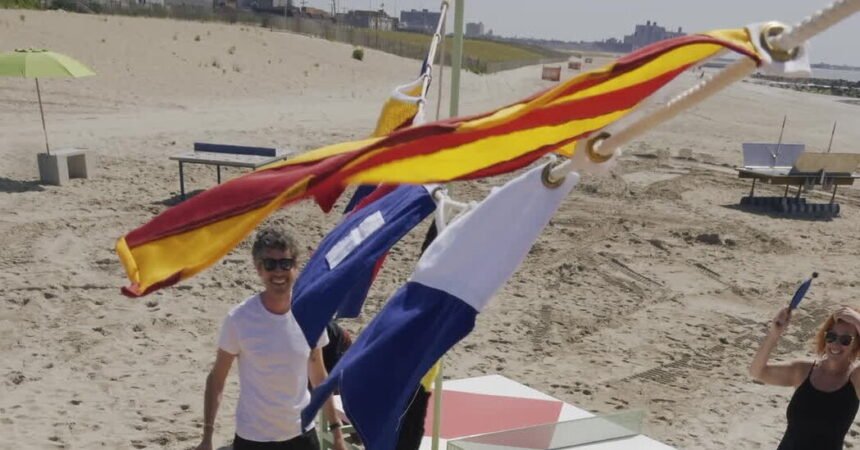
She has brought that collective sensibility to four tables conjoined in a zigzag formation. With the international alphabet of colorful symbols sailors use on maritime flags, Pica has spelled out “Fair Play” across the surface of her tables and “Come Play” on handmade fabric flags suspended from poles at each end of her piece.
The coded imagery of maritime flags “wink to the history of Latin American Concrete art and modernist geometry,” she said. “It feels like a good metaphor for what you do as an artist.”
Up to 10 people can play simultaneously, and Pica hopes strangers will team up.
Las Hermanas Iglesias, ‘DiMeLo’
Las Hermanas Iglesias, the Queens-born sister duo Lisa and Janelle Iglesias, have frequently turned to table tennis “to engage in problem-solving and bounce things back and forth quite literally,” Lisa said. In their practice, Las Hermanas Iglesias often make projects that are interactive, disruptive and absurd.
For Rockaway Beach, which the sisters visited throughout their childhood, they created a hybrid table that can be “played” as sport and musical instrument. The surface is embedded with tom drums, cymbals, a handpan and the bars of a glockenspiel tuned to the key of A — a nod to “Take the ‘A’ Train.”
“We wanted to draw from a rich diversity of different musical traditions but also instruments that would benefit from the stroke of a Ping-Pong ball and that sonic randomness,” Janelle said. Lisa added: “It also hits upon that playful noncompetitive sibling dynamic we’ve experienced for our lives.”
Carlos H. Matos, ‘Tlachco’
This Mexico City-based artist draws on pre-Hispanic Mexican traditions and modernist architecture. Matos has merged the dimensions of table tennis — which he played as a child in his garden — with the design of courts found at archaeological sites for Ulama, the ancient Mesoamerican ballgame.
Symbolic of cosmic battlers, Ulama players use their hips, forearms and thighs to strike a large rubber ball. “The game is having a rebirth in recent times,” said Matos, whose mash-up table has angled side walls on which to spin the ball off and back into the court. “There is not a clearly defined way of playing Ulama,” he said. “The game is still in the imagination somehow.”
At Rockaway, players can reinvent the game with table-tennis paddles and balls. Matos’s tabletop, made of aluminum with a volcanic rock base, has a futuristic look and two tall posts with small hoops that flank the center line.
“In some parts of Mesoamerica, when you passed the ball through the hoop, you automatically won,” he said. “It’s very beautiful to try to decipher how these things might have worked.”
Ilana Harris-Babou, ‘for those of us who live at the shoreline’
“I have an ambivalent relationship to Ping-Pong,” said the artist, a Brooklynite who has used sculpture, installation and video humorously to consider how people shape their identities through objects. “As a New Yorker, I can’t swim,” she said. “As an artist, I’m bad at sports.”
To equalize the field for all, Harris-Babou has embedded the sparkly terrazzo surface of her table with an obstacle course of paraphernalia cast in ceramic, including flip-flops, sunblock, a book, a water bottle and sunglasses.
“Everyone will be bad, so that might make it inviting to more people to try it out or imagine doing something else with it,” said Harris-Babou, who has provided adjacent seating for those who merely want to have a beer, she suggested, or change their baby’s diaper.