Published on 6/26/2026
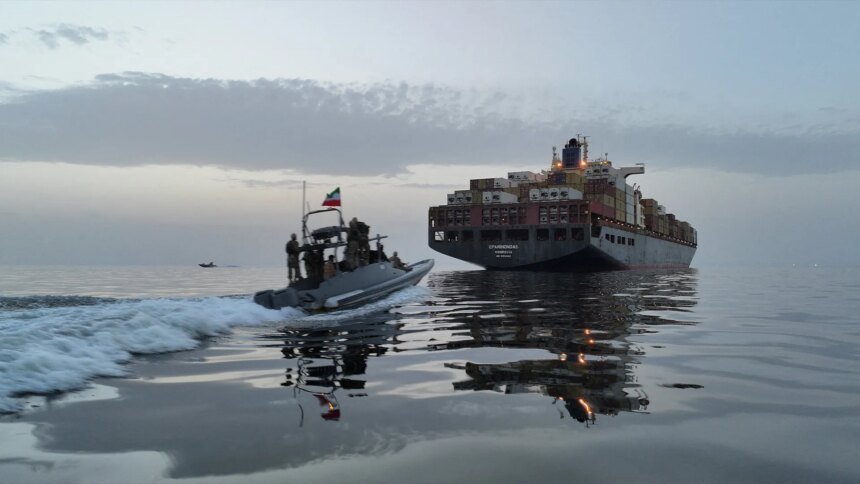
The initial understandings between Washington and Tehran faced their first practical test following the return of military tension in the Strait of Hormuz, which put Article Five of the Memorandum of Understanding at the forefront of events.
Analysts presented, in an analytical segment on Al Jazeera, the reasons for the failure of the item to release the frozen Iranian funds, and the impact of this financial and technical complex on international waterways, coinciding with the preparation for detailed negotiations in Geneva that meet the stipulated 60-day deadline.
In his analysis of the background of the recent tension in the Strait of Hormuz and the targeting of the Singaporean oil tanker, the director of the Arab Center for Iranian Studies, Muhammad Saleh Sedqian, said that the problem stems from Washington’s failure to implement immediate commitments.
Sadiqian added that the first paragraph of the memorandum of understanding – signed by US President Donald Trump – explicitly stipulated the end of military operations in conjunction with the removal of the embargo on frozen Iranian assets immediately after signing.
At the beginning of his talk about the first clause of the memorandum of understanding, Sedqian mentioned that Washington practiced deception, and its officials come out on a daily basis to say, “We did not give Tehran a single penny.”
He explained that Tehran faced a delay in implementation, as the United States did not release any part of the funds despite facilitating navigation in the strait. He pointed out that the Revolutionary Guard’s movements in Hormuz come to put pressure on Washington before the start of negotiations on the detailed issues in Switzerland, stressing that the continued freezing of funds will complicate the entire scene.
The American and Gulf vision
In his response to the Iranian story, former US Deputy Assistant Secretary of State Joey Hood stated that the behavior of the Iranian Revolutionary Guard and targeting unarmed commercial ships with rocket-propelled grenades in the territorial waters of the Sultanate of Oman reflects an attempt to impose military pressure whenever Tehran is dissatisfied with the course of implementing the terms of the agreement.
Hood said about the security tension in the Strait of Hormuz that targeting unarmed commercial ships with rocket-propelled grenades in Oman’s territorial waters is sabotage behavior, and Iranian talk about linking this escalation to the Lebanon front file represents “a weak argument that does not serve smart diplomacy.”
He stressed that Washington sees in these moves an attempt by the Revolutionary Guard to impose its sovereignty over the strait and send a message showing boldness in confronting the Americans, and claiming that the Gulf states no longer have sovereignty over the waterway, which is behavior that depends on destabilization.
For his part, the head of the Al-Madar Center for Political Studies, Saleh Al-Mutairi, stressed that the Gulf Cooperation Council countries adhere to freedom of transit navigation without restrictions.
Al-Mutairi said that the Strait of Hormuz is considered an energy artery that concerns the entire world, and it is not the property of Iran to impose conditions or collect fees outside the framework of international law.
He added that targeting the Singaporean tanker 7 nautical miles from the Omani shores represents an attack rejected by the Gulf side, pointing out that the free flow of energy is a supreme international interest, and that trying to mortgage the safety of the waterway on the file of frozen assets will deepen Tehran’s political crisis and make it lose its credibility before the mediators.
The Secretary-General of the Gulf Cooperation Council, Jassim Mohammed Al-Budaiwi, praised the Sultanate of Oman’s announcement of providing the option of using a temporary sea lane for ships in the Strait of Hormuz, in coordination with the International Maritime Organization.
The statement of the General Secretariat of the Council stated that the Omani initiative aims to launch a plan to evacuate more than 11,000 stranded sailors, to support freedom of maritime navigation and the flow of supply chains for the global economy in accordance with international law and the law of the sea.
On the other hand, Al-Budaiwi expressed the GCC countries’ rejection of Iranian allegations and threats to the movement of ships in the Strait following the announcement of this initiative, stressing support for efforts aimed at enhancing maritime security and reducing tension in the region.