
One of my favorite challenges as a cook is to find the soul of a dish, especially one that has never wowed me. Sometimes it takes years, even decades. But I’m an equal opportunity eater and try not to discriminate. I do my best to cook my way through multiple versions of a dish I don’t care for until I respect it and, ideally, learn to crave it.
So Italians, forgive me, but for years I never understood the appeal of spaghetti with garlic and olive oil, or aglio e olio. It’s a pantry pasta, arguably the pantry pasta. But why turn to it when there are much more flavorful dishes like carbonara, amatriciana and pomodoro at my disposal? I’d take a simple buttered noodle over an aglio e olio any day, or so I thought.
My part-Italian fiancé, Paolo, is a purist when it comes to classic Italian pastas and admits that aglio e olio is never his first choice either. But with him by my side over the years, traveling in many countries, I’ve gathered evidence that garlic-oil spaghetti can be life-changing, something worth craving. In my mind, you won’t necessarily find the dish’s soul in the aglio, but rather in the olio.
Last year, in Takayama, Japan, we made the short walk from the train station to find a small restaurant that serves one of the best aglio e olios I’d ever had. It was deeply savory yet elegantly sparse, and, slurping my way through the mound of dynamically spiced spaghetti, it dawned on me that what made this particular version sing was the flavorful oil that slicked the noodles. It had been seasoned with a single dried red chile, whole parsley leaves and, true to its name, slivers of garlic. All of those things had been fried in the oil, tinting and flavoring it. The garlic was evenly golden, decidedly not brown, and piled atop the noodles like treasure, another signal that much care and attention had been put into my little lunch.
One summer, in Zermatt, Switzerland, we stopped by a restaurant in the mountains for beer, French fries and a plate of garlic-oil spaghetti that lit up our senses. It was, as usual, visually unassuming, but after taking a bite, I noticed a gentle flurry of grated Parmesan threaded throughout, which some would argue took the dish beyond the realm of aglio e olio. The reason it worked here, I surmised, was that it helped the flavorful oil cling to the noodles. There was something almost fluffy about the spaghetti strands, each tangle delivering an avalanche of savoriness, a comforting bounciness not just in taste but in texture as well.
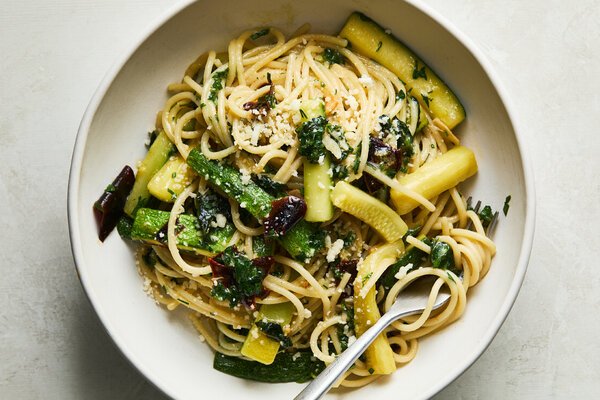
At home, after months of trial and error, I found my dream aglio e olio. It relies on the freshest bulb of garlic I can find and thinly sliced cloves that won’t burn. The parsley, as well, I look for a fluffy bouquet of, something juicy and fragrant. Good parsley smells and tastes almost as strong as celery, have you noticed? The pepperoncino element here comes in the form of whole dried red chiles, like the kind I found at the bottom of my plate in Japan. I like to use guajillos for their smoky, savory, almost jammy flavor, but a recently dried Calabrian chile would be phenomenal. They’re torn into large pieces and fried in good extra-virgin olive oil until their dull brick color turns a brilliant ruby red. Anything you toss in that oil — like spaghetti or, I don’t know, zucchini — blooms in flavor.
I’m of the belief that eating zucchini raw is often the best way to enjoy it, as long as it’s good and fresh. But there are other ways to maximize its deliciousness. Different cuts of zucchini, for instance, bring out different qualities when cooked. With this recipe, I tried all of the shapes: thin coins (which, annoyingly, stick to one another), thick rectangular prisms (which taste like bland bricks), even fine shreds (which get mushy in a flash). But the shape that tasted best with long noodles was a ½-inch-thick baton, thicker than a matchstick but thinner than a steak fry. I love turning my dainty zucchini sticks in that ridiculously savory garlic-chile-parsley oil, letting them drink it up.
So what makes some aglio e olios bland and others revelatory? With old garlic, dusty red-pepper flakes and bland olive oil, it’s hard for pasta aglio e olio to do anything more than get the job done. The secret to a great version, I’ve learned, is a little soul.
Follow New York Times Cooking on Instagram, Facebook, YouTube, TikTok and Pinterest. Get regular updates from New York Times Cooking, with recipe suggestions, cooking tips and shopping advice.