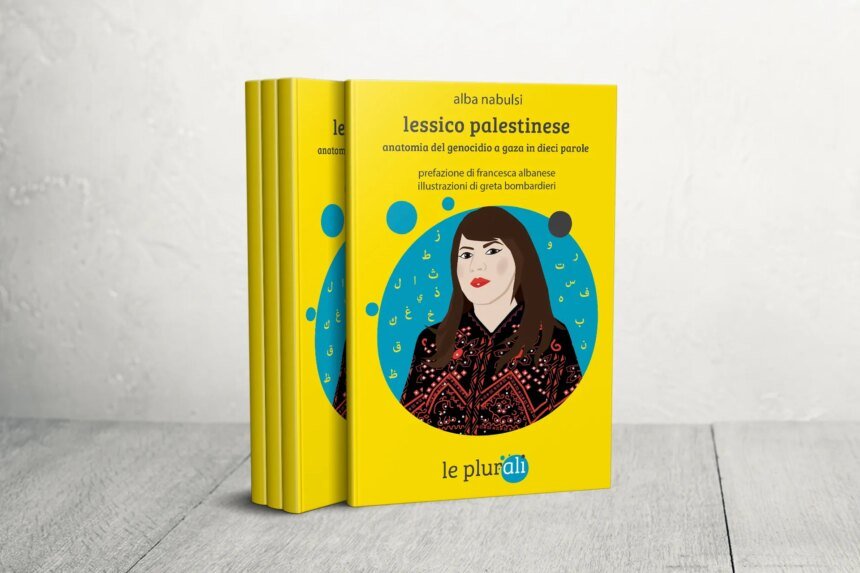
In her recently published work in Italy, “The Palestinian Dictionary – An Anatomy of Genocide in Gaza through Ten Words,” Alba Al-Nabulsi presents a reading of genocide in Gaza through ten vocabulary words: the novel, amputation, the veil, rape, identity, ethnic cleansing, the annihilation of the city, psychological disorder, hunger, and motherhood. The semantic fields of these vocabulary are intertwined around the term “the body” as a battlefield and space for resistance, and a tool in the struggle against oppression and the obliteration of history. Palestinian.
The Palestinian-Italian writer weaves her work based on historical data, journalistic sources, as well as her personal biography, so that her family’s story becomes a symbol of the Palestinian diaspora and the steadfastness that extends across generations. Alba Al-Nabulsi is an independent journalist and curator. She collaborates with Italian and international newspapers such as Il Fatto Quotidiano, Il Manifesto, and Art Tribune, among others.
Read also
list of 2 itemsend of list
She received her education in Italy and France, where she moved between philosophical, sociological, and geographical specializations, which she adopted in her book, the introduction of which was written by Francesca Albanese and which was the subject of discussion at the International Book Salon in Turin recently, where we had this dialogue with the author.

-
Your participation as a Palestinian writer in the most prominent cultural event in Italy through a book that explains the genocide in Gaza, is it an indication that the Palestinian narrative has finally succeeded in imposing itself on the “mainstream” culture in Italy?
I think it is still too early to talk about a complete consolidation of the Palestinian narrative within the cultural mainstream in Italy. Rather, what we are witnessing is a crack in a dominant narrative that has been monopolized for decades in the European discourse on Palestine.
Programming a book that discusses the genocide in Gaza within a central cultural space in Italy, such as the International Book Salon in Turin, does not necessarily mean that cultural institutions have actually adopted the Palestinian perspective, but it does mean that ignoring it will become more difficult tomorrow. This change has imposed itself mainly due to Palestinian perseverance, the work of solidarity networks, and the impossibility of hiding what Gaza has shown to the world.
-
In her introduction, Francesca Albanese describes your book as a “deconstructor of colonialism.” Do you feel that the weight of responsibility placed on the Palestinians of the diaspora in dismantling colonialism is the same as that placed on the Palestinians of the interior and the Palestinians of Gaza and the West Bank, or is there a difference in the hierarchies?
Responsibility is not identical, because the material conditions are not. Palestinian women in Gaza write and resist under siege and bombing. While the Palestinian diaspora operates within Western structures that often produce and justify colonial violence. This applies to those who suffer daily in Jenin, Jerusalem or Nablus.
But of course, the privilege of living within a context in which health, educational, social and economic conditions differ from the situation in Palestine cannot be denied. But there is also a powerful shock to our generation, a haunting feeling of guilt and helplessness, as well as the threat of censorship and marginalization.
Accordingly, the diaspora has a specific task: translation, mediation, and deconstruction of the language that is formulated in centers of imperial and local power. There is no hierarchy of pain, but rather a difference in the political and historical location of each of us. One hand extends to another, and one voice listens to another, just as in the song “I Call You” by Ahmed Kaabour, which my father used to listen to me since my childhood.
-
You open your book with a poem by Mahmoud Darwish and close it with verses by Fadwa Tuqan, and your language is not devoid of a literary spirit. Rather, you went on to consider the “novel” as part of the Palestinian body. Is every Palestinian person born a poet or novelist by nature, or are there changes that occurred in his vocabulary after the clash with colonialism to address the conscience of the world?
I do not believe that every Palestinian is born a poet, although the writing I adopt often tends towards poetic language rather than rhetoric. Therefore, I am grateful to poetry because it stores within it a wealth that the language of prose cannot translate, which is what inspired me and pushed me to write.
In fact, the Palestinian situation forces everyone to bear constant witness, even those who from other locations can enjoy the privilege of practicing “art for art’s sake.” But when your very existence is denied, language ceases to be merely an artistic expression, and becomes a trace, a record, and a resistance. Therefore, Palestinian literature rarely separates aesthetics and memory, and between beauty and political awareness.
Mahmoud Darwish and Fadwa Tuqan are not just cultural references, but rather they are part of a Palestinian emotional and political lineage, written between smiles and tears, and the smell of maqluba, engraved on the bodies of martyrs. There is no hierarchy between “I Long for My Mother’s Bread” and the pen of any writer or the brushstroke of any Palestinian artist. It is a continuous extension, an endless tape in which the beginning and the end are mixed, forming a reality that continues even in diaspora. It is a memory of a place that we may sometimes preserve better in a painting than in reality.
Just as Muhammad Jeha does in his paintings of Gaza, which were unintentionally transformed from a captured moment of memory from his beloved land into testimonies of a destroyed and shattered space as the Gaza Strip has become. Or as Vera Tamari does in aesthetically archiving plant seeds, celebrating the deep roots of our olives as a contemporary symbol of resilience.
-
It was noteworthy that you mentioned the word “rape” at the beginning of your book, where you point out that the chapter contains shocking descriptions and you call for skipping it for those who cannot bear the burden of it. How were you able to write a chapter like this and what was its impact on you?
The publishing house that published my book, Le Plurali, is a house founded by women for women, with a feminist sensibility. The note stemmed from awareness that some topics have a severe impact, especially for victims. Writing that chapter was very difficult, because colonialism does not just occupy the land: it invades the body, intimacy, and memory.
One of the most painful issues was confronting the way in which sexual violence is exploited in the media. For example, the New York Times article “Screams Without Words,” which was published after October 7, contributed to the publication of accusations that were later forcefully denied by investigative journalists, academics, and even by some of the families concerned. In contrast, documented testimonies of sexual violence and violations against Palestinians in Israeli prisons and during the Gaza war received much less attention, despite being documented in later reports.
Among them is surgeon Adnan Al-Barsh, who was arrested in December 2023 while working in northern Gaza, and died in Ofer prison. Horrific accounts of his death and the condition of his body were received from other detainees and human rights organizations, as it is believed that the doctor was raped and tortured to death, which was reported by Al Jazeera.
This inequality reveals which bodies are deemed credible and which remain invisible. Writing about this means crossing two traumas: the trauma of violence, and the trauma of political manipulation of pain. The opposite is also true: making false comparisons is wrong. For example, talking about the Palestinian issue as an equal “conflict” with the Zionist entity, as if there were two armies of two recognized states facing each other. Or making comparisons between state violence and the violence of individuals or militias. The Palestinians find themselves, among a thousand ways in which they resist, with unequal weapons: they inherit a battlefield, and they defend themselves as best they can in the midst of complete oblivion about them.
Personally, I believe that the best image of resistance is that of an oppressed prisoner making his way to freedom, even if only for a few days, with a spoon; Or the image of the Gazan woman who insists on bringing a baby into this world, even in the midst of genocide.

-
You say that the term “hijab” was the most controversial chapter in your work. How?
Because the veil in Western discourse is rarely left to speak for itself. It is often transformed into a symbol: of oppression, backwardness, extremism, or “a liberation that must be saved.” There are stereotypes about the body of Palestinian women that apply to both the right and the left. The Orientalist right sees it as inherently oppressive and in need of Western “preparation.”
While part of the liberal left accepts its freedom only when it conforms to Western standards of secularism and individual liberation. In both cases, the problem is the same: Palestinian women are still read through classifications produced by others. This chapter upset everyone because it rejects colonial patriarchy as well as the idea that there is one “right” way to freedom. For me, self-determination is the only compass that should be relied upon in such issues.
-
Is it not useful, then, to import forms of resistance created in the West for the sake of liberation from Western hegemony, or must the tools of struggle be authentic and innovative from within the oppressed culture?
Every anti-colonial struggle must question its tools. Some concepts developed in the West, such as feminism, intersectionality, and postcolonial studies, may be useful, but they become problematic when they are exported as universal models.
Liberation cannot be an imported theoretical version, but must stem from the concrete experience of the oppressed, otherwise we will replace one hegemony with another. For example, civil and gender rights issues were severely hampered by funds directed during Oslo after it was observed that certain human rights organizations were favored and coddled because they were less “problematic” compared to those demanding political rights, creating an artificial competitive situation created by “development aid,” which limited Palestinian agency and produced colonial stereotypes even on just issues.
-
What distinguishes your book and enables it to become a reference for Palestinian vocabulary in light of the multiplicity of opinions and division over every word you present?
I do not believe that there is one definitive Palestinian dictionary. Palestine itself is fragmented by exile, occupation and diversity of experiences. The book does not claim to present absolute truth, but rather attempts to show how words are arenas of political struggle. Terms such as “terrorism,” “resistance,” “security,” “peace,” and even “humanity” are not neutral.
Perhaps this book can become a reference because it actually reveals these tensions rather than hiding them. In the future, I want to study the ways Palestinians record their history and compare their dictionaries with mine. This is the topic of my next research.
-
You concluded your intervention at the International Book Salon in Turin with the phrase: “Don’t talk about the Palestinians, talk to the Palestinians.” To what extent is the Palestinian voice still not represented in Italy?
The problem in Italy is not only the absence of Palestinian voices, but that Palestinians are often invited to speak within narrow limits: only as victims, and not as full political actors. “Talk to the Palestinians” means acknowledging their narrative authority, not just human sympathy for them.
It also means using their language and reconsidering the discourse that has distorted the Palestinian reality for decades, such as continuing to describe the situation as a “conflict” in a way that suggests a non-existent equality. Many European media terms are derived from Israeli propaganda and reproduce its map of meanings: “human shields,” “war on terror,” “confrontations,” and “directed operations.” Words are not neutral; It creates what the public will consider legitimate, humane, or inevitable.
Therefore, the issue of representation is not only related to who speaks, but also to the language used to talk about Palestine. I believe that my book attempts, with humility, to present an approach that is grounded in historical experience, centered around bodies and what they experience and what they do. It is a personal dictionary because it is political, and political because it is personal and family. Its title is a tribute to the Italian Jewish writer Natalia Ginzburg, who rejected Zionism even before its rejection became commonplace today.