Published on 6/25/2026
|
Last update: 19:45 (Mecca time)
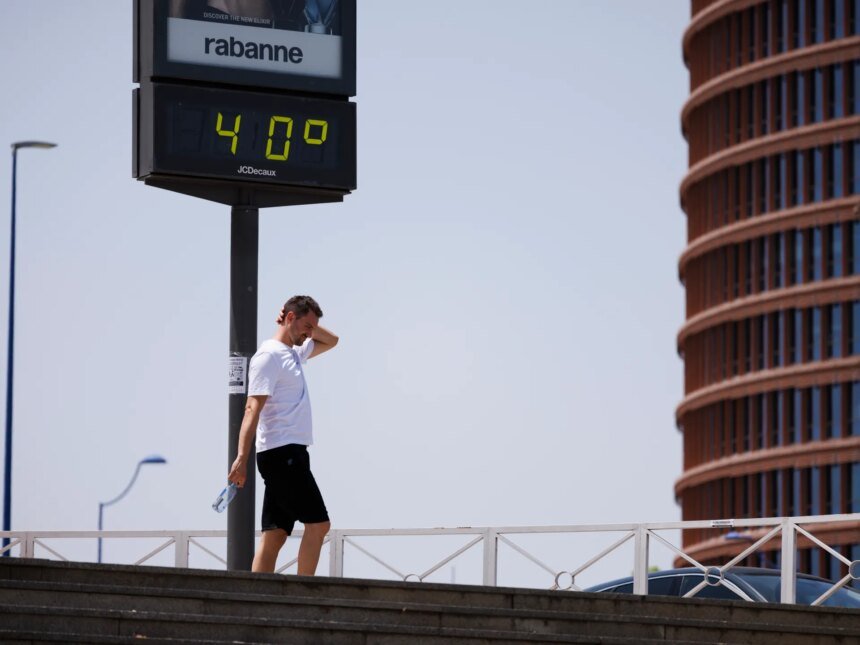
In the second step of its kind within a week, today, Thursday, the main French energy company stopped two nuclear reactors in a measure to protect the environment, while the municipality of Paris called on residents to be cautious, amid a record heat wave hitting the country and large parts of Western Europe, causing dozens of deaths, power outages, and the closure of public facilities in Spain, Italy, and Britain.
The severe heat wave hitting European countries resulted in the deaths of 212 people in Spain, and 48 people, including 3 children, in France, this week.
According to Agence France-Presse, today, Thursday, no less than 101 million people in Europe, including more than 50 million in France and 18 million in Germany, are expected to witness temperatures exceeding 35 degrees.

France: Dozens of deaths, including 3 children
Electricité de France announced that it had temporarily closed two reactors at the Nogent-sur-Seine power station on the Seine River in northern France, and the Puget station on the Rhone River near the city of Lyon in the southeast of the country, in order to avoid discharging large quantities of hot water into rivers that are witnessing a rise in temperatures as a result of a record heat wave, and in compliance with the restrictions imposed on river temperatures.
The “Nogent-sur-Seine” station had reduced production in another reactor a few days ago “to limit the temperature rise between the water withdrawn from the Seine River and the water returned to it, and thus protect aquatic plant and animal life.” The French Electricité de France also resorted to the same thing, last Monday, with the “Golfish” station in the southwest of the country on the Garonne River.
In a parallel trend, on Thursday, Paris Mayor Emmanuel Gregoire called on residents to be cautious, asking those between the ages of 50 and 70 to protect themselves.
The authorities reported yesterday, Wednesday, that the death toll since the beginning of the heat wave had risen to at least 45 people who drowned, and 3 children died inside cars. At the same time, Gregoire announced that the number of deaths in the capital was increasing, without providing specific numbers.
On Wednesday, France recorded the hottest day since temperatures began to be measured in 1947, with the general average reaching 30 degrees Celsius, while the temperature in Paris exceeded 40.3 degrees Celsius, which is the fourth time it has exceeded 40 degrees in 150 years.
Spain: more than 200 victims
Data showed that there were more than 212 deaths recorded between last Sunday and Wednesday, which could be linked to the heat wave hitting Spain, according to the Carlos III Health Institute in Madrid.
These estimates are based on a system that collects the numbers of daily deaths in Spain, and calculates the differences between them and expected deaths based on historical data.

5 deaths in Italy
In Italy, Health Minister Orazio Schillaci called for a meeting to discuss the dangers resulting from the heat wave, after Italian media reported the death of 5 people yesterday, Wednesday, as a result of incidents related to it.
The Ministry of Health placed 16 cities – including Florence, Milan, Rome, Turin and Verona – under the highest level of heat warning, and warned that the heat wave may intensify further, reaching its peak on Sunday and Monday.
Some tourist attractions closed their doors in London due to the heat wave, which disrupted some means of transportation in the British capital.
The maximum temperature will exceed 30 degrees for more than 380 million people in Europe (excluding Türkiye), which represents about two-thirds of the population on the continent.
Temperatures are also expected to exceed 30 degrees in areas with more than 70 million people in Germany, 48 million in Italy, and 38 million in the United Kingdom.
The causes of the extreme heat wave are due to a climate phenomenon known as the Omega Barrier, as this phenomenon pushed temperatures up to 18 degrees Celsius above normal, according to the Reuters Climate Observatory.
Experts attribute these extreme weather conditions to atmospheric and air circulation patterns that keep hot air confined in place for days, and these factors are exacerbated by climate warming.