Soccer is more than 22 people and a ball
It is unfortunately difficult to avoid the World Cup. If nothing else, I’m starting to long for a really exciting match, the kind that could be historic. Dream of a charged grudge match, or a real brawl. In the middle of the protracted and somewhat sleepy group stage, I go and see Juan Cabral’s and Santiago Franco’s documentary about what has been called the Match of the Century: the quarter-final of the 1986 World Cup between England and Argentinaat the Aztec Stadium on June 22. The soundtrack is dominated by The Queen, the pants are short and tight, the jerseys are spacious and the pitch is far from perfect.
At first, “The Match” resembles any retrospective documentary, when you line up those who were there, now distinguished older men. Yes, those who are still alive. Because the epicenter of the film is of course Diego Maradonadead at the age of 60 in 2020. He who scored both goals when England was defeated, and a few games later became world champion.
But why is it the “Match of the Century” and why should anyone but total football fools care?
It’s the movie’s premise and case to unravel, and in the process creates a declaration of love for a sport that sometimes transcends, goes up another level, transcends the real and becomes a dream, a place where misfortune and happiness change places and merge.
The question posed in the documentary is: when does a match start, and when does it end?
The story of this particular one begins a bit pointedly in January 1765 when the vice admiral John Byron (by the way, also grandfather of Lord Byronthe poet) annexed the Falkland Islands on behalf of Great Britain. Many tours later, the British flag was put back in place in 1833, and again in 1982 when the last war ended.
Of course it is colonial history and the Falklands War a dark wall against which the film and possibly the match leans. The parallels become painfully clear between the flag-waving that goes on in the square when the war is celebrated – and the flags seen in the stands. The international battles as the peaceful wars, war substitutes. Maybe that’s why they don’t appeal to me.
The fall of the Argentine junta, which was nevertheless a consequence of the war defeat, is barely mentioned in the film. It is clear that the film is not about the politics of football but about the inherited psychological stress of football and international matches.
A person half-interested in soccer probably just says that Argentina won because Maradona scored with his hand. A fool says: that was the beauty of football, far beyond anything rational. Football is not 22 people and one ball. Football is nationalism, it is bloody serious and still “just football”. It’s politics and “just football” at the same time, and everyone has understood that at least now that the last World Cup tournaments have been hijacked by corrupt forces.
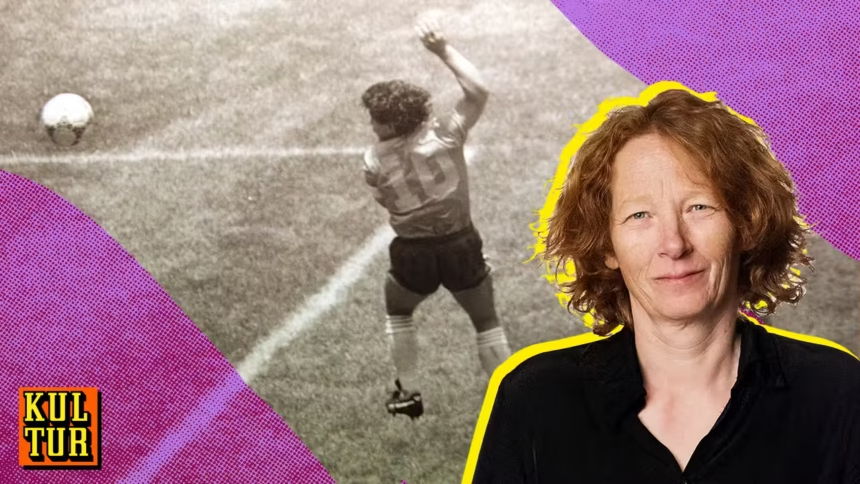
Aztec Stadium 1986: maybe not everyone, but a large part of the audience must have seen how Maradona boxes the ball into the goal, in an aerial duel with the English goalkeeper Peter Shilton. Even a linesman claimed afterwards that he had seen, but back then linesmen had no power compared to now. With the technology of the time, it took several hours before a photographic proof existed. Therefore, the goal could be approved – and later attributed to the “hand of God”.

The video refereeing system, VAR, crushes such an event.
That doesn’t mean it was better before. But the beauty of football, its transcendence, is killed by the increased control and the dream of justice. A dream connected with the possibilities of predictability.
“The Match” wants depicting how various small events led up to and even past the iconic moments. Hate matches between the teams long ago, or what music the Argentine national team always listened to. How early football came to Argentina from England with railway workers. That it replaced the midfielder Steve Hodgewho unhappily spliced the ball into the first back goal, was the person who managed to get his hands on Maradona’s number ten shirt and in 2022 it will cost £7 million.
Somewhere in there, one can imagine the beginning to the end of the match of the century. Perhaps also a kind of monetary divine justice? As if by chance sold in days Pelés jersey from the World Cup final in 1958 at any auction house in the world. It is estimated to go for 6 million dollars.
Ulrika Stahre is editor and critic at Aftonbladet Kultur, responsible for art coverage.