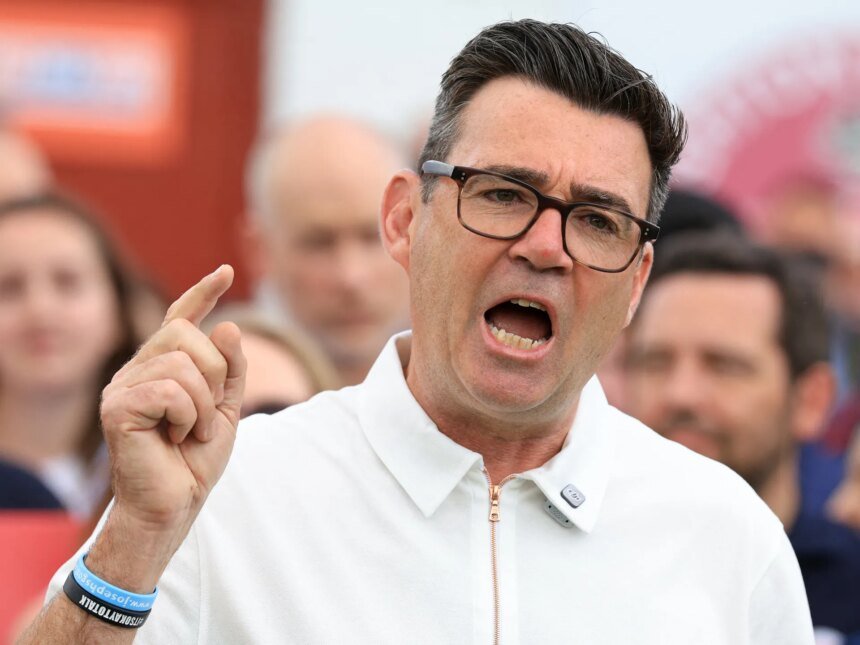
Although he has not yet stepped onto the doorstep of Downing Street, former Manchester Mayor Andy Burnham, the most prominent candidate to succeed British Prime Minister Keir Starmer following his resignation, appears to be on the verge of an early confrontation with US President Donald Trump.
With his return to the House of Commons this June as a representative for the Makerfield constituency in northern England, and speculation mounting about his entry into the leadership race of the Labor Party, British analyzes began to question the nature of the relationship that might link him to the Trump administration if he became prime minister.
Read also
list of 2 itemsend of list
Analysts believe that the relationship between Burnham and Trump may be vulnerable to tension due to discrepancies on a number of issues, as well as the public criticism directed by Trump against Starmer and the policies of the Labor government even before he announced his resignation.
What are the most prominent potential points of disagreement between politicians? Why might the next Labor Party leader inherit a complex relationship with Washington even before he takes office as prime minister?
Immigration
The issue of immigration and border management stands out as one of the main files that may complicate the relationship between Burnham and Trump.
In an article in the iPaper newspaper, political writer and editor James Ball indicated that Trump took the initiative to comment on Starmer’s departure even before it was officially announced, through a post on the “Truth Social” platform, in which he said that the British Prime Minister “failed miserably on two very important issues: immigration and energy.”
In turn, American affairs commentator at iPaper, Simon Marks, says that pleasing Trump on the immigration issue may be a complex task for Burnham, pointing out that the description given by Nigel Farage, leader of the right-wing “UK Reform” party, to Burnham as having “open borders” may quickly find an echo within the White House.
At first glance, Burnham, who comes from a labor and left-wing background, does not appear to be the type that Trump prefers, in addition to that he is still a largely unknown figure in American political circles, especially in Washington, according to the article.
Paul agrees with this proposal, as he believes that managing this file will not be an easy task for Burnham, explaining that net immigration has decreased by about 75% since Starmer took office as prime minister, and it is unlikely to decline further, and may even turn into negative numbers during the next year.
However, the writer adds that this decline did not receive much attention in Britain, where the debate over immigration is still raging and the division over it continues. Nor did it attract the same attention from the US President or among the American right, which he believes are trying to exploit the issue to “inflame tensions” in Britain.

Energy and oil
In addition to immigration, Trump accuses the Labor Party’s policies of being deficient in the field of energy and oil exploration. Marks quotes Trump as saying in statements from the White House after Starmer’s resignation, “You are screwing things up in the energy field. You have wind turbines everywhere, and at the same time you have North Sea oil, but they don’t allow anyone to drill. They don’t want that for environmental reasons.”
The writer considers that these statements reinforce what he calls the Trump administration’s “road map” toward Britain, whether for Burnham or any other potential leader of the party, as the American president places the next prime minister before two basic conditions: tightening border closures, and expanding oil exploration operations under the slogan, “Drill, guys, drill.”
The writer continues that Burnham’s willingness to resume drilling operations in the North Sea would give him support from Trump, even if the British Treasury doubts the extent of this step’s ability to reduce the burden of energy prices on families.
Likewise, Paul argues that the North Sea oil issue may be a point through which Burnham can make concessions to satisfy Trump, in light of internal political pressures pushing towards allowing more oil and gas exploration operations, currently subject to government restrictions.
But even if Burnham tends to support some drilling operations, this may constitute a card to temporarily calm Trump if the US President notices this at all, according to the article.
Foreign policy
British foreign policy, especially with regard to participation in US-led wars, is among the most prominent issues that may test the nature of the relationship between Trump and Burnham if the latter takes over as prime minister.
In this context, Marks points out that Trump, during the aforementioned statements, criticized Starmer’s position regarding delaying granting the United States access to air bases in the United Kingdom with the beginning of the war on Iran.
Starmer’s experience in this file reveals an ongoing problem, as rejecting the White House’s demands – as the author explains – may quickly arouse Trump’s anger, while compliance may lead to Britain getting involved in legal problems related to the nature and objectives of military operations.
The writer also mentions that Trump expects his allies to be prepared to engage in any future wars he may decide to fight, considering that any position that is not consistent with that may arouse widespread American dissatisfaction.
In this regard, Paul believes that Burnham is unlikely to commit to supporting any new American military action, noting that allowing British bases to be used in unpopular wars usually reflects negatively on Labor prime ministers.
Taken as a whole, these analyzes outline the most prominent potential disputes between the US President and the next British Prime Minister, amid questions about whether Starmer’s successor will inherit the same challenges in dealing with Trump, or whether he will be able to manage these differences with the United States, one of the United Kingdom’s oldest and most prominent allies.