Published on 6/23/2026
The attack that targeted Diori Hamani International Airport and a military base adjacent to it in the capital, Niamey, last Thursday morning, raised questions about the path of security stability in Niger, after the “Support for Islam and Muslims” group linked to Al-Qaeda claimed responsibility for the operation later the same day.
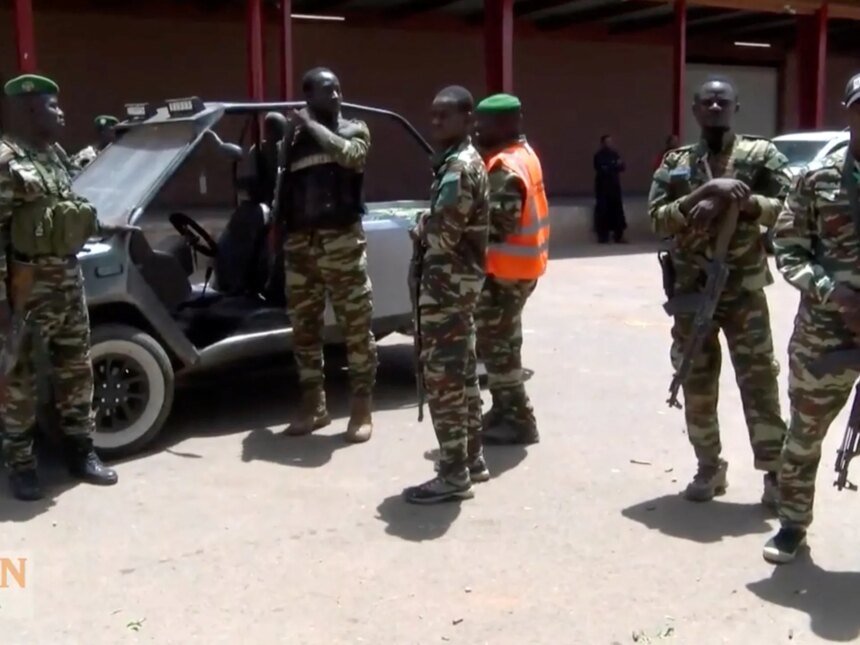
The Nigerian Ministry of Defense announced in a statement that 11 soldiers, two civilians, and 22 attackers were killed, about 20 suspects were arrested, and 4 people were injured, according to a preliminary toll. The statement added that a “large-scale operation” carried out by the army is underway, and that the international airport is “fully secured and remains open to air traffic.”
The attack began around six in the morning local time (05:00 GMT) by gunmen belonging to an armed group. A source told Agence France-Presse that the gunmen arrived at a security checkpoint near the airport “by taxi,” and then faced “fierce resistance” from the security forces.
A witness and two residents close to the site told Reuters that the situation had returned to being mostly calm by noon (11:00 GMT), with sporadic gunfire possibly linked to sweeping operations. No immediate responsibility was claimed for the attack, but it was later claimed by the “Support of Islam and Muslims” group, which said in a statement that it had carried out a “suicide attack” on the airport and the nearby military base.
An escalation in ability and ambition
Hani Nasibiya, chief West Africa analyst at ACLED, an organization specialized in monitoring conflicts, believes that the attack “highlights a dangerous escalation in the ability and ambition of these groups together, and represents a transition from a local rural rebellion to coordinated strikes on vital national infrastructure.” He added, in a comment published by the organization, that this is “the third attack targeting an airport in Niger during the past six months, after the other two attacks were carried out by other groups, and the second was against Niamey Airport, which clearly demonstrates the increasingly fragile security environment in Niger and the Central Sahel region in general.”
Nasibiya linked the attack to a broader regional pattern of groups expanding towards major population centers and sensitive infrastructure, citing the coordinated attack launched by “Supporting Islam and Muslims” in Mali on April 25, targeting Bamako airport, the city of Kati, and other towns. He pointed out that the operation “also indicates the parallel expansion of the group “to support Islam and Muslims” and the Islamic State in the Sahel, where their long-standing competition for regional hegemony is pushing for increasingly frequent and high-impact attacks against strategic and symbolic targets.”

Strategic location
Niamey Airport is one of the most prominent strategic military sites in the country, as it hosts foreign military units, including Russian forces and drone units, in addition to strategic stocks of uranium that Niger seeks to sell. In recent weeks, the authorities began demolishing thousands of illegally built homes near the airport as part of what they described as confronting a “terrorist” threat, while extending the security fence and installing more than 350 surveillance cameras inside and outside the perimeter.
The June attack comes months after an attack targeting the same compound on January 29, which was claimed by the Islamic State branch in the region, and which, according to the authorities, resulted in the killing of 20 fighters and the wounding of 4 soldiers. The leader of the military junta, General Abderrahmane Tiani, had accused the presidents of France, Benin, and Côte d’Ivoire of sponsoring the January attack without providing evidence, an accusation that was rejected by Paris and the two capitals concerned.
Niger, like its neighbors Mali and Burkina Faso, is facing difficulties in containing attacks by armed groups linked to Al-Qaeda and the Islamic State, which have left thousands dead and millions displaced in the three countries, at a time when the three countries have rearranged their alliances after withdrawing from the Economic Community of West African States (ECOWAS).