Published on 6/24/2026
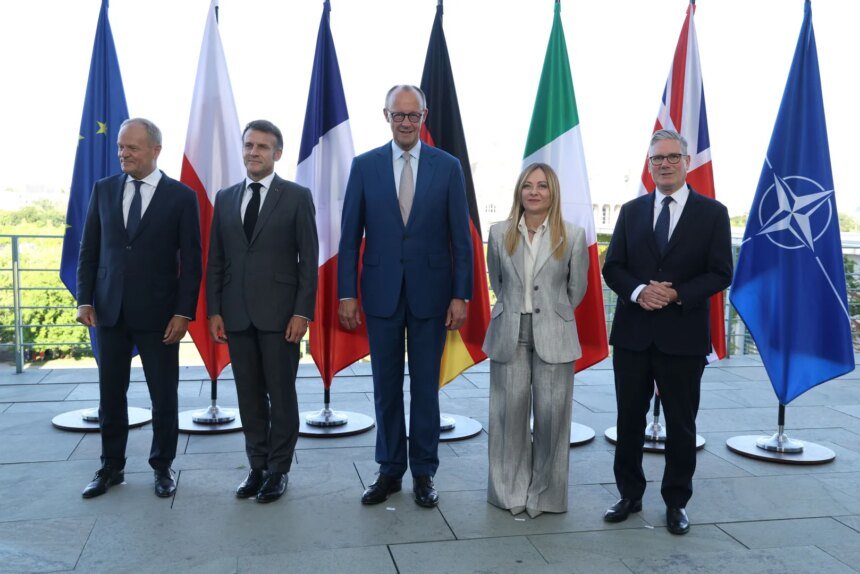
Leaders of the five European countries met in Berlin on Wednesday to outline a unified position before the upcoming NATO summit in Ankara, amid efforts to confirm that Europe wants to play a greater role in protecting its security, enhancing its military capabilities, and maintaining the cohesion of the transatlantic alliance.
The meeting, which brought together the leaders of Germany, France, Britain, Italy and Poland, focused on three main files:
- Future support for Ukraine in the face of Russia.
- Strengthening European defense capabilities.
- Coordination with the United States and NATO is at a stage that is witnessing a redefinition of international security equations.
European leaders stressed that the next stage requires Europe to move from a position of complete dependence on allies to possessing a greater ability to defend itself, with a commitment to raising defense spending to unprecedented levels, and strengthening European military industries to meet the challenges of modern wars.
German Chancellor Olaf Scholz opened the press conference by emphasizing the importance of team spirit and European cooperation, praising the role played by allied countries in supporting the security of Europe and NATO.
Schulz stressed that the current stage requires strengthening coordination between European countries, especially in light of the increasing security challenges, stressing that the Berlin meeting comes within the framework of preparation for the Ankara summit and a clear message about the unity of the European position.
He pointed out that Europe is working to strengthen its defense capabilities, including increasing investment in the military sector and related industries, given that European security has become directly linked to the continent’s ability to produce its defense tools.
Preparing for the NATO summit
Italian Prime Minister Giorgia Meloni confirmed that the meeting comes in the context of preparing for the next NATO summit, noting that NATO Secretary-General Mark Rutte participated in the meeting before heading to Washington to meet with US President Donald Trump.
Meloni said that European leaders want to send a clear message to their partners that Europe is committed to a cohesive NATO alliance capable of protecting security in the Euro-Atlantic region.
She stressed the commitment of European countries to what was agreed upon at the Hague Summit, especially raising defense spending to 5% of GDP before 2029, noting that countries such as France, Poland and Germany have already begun investing in developing their defense industries.
French President Emmanuel Macron focused his speech on the necessity of building a common European defense, warning that each country relying on its own capabilities would be a “serious mistake.”
Macron said that Europe needs deeper cooperation at the European and Atlantic levels, noting that Germany’s increasing defense strength should be a source of reassurance to its neighbors and not a source of concern.
He stressed that the new challenges are not limited to conventional weapons, but rather include areas such as artificial intelligence, space capabilities and military technology, which requires the development of the European defense industry collectively.
Regarding the Ukrainian file, Macron said that European leaders want to send a clear message from Ankara that Ukraine will remain strong as long as its support continues, calling on Russia to enter into serious and constructive negotiations to end the war.
Iranian file
Polish Prime Minister Donald Tusk confirmed that the Ukrainian issue was the main focus of the discussions, along with the Iranian file and Middle East issues.
He pointed out that European countries and the United States have become closer in their position towards Ukraine, stressing that the recent G7 summit in Evian was an important milestone to demonstrate the unity of the Western position.
Tusk said that Washington affirmed its support for Ukraine’s sovereignty, and also agreed to continue pressure on Russia through sanctions, including measures related to Russian energy.
Regarding the Middle East, Tusk spoke about European countries’ support for any diplomatic steps that ease tensions, pointing to participation in the “Hormuz Mission,” which aims to provide support without engaging in military operations, in addition to supporting Lebanon and preserving its sovereignty and territorial integrity.
He stressed that the Ankara summit will be an opportunity to show that NATO is not just a military alliance, but rather a political and strategic framework that preserves the unity of the West.
British Prime Minister Keir Starmer confirmed that his country is working to strengthen its relationship with Europe and its allies, stressing that Britain stands by respect for international law.
Starmer said that supporting Ukraine will remain at the top of his country’s priorities, stressing that Moscow is facing increasing economic pressure due to war-related sanctions.
He pointed out that the upcoming NATO summit represents an opportunity to strengthen the European role within the alliance, while maintaining cooperation with the United States, considering that deterrence power is the basis for confronting current and future threats.
He revealed that Britain is preparing for the largest increase in defense investments since the end of the Cold War, not only to raise military spending, but to redevelop the way these funds are used to serve innovation and defense industries.
He stressed that modern wars no longer depend solely on superiority on the battlefield, but rather on superiority in technology, production, and economic ability.