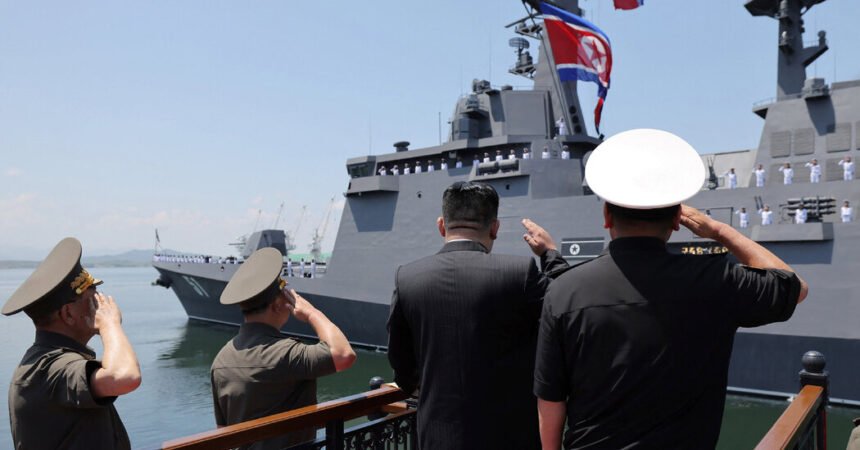
The ambition of North Korea’s leader, Kim Jong-un, to project naval power beyond his country’s coastal waters was boosted this week when he officially commissioned the country’s first naval destroyer, which he said was armed with nuclear-capable missiles.
Mr. Kim attended a ceremony for the 5,000-ton Choe Hyon on Tuesday in Nampo, a port southwest of the capital, Pyongyang, according to state media. The largest warship North Korea has ever built, the vessel has come to symbolize Mr. Kim’s drive to expand and nuclearize his navy since its maiden test run in April last year.
Mr. Kim said in a speech at the ceremony that the navy was going into “full-fledged service” and that “the program of equipping the navy with nuclear weapons is following its planned course unerringly.”
North Korea’s navy has long been overshadowed by its South Korean counterpart and by U.S. naval fleets operating in the region. Its aging fleet — most vessels were designed and built during the Soviet era — has been confined largely to coastal patrols.
Mr. Kim’s naval expansion has coincided with his decision to supply weapons and troops to Russia, in support of its war against Ukraine. Russia is widely believed to be reciprocating with shipments of oil and food, as well as technology and materials to help modernize the North Korean military. South Korean analysts who observed recent missile tests conducted from the Choe Hyon said that some of the weapons, including a supersonic cruise missile, appeared to incorporate Russian technology.
Historically, North Korea’s nuclear arsenal has been built around ballistic missiles, as the country lacks nuclear-capable aircraft or submarines. In recent years, however, Mr. Kim has made the nuclearization of his navy a priority — testing submarine-launched ballistic missiles, unveiling the hull of what Pyongyang described as a nuclear-powered submarine and developing unmanned underwater vehicles that it said were capable of carrying nuclear warheads.
The destroyer program has not been without setbacks. In May last year, a second 5,000-ton destroyer — the Kang Kon — capsized during its launch from North Korea’s east coast, a humiliating failure for the regime.
Mr. Kim said Tuesday that the Kang Kon, now salvaged and repaired, would soon be commissioned and pledged that warships would follow.
“We should build, every year, two surface ships whose class is higher than the Choe Hyon, including a 10,000-ton cruiser,” he said.
North Korea routinely uses the unveiling of major weapons systems to burnish Mr. Kim’s image as a leader who has defied U.S.-led international sanctions to strengthen national security. Yet analysts noted that the Choe Hyon falls short of modern destroyer standards, lacking sophisticated missile defense radar.
“It looks more like an attack destroyer chock-full of various missiles,” said Yang Moo-jin, a former president of the University of North Korean Studies in Seoul. “We will need to study how well such a ship would survive in modern warfare involving precision strikes and drone attacks.”
Nevertheless, military analysts warned that a North Korean fleet of larger, more heavily armed vessels could heighten tensions in waters around the Korean Peninsula, where the United States and its allies are already contending with an increasingly assertive Chinese military presence.
Ships like the Choe Hyon could give North Korea a mobile surface platform for launching nuclear weapons, said Hong Min, a North Korean military expert at the Korea Institute for National Unification in Seoul. Mr. Hong added that Mr. Kim may be drawing lessons from the recent crisis in the Strait of Hormuz about the strategic value of threatening major sea lanes — a concern of particular relevance to South Korea, which imports all of its oil and gas, much of it through ports near the two Koreas’ disputed western maritime border.
North Korea does not recognize the boundary, which was established by the U.S.-led United Nations Command at the close of the 1950-53 Korean War. The two Korean navies have fought several deadly skirmishes there over the decades.
This week, Mr. Kim said — without elaboration — that his navy would take on “a different mission” and operate over “a different area of waters.” The era when the North Korean navy just defended its coastal waters, he declared, “has now firmly become a thing of the past.”