
Published on 6/25/2026
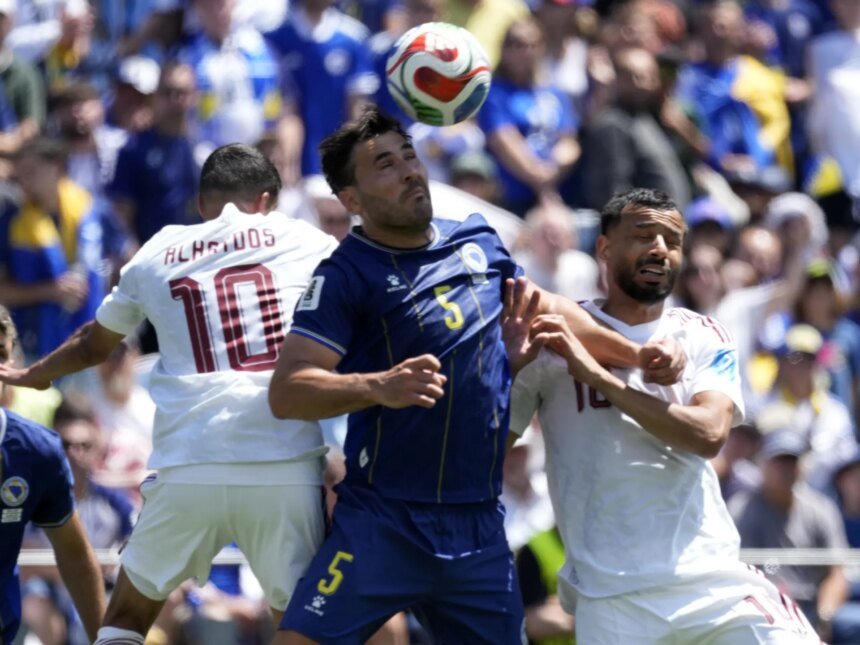
The Qatari national team brought down the curtain on its participation in the 2026 FIFA World Cup with a loss to its Bosnian counterpart 3-1 in the third and final round of the group stage, ending its campaign in fourth place in the group after expectations had risen in the wake of Al-Anabi scoring a valuable point in the first round after its exciting draw with Switzerland, which finished the first round at the top of the group with 7 points.
A defensive tendency dominated Lopetegui’s options
Spanish coach Julen Lopetegui relied on a 4-4-2 playing style, with a clear focus on the defensive aspects, as he fielded a midfield quartet that included Hassan Al-Haydos, Karim Boudiaf, Ahmed Fathi and Jassim Jaber, with the aim of closing spaces in front of Bosnian attempts and reducing the threat of the opponent in depth and on the flanks.
Read also
list of 2 itemsend of list
On the front line, the task was entrusted to Akram Afif and Edmilson Jr., relying heavily on counterattacks and exploiting speed in offensive transitions.
However, this approach gave the Bosnian national team a clear advantage in controlling the course of the game, especially since the opponent had a solid and experienced defensive line, which made it difficult for the Qatari attack to create surprise opportunities and counter-attacks and reach goalkeeper Nikola Vasiliy.

The absence of a clear spearhead from the beginning weakened the effectiveness of the Qatari attacks, as Almoez Ali and Mohamed Muntari sat on the bench.

Absence of high pressure and giving advantage to the competitor
The Qatari team’s retreat into its defensive areas for long periods allowed the Bosnian team to have an advantage in possession and initiative, which allowed it to advance easily towards the final third of the field, and also gave it sufficient spaces to shoot from outside the penalty area or move the ball from one side to another.

These problems appeared clearly in the first and second goals, as the Qatari defense struggled to deal with movements between the lines and penetrations coming from deep, in addition to the slowness in transitioning from the defensive to the offensive state.
A missed opportunity after Al-Haydos’ goal
The Qatari team had a real chance to come back after Hassan Al-Haydos’ goal, which reduced the score to 2-1. After the goal, the players regained some of their confidence, and signs of confusion appeared on the Bosnian team, which retreated relatively to its defensive areas.

During that period, Pedro had a valuable opportunity to equalize, an opportunity that could have completely changed the course of the match, especially since scoring the second goal would have given the Qatari team a great morale boost and put the opponent under clear psychological pressure.
However, not exploiting this positive moment allowed Bosnia to regain its balance and close the spaces again before the confrontation was finally resolved.
Fixed balls…a weapon that has not been exploited
Among the aspects that the Qatari team did not invest in were set pieces and corner kicks.

Al-Annabi received five corner kicks and nine violations during the match, which are numbers that would have been sufficient to create real opportunities if they had been invested better.
In general, the second participation of the Qatar national team in the World Cup represents an improvement, even if it is relative, in terms of results. It also adds to Al-Annabi’s experience in the most prominent global forum, for other better and more influential participations.