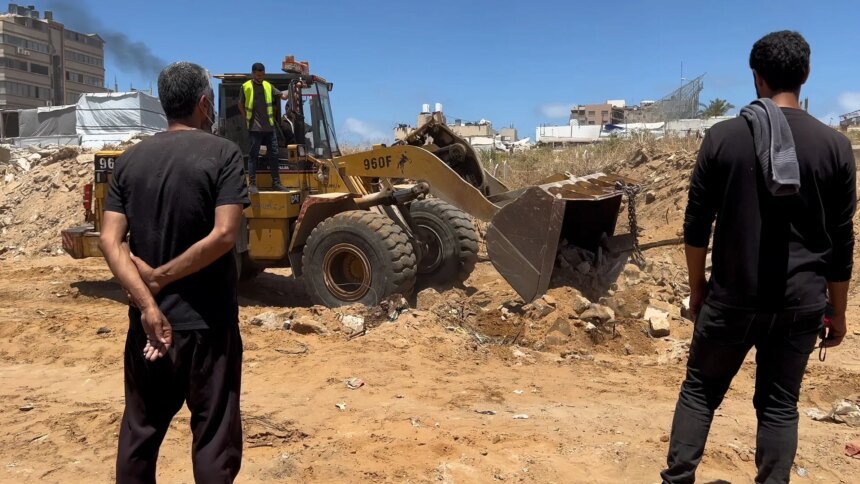
Gaza – Under the rays of the afternoon sun, a worker stands with his gaze carefully focused downward, following the movement of the bulldozer’s rams as it slowly digs and shovels sand.
The task of this worker requires extreme attention and caution; His eyes are focused on the spread soil, searching for any piece of white cloth that protrudes from among the folds. It is most likely a “shroud,” which means the discovery of a new body.
A previous Israeli bombing of the eastern and southern sides of the Sheikh Radwan Cemetery, west of Gaza City, led to the complete disappearance of hundreds of graves and gravestones under piles of sand, making the bodies buried at the bottom “unidentified”, after they were stripped of any signs indicating them.

A corpse turned into a “number”
This dilemma coincided with many families being forced to bury the bodies of their martyrs’ relatives in nearby random cemeteries, as a result of the main cemetery being completely filled, and the lack of any additional spaces for burial within its walls.
Suddenly, the bulldozer stopped at the signal of the workers after a piece of cloth appeared at the eastern edge of the cemetery. A worker wearing black gloves came forward and pulled the worn-out shroud, which had changed its original white color over time, to scatter the bones of a completely decomposed body that apparently belonged to one of the ancient graves.
The worker called a colleague to prepare a tight nylon bag designated to collect the remains of decomposed bodies. Despite the procedural nature of the work, the scene aroused clear anger among the worker, who expressed his shock in an audible voice, denouncing the horror of the scene and the atrocity of the Israeli crime: “These are our corpses. These are our children. These are our women! God suffices us, and He is the best disposer of affairs.”
The bag was then transported after closing it to be placed next to dozens of other bodies that had been recovered since the morning, almost all of which had “Unidentified” written on them.
The damage in the Sheikh Radwan cemetery was not limited to the erosion of the soil, but also the shrapnel and explosions affected the external structure of hundreds of existing graves, as the cement and marble headstones bearing the names of the deceased and the dates of their death were destroyed.

The beginning in “Sheikh Radwan”
Near the workers, the director of the cemeteries department at the Ministry of Endowments and a member of the corpses management committee, Ziad Obaid, was monitoring the progress of work. He told Al Jazeera Net that they began – yesterday, Tuesday – the first phase of the project to rehabilitate and restore the cemeteries that the occupation army attacked and destroyed the graves inside, in order to preserve the dignity of the remains that remain in them.
He stated that the mortuary management committee consists of representatives of the Ministry of Health, Civil Defense, Forensic Evidence and Forensic Medicine in the Police Service and the Ministry of Endowments.
The project began in the Sheikh Radwan cemetery, which was subjected more than once to Israeli bombing, especially on its eastern and northern sides. Later, according to Obaid, the work will extend to the rest of the cemeteries that were attacked, and there is the possibility of reaching them.
It is unfortunate that the majority of these graves are unidentified after their headstones were destroyed, Obaid says, adding, “We are working to restore these graves and try to identify the remains. These graves were previously unidentified, and today they have become unknown, and this represents a new challenge in the file of unidentified people and their bodies.”
Documenting and burying bodies
Regarding initial estimates of the number of bodies expected to be recovered, Obaid said it was likely that more than 40 bodies would be recovered by the end of the first day, while the total number of bodies exhumed after all work was completed in the Sheikh Radwan cemetery may reach no less than 300 bodies.
Regarding how to deal with the dilemma of the lack of data for unidentified bodies, Obaid stated that the forensic and forensic teams in the police force are working to document the cases with photographs and collect vital samples to prepare them for DNA tests in the future if capabilities are available, hoping that these steps will contribute to identifying their owners.
He stressed that the current goal is to “preserve the dignity of these dead in accordance with what is stipulated in divine laws and international laws,” by removing the scattered remains and reburying them properly until the identities are determined.

In the absence of parents
In a related context, the official justified the absence of families from the place to identify the bodies, despite the prior announcement of the campaign about a week ago, by the decomposition of the bodies and the difficulty of identifying them by inspection.
Obaid attributed this to the indiscriminate Israeli bombing of the cemetery, and the nature of forced burials during the war. The bodies were buried in a hurry, and often without the knowledge of their families, as a result of the large increase in the number of martyrs and the scattering of bodies in the streets.
He added that dozens of these bodies were buried in the available spaces next to the cemetery wall as it was the closest place available at the time, similar to dozens of random graves that were established in empty lands and roads, to include the unknown martyrs who were found during the Israeli attacks.
Obaid stated that this operation is not isolated, but rather comes as part of a plan that includes the 62 cemeteries in the Gaza Strip, all of which were subjected to systematic destruction and attacks.
After the completion of the Sheikh Radwan cemetery, the project will move to exhuming the bodies from the Sheikh Shaaban cemetery in Gaza, and the cemeteries in the northern Gaza Strip, such as Al-Faluja, and the Beit Lahia project, to restore what was destroyed and reburial in a way that guarantees the dignity of the dead and martyrs, according to Obaid.
The spokesman pointed out that there are cemeteries in the “yellow areas” that are completely under the control of the occupation forces, such as the Martyrs’ Cemetery east of Jabalia, the Beit Hanoun cemeteries, and the Rafah area, whose conditions are not available, and the occupation prohibits approaching them.
Targeting to erase memory
According to a statement issued by the Euro-Mediterranean Human Rights Observatory on March 15, 2026, about 93.5% of the Gaza Strip’s cemeteries have been documented to have been completely or partially destroyed since October 2023, within the context of what it described as an ongoing crime of genocide.
The Observatory explained that this “systematic” targeting, through bulldozing and destruction, is not limited to being a grave violation of international humanitarian law, “but rather reflects a deliberate policy to obliterate material monuments and inflict deep psychological and spiritual damage on the living, leading to undermining collective memory and severing the historical connection to the land and ancestors.”
According to the Observatory, an analysis of data from 62 official cemeteries distributed across the governorates of the Gaza Strip showed that 39 cemeteries (62.9%) were completely destroyed, and 19 cemeteries (30.6%) were partially destroyed, while only 4 cemeteries (6.4%) remained without significant damage.