
Published on 6/23/2026
|
Last update: 19:55 (Mecca time)
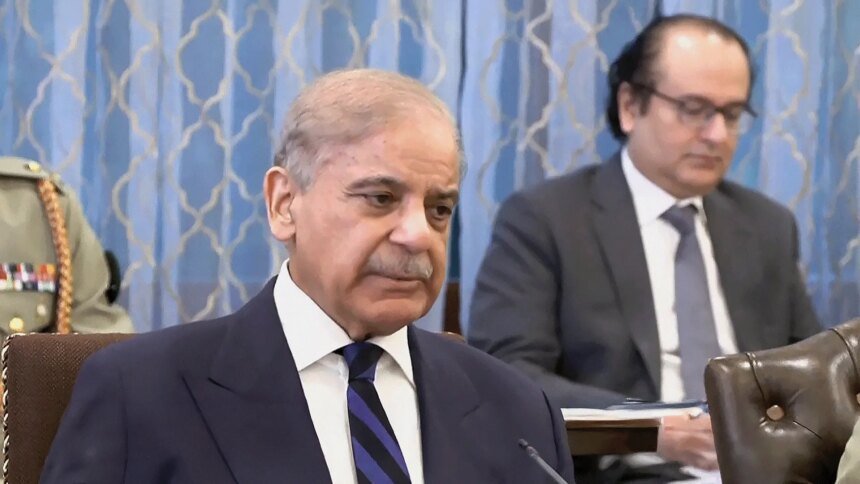
Pakistani Prime Minister Shehbaz Sharif confirmed today, Tuesday, that the memorandum of understanding signed by the United States and Iran did not address Iranian ballistic missiles, and that a country cannot be allowed to possess this weapon and prevent another country from possessing it, calling for not listening to those who want to sabotage the agreement.
Sharif said in a press conference with Iranian President Masoud Pezeshkian, who arrived in Islamabad on an official visit today, that the issue of ballistic missiles was not up for discussion, and that the Iranian side was not prepared to talk about it in any way.
He added that preventing Iran from possessing these missiles that other countries possess is considered an unacceptable double standard, calling for not listening to those who say they want to sabotage the agreement between Washington and Tehran, and keep the Iranian nation in a constant state of war.
Sharif also stressed his country’s desire to continue the role it plays between the United States and Iran until peace is achieved, stressing that the war could have destroyed everything.
Continue mediation
The Pakistani Prime Minister praised the efforts and great support that Pakistan received from countries, led by Qatar, Egypt, Saudi Arabia and Turkey. He said that these efforts were what led to the US-Iranian negotiations that began in Switzerland yesterday, Monday.
Sharif sent a message to Iranian Supreme Leader Mojtaba Khamenei, in which he said that the memorandum of understanding that his country signed preserved its dignity and ceased fire.
He said, “We are living through the most difficult moments today, and we will work to rebuild relations between Pakistan and Iran in all fields, including trade, investments, and reconstruction,” stressing that the Iranians “came out of this war stronger than they were.”
He stressed that his country will continue to work with Iran to enhance stability in the Middle East, the Gulf, and East Asia, and that “they have become two friendly countries that will share joy and sorrow.”
Sharif expressed his confidence that “the brave and intrepid Iranian people have the highest knowledge, and this country that possesses fertile lands and precious minerals will turn into one of the highest growing economies in the near term.”
Constructive conversations
In turn, Iranian President Masoud Pezeshkian said that his country’s acceptance of Pakistan’s mediation reflects its long-standing confidence in the Pakistani state and its people, and that the government and people of Iran appreciate Islamabad’s support and solidarity with them.
He added that he held constructive discussions with officials in Pakistan, including the presidents of the republic, the ministers, and the army commander, General Asim Munir, noting that they dealt with bilateral relations and the latest developments in the region and the world.
He explained that the two countries want to exploit the current situation to strengthen relations and begin a new phase of cooperation based on common interests, and that Tehran “believes that peace and sustainable security only come through negotiation, cooperation and constructive talks between the countries of the region.”
Pezeshkian said that his country extends its hand to Islamic countries in order to strengthen this friendship and security, and that the leaders and officials of Qatar, Egypt, Saudi Arabia and Turkey played an important role in finding a common language.
He added that Muslims must be one hand, and that Iran believes in the possibility of raising relations between Islamic countries and providing a model for cooperation between the region with its capabilities.
He stressed the desire of Pakistan and Iran to strengthen political and economic relations, and that they held talks that led to good results, calling on Sharif to attend the burial ceremony of the late Supreme Leader Ali Khamenei, which will be held later.
Earlier today, Pezeshkian arrived in Pakistan from the Sultanate of Oman, where he met Sultan Haitham bin Tariq Al Said and discussed with him developments in the crisis. The Iranian President said that progress in the talks will be measured by adherence to the agreed-upon pledges and their strict implementation.
In turn, the Iranian Foreign Ministry confirmed that a mechanism had been agreed upon with the participation of Iran, Qatar, Pakistan, America and Lebanon to prevent escalation, adding that stopping the attacks on Lebanon is an integral part of the memorandum of understanding and that America’s commitment is clear in this regard.