Published On 4/6/2026
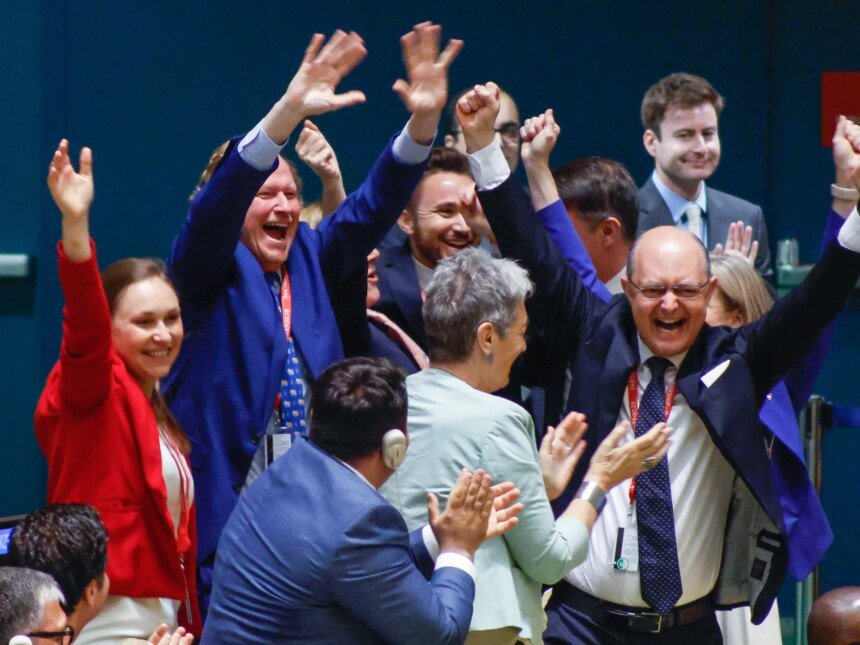
Germany suffered a severe defeat in its bid for a non-permanent seat on the UN Security Council, losing for the first time to Portugal and Austria, which received the majority of votes for the two seats allocated to Western Europe, which will begin representation in 2027.
In a secret ballot conducted by the United Nations General Assembly to choose European representatives, Germany received only 104 votes, and was eliminated from the first round of voting.
On the other hand, Portugal got 134 votes, and Austria got 131 votes, out of the 193 United Nations member states, noting that Afghanistan and Venezuela are not currently entitled to vote.
Germany has previously held a seat in the Security Council 6 times, most recently in 2019 and 2020. It traditionally runs for a seat every 8 years, and has never failed in any electoral attempt, according to diplomats.
Germany was a candidate to fill one of the two vacant seats in the “Western Europe and Other Countries” regional group for the years 2027 and 2028.
Portugal, a member of the European Union and NATO, has campaigned to make the Security Council more transparent and representative, and benefits from very close relationships with countries in Africa and Latin America.
Austria and Portugal will hold their seats for two years and join Zimbabwe, which won the African seat with 182 votes, but was the only candidate for the continent, while Trinidad and Tobago, which also did not face competition, won the Latin American and Caribbean seat with 181 votes.
A second round will be held on Wednesday to choose representatives from Asia, with the Philippines and Kyrgyzstan competing to win the seat allocated to the continent. The five elected countries will replace Pakistan, Somalia, Greece, Denmark and Panama starting from January 1, 2027.
These countries will join the Democratic Republic of the Congo, Liberia, Latvia, Colombia and Bahrain, the other five members elected for 2026 and 2027.

The bitterness of defeat
This result is a setback for Chancellor Friedrich Merz and Foreign Minister Johan Vadevol, who sought to strengthen Germany’s position on the international stage.
Commenting on the defeat, Merz said: “Germany will continue to fulfill its responsibilities within the United Nations despite the result, and the tasks assigned to us within the United Nations will not change after this result. Germany will remain a reliable pillar of the multilateral system, and we bear this responsibility firmly.”
From New York, Vadiful acknowledged the defeat, saying, “The result is really disappointing, and it is a bitter defeat.” In his initial assessment of the outcome, Vadiful suggested that Germany’s strong support for Ukraine may have contributed to the defeat. He said it was no secret that Russia had launched a campaign against Germany’s candidacy.
The German Foreign Minister had previously expected a “exciting ending” that prompted him to travel to New York last week in an attempt to persuade hesitant United Nations members at the last minute and avoid embarrassment. But his efforts ultimately failed.
Vadiful tried to appear confident before the vote, and took selfies in the United Nations General Assembly hall with his Austrian and Portuguese counterparts, Beat Meinel-Reisinger and Paulo Rangel.
“We enter this vote with confidence and optimism,” Vadiful told reporters before the vote, noting that Austria and Portugal “fought a fair and constructive competition with us, and regardless of the result, the two countries are European countries with whose governments we have very close relations.”

Harvest silence
In Berlin, Ines Schwerdtner, leader of the Left Party, said that the failure of the bid for a non-permanent seat on the Security Council had undermined Meretz’s efforts to prove himself as a “foreign policy advisor.”
She attributed the result to “Germany’s silence regarding the critical conflicts ravaging the world, and its failure to clearly define violations of international law.”
As for Alice Weidel, from the far-right populist Alternative for Germany party, she considered the defeat another “embarrassment” for Meretz.
The German campaign faced challenges from the beginning, as Berlin entered the race in 2020, lagging behind its competitors, Portugal and Austria. Germany’s position on the Gaza war has also been criticized, as have its cautious response to the Israeli attack on Iran and US operations in Venezuela.
Meretz and Vadiphol had hoped that a seat on the Security Council would allow Germany to play a greater role in addressing international crises, including the war in Ukraine and the future of the Gaza Strip.
Vadivule repeatedly stressed the need for the United Nations and its Security Council to remain central institutions for finding political solutions to wars and conflicts.
The Security Council consists of 15 of the 193 member states of the United Nations. The permanent members of the Council are five nuclear countries that were victorious in World War II and have veto power: the United States, China, Russia, the United Kingdom, and France, while the other countries take turns to occupy the remaining ten non-permanent seats for a period of two years.
Germany, a member of the G7, is the largest economy in Europe and is seen as a political and security pillar of the continent.
Critics are likely to complain louder than before that Germany is spending huge sums of money on the UN but not getting enough attention when filling important positions.
Germany is the fourth largest contributor in terms of membership fees, after the United States, China and Japan. If the budget for peacekeeping missions and volunteer payments are added, it ranks second.