Published on 6/19/2026
An untitled notebook, saved by the curiosity of an employee on the cusp of retirement, reveals composition lessons that Mozart wrote by hand for a Parisian schoolgirl, in the same months in which his mother died in that city.
Weeks before his retirement, François-Pierre Goua sat in front of twenty notebooks of anonymous music manuscripts, examining them one by one.
Gua, curator of the music department at the French National Library, has loved these papers that do not bear the names of their owners for years, so he chose from them an untitled notebook.
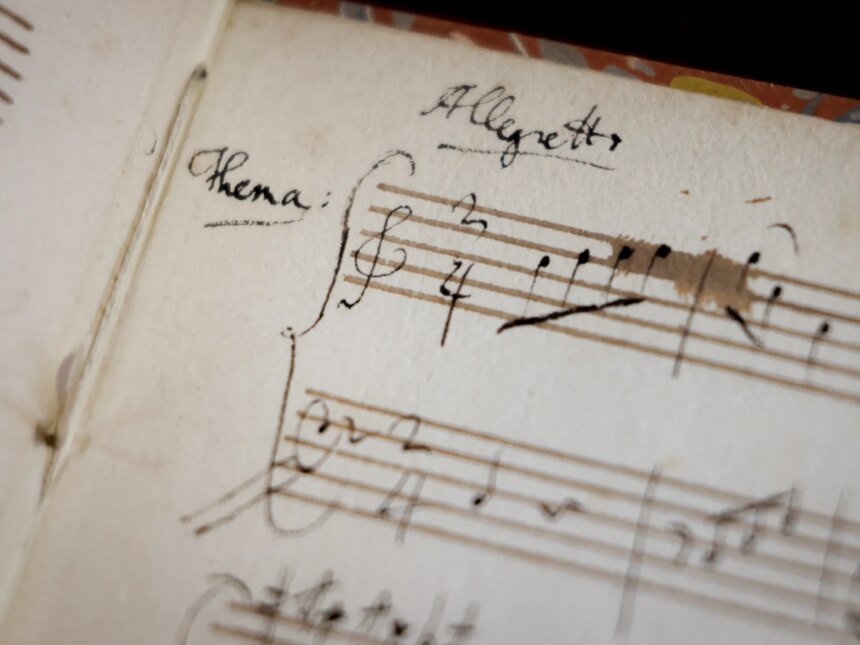
As he began to turn its pages, he stopped. The hand filling the papers was a hand that a music lover would recognize at a glance: the hand of the famous musician Wolfgang Amadeus Mozart (1756-1791).
It was not a hasty assumption, as experts have certified the authenticity of the manuscripts, including a researcher from the Mozarteum Foundation in Salzburg, the world reference in documenting the works of the musician in his Austrian hometown.
But what was found was not a lost piece, but rather a record of the daily lessons that Mozart taught, in person and in his handwriting, to a Parisian schoolgirl in the summer of 1778.

Classes in Mozart script
The notebook contains, in 44 well-preserved pages, about a dozen “composition lessons” and daily exercises that Mozart gave between May and July 1778 to Marie-Louise-Philipine du Bonnière de Guennes, an accomplished harp player and eldest daughter of the Duc de Guennes, a famous flutist.
Its pages are interspersed with seven flute and harp pieces, the last of which is unfinished and suddenly breaks off in the middle of a musical phrase.
Behind these papers is a story that Mozart historians know well. The musician went to Paris in the spring of 1778 as a twenty-two-year-old young man looking for a job and a livelihood. He offered his services to the nobility as a teacher and composer in an expensive city.
There, Baron Grimm introduced him to the Duke de Guennes, who served as French ambassador to England. Mozart admired his flute playing and described his daughter’s playing of the harp as “wonderful.”
The student who did not learn
The admiration stopped at the performance. When the student sat with Mozart in the Ducal Palace in Paris to learn how to compose, he found her completely lacking in talent in this art.
The notebook that came out of oblivion today is, in a sense, the record of that faltering education, between an impatient professor and a student who was not good at what he was teaching her, no matter how skilled her fingertips were on the strings.
But that Parisian room did not give birth to the exercises alone. From the same relationship, and from the same months, the “Flute and Fugitive Concerto” in du Major (K. 299) was born, which Mozart wrote in 1778 for the Duke and his daughter – and the number here is from the “Küchel” index, which numbers Mozart’s works.
It is the only work Mozart ever composed for harp, one of only two double concertos in his entire discography, and one of the most beloved of his concertos to the public to this day.
While the original manuscript of the concerto rests in the library of the Jagiellonian University in Krakow, the lesson papers have returned to float in Paris, as if they were the other half of the story.

In the shadow of imminent death
The notebook gains its true weight when it is returned to its time. Mozart’s mother, Anna Maria, accompanied her son on a trip to Paris, but there she fell ill and died on July 3, 1778, and was buried in the Church of Saint-Eustache.
That is, these playful exercises for an aristocratic salon were written in the very weeks when his mother was dying in the city, a few streets away from the court where he was tutoring the duke’s daughter.
As if the bitterness was not enough, the Duke de Guenne never paid Mozart the price of the concerto, and offered him only half the fee for the lessons through his housekeeper, but the musician rejected it, and he began to hate his patron.
From this lonely Parisian spring, not from any joy, came some of his deepest music; Out of his mourning for his mother, his eighth sonnet in the minor “la” was born, one of his two orphan sonnets in the minor maqam.
After two and a half centuries
These pages come back to life after nearly 248 years of silence on paper.
The pieces will be played for the first time on Sunday, on the Feast of Music (the annual French celebration of music every June 21), by players from the French Radio Philharmonic Orchestra, in a concert hosted by the National Library.
The manuscripts will be displayed along with the performances before they are later moved to the Library Museum. Those who missed the concert will listen to about 20 minutes of restored Mozart’s music on Monday on France Musique Radio, at three in the afternoon (13:00 GMT).
The Seventh Piece ends suddenly, incompletely, just as that same Parisian summer was interrupted, and what Mozart was unable to teach his student has become, after two and a half centuries, what everyone wishes to hear.
The notebook that lay nameless on a shelf, until a curious eye passed by it weeks before her retirement, is now preparing to speak audibly what had been kept silent for so long.