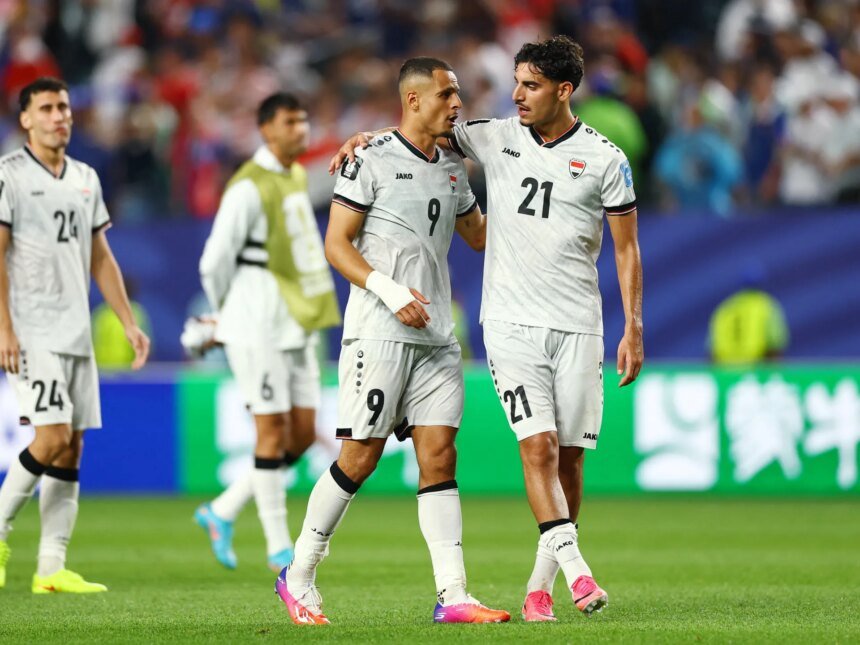
Simple details, in addition to the regulations adopted in many cases, play a major role in determining the fate of the teams participating in the tournaments, whether they are combined or local leagues, through winning titles or promotion, relegation, and elimination, each according to its results and related details.
The current edition of the World Cup Finals, which began on June 11 and continues until July 19, is living on the impact of these details par excellence, and perhaps what happened with several teams, led by Arab teams such as Tunisia, Iraq and Jordan, is the best evidence of that.
Read also
list of 2 itemsend of list
The three aforementioned teams suffered the bitterness of defeat in their first two matches in the tournament, which caused the early exclusion of Tunisia and Jordan, while Iraq still maintains a slight glimmer of hope to advance beyond the group stage.
The Tunisian team lost to Sweden 1-5 and Japan 0-4 in Group Six, and the same happened to Jordan, which was defeated twice by Austria 1-3 and Algeria 1-2 in Group Ten.
The same thing happened with Iraq, which tasted the bitterness of defeat against Norway 1-4 and then France 0-3, in the ninth group matches.
Given these results, it is certain that Tunisia and Jordan will occupy last place in their groups, regardless of the result of their third match in the group stage, but Iraq has a strong chance to occupy third place, and perhaps advance to the knockout rounds.
The reason for this is due to the rule adopted by the International Federation of Association Football (FIFA) to determine the advantage of one team over another when they have equal points in groups.
FIFA gives preference primarily to the outcome of direct confrontations, an item that officially led to the exclusion of Tunisia and Jordan.
Tunisia national team
In the final round, the “Carthage Eagles” will face the Netherlands team next Friday, and at the same time another match will be held between Sweden and Japan within the same group (sixth).
If the Tunisian team manages to win over the Netherlands, it will get 3 points, which is the same score as Sweden if it loses to Japan, which has 4 points in the current situation.

Then Tunisia and Sweden will be equal on 3 points, but the difference in direct confrontations favors the European team, giving it the advantage of occupying third place.
Jordan national team
“Al-Nashama” is experiencing a situation completely similar to that of Tunisia. In the final round, the Jordanians collide with world champion Argentina, led by their legendary star Lionel Messi, the all-time top scorer in the World Cup, next Sunday morning, Mecca and Amman time. If they are able to achieve a resounding surprise and win over “Tango” by any result, the team will get the first 3 points.
At the same time, the Algerian and Austrian teams will play from the same group (tenth), in a confrontation in which the two teams will compete for second place, knowing that each of them has 3 points before their awaited match, which is the same balance hoped for for Jordan if it wins over Argentina.

In the best case scenario for Jordan, the balance of the loser from Algeria and Austria will stop at 3 points, and therefore, given the rule of direct confrontations, any victory for the “starchy” will not be enough to qualify, but it will be like saying goodbye to the World Cup from the big door.
Iraq national team
In complete contrast to Tunisia and Jordan, the “Lions of Mesopotamia” control their fate through the players’ feet with regard to occupying third place, as they face Senegal in the third round next Friday in Group Nine, noting that both teams did not score any points.
Given the difference in direct confrontations, Iraq’s victory will give it third place, after which it will wait until the end of all the first round matches to find out whether it will be among the best 8 third-placed teams to reach the round of 32, which will be determined according to other criteria that we will explain later.

As for the result of the tie, it will not serve the interests of Iraq or Senegal, given that each of them will end their current World Cup participation at that point, but then third place will go to Senegal, based on the second criterion related to the goal difference (scored and received).
The Senegalese team also lost the first two matches to France 1-3, then with difficulty to Norway 2-3.
The “Lions of Teranga” has a goal difference of (-3), having scored 3 goals and conceding 6 in two matches, while Iraq has a goal difference of (-6), scoring one goal and conceding 7 goals.
Türkiye follows in the footsteps of Tunisia and Jordan
The situation of the Arab national teams, Tunisia and Jordan, was repeated with the Turkish national team, which suffered two defeats in the first two matches to officially bid farewell to the World Cup before playing the third round match.
Arda Guler’s teammates lost their first two matches in Group D to Australia (0-2) and Paraguay (0-1), and their last match will be against the United States next Friday morning.

The Turkish team will not be able to occupy third place, even if it wins with a wide score, and then it will have 3 points. If Australia or Paraguay wins the other match, the loser between them will freeze their score at 3 points, but will remain third after resorting to the direct confrontations rule.
Tie-breaking criteria in groups
In general, FIFA had announced the criteria for breaking ties in World Cup groups, if two or more teams had an equal number of points in the same group after the end of the first round.
These criteria are used in order, starting with the first, then the next, and the next when one of them is equal, all the way to the final decision.
Criteria set by FIFA for breaking ties in groups:
- The teams with the highest number of points achieved in group matches between the concerned teams.
- The teams with the best goal difference in group matches between the respective teams.
- The teams with the highest number of goals scored in group matches between the respective teams.
If it is not possible to decide according to these conditions, other criteria will be used that will be applied to the two teams with equal number of points:
- The teams with the best goal difference in all group matches.
- The teams with the most goals scored in all group matches.
- The teams with the highest degree of team discipline (key players, substitutes, coach, and officials) according to the number of yellow and red cards obtained.
If these standards continue to be equal, FIFA will have a final solution that will settle the matter once and for all, which is:
- Referring to the latest classification issued by FIFA.
Criteria for selecting the best three
After the end of the group stage matches, 32 teams will qualify for the next round, namely the first and second placed teams in each of the 12 existing groups, in addition to the best 8 teams from among the third placed teams.
FIFA has set 5 criteria through which these eight teams will be determined to continue participating in the World Cup from third place.
The five criteria, with priority given to the first item and then the next if equal:
- The teams with the most points.
- The teams with the best goal difference (scored and conceded) in all their group matches.
- The teams with the most goals scored in all their group matches.
- The teams with the highest degree of discipline (starters, substitutes, coach and officials) according to the number of yellow and red colored cards they obtained in all their group matches (fair play).
- Referring to the latest classification issued by FIFA.